
Permissioned DeFi pools are reshaping decentralized finance by offering compliance-focused platforms for institutions. They cater to asset managers, corporate treasuries, and other regulated entities by combining blockchain efficiency with regulatory safeguards. These pools ensure only verified participants can access DeFi yields, addressing legal risks and providing tools like audit trails and segregated custody.
Key highlights:
- Institutional DeFi assets reached $47 billion in Q1 2026, up from under $1 billion in 2020.
- Over 900 institutions gained whitelisted access by mid-2025.
- Yields range from 4% to 15%, often surpassing traditional financial products like U.S. Treasuries.
Top platforms:
- Aave Arc: $8.7B managed by 31 institutions; supports multiple assets with smart contract-driven compliance.
- Compound Treasury: $4.2B in deposits; fixed 4% APY on USDC; user-friendly, API-driven service.
- Maple Institutional: $4.59B AUM; offers fixed-term, high-yield loans with robust credit checks.
Quick Comparison:
| Platform | TVL/AUM (2026) | Yield Type | Supported Assets | Best For |
|---|---|---|---|---|
| Aave Arc | $8.7B | Variable & Stable | USDC, ETH, wBTC, DAI | Advanced on-chain strategies |
| Compound Treasury | $4.2B | Fixed (~4% APY) | USDC only | Simple treasury management |
| Maple Institutional | $4.59B | Variable (6-12%+) | USDC, USDT, BTC | High-yield secured lending |
These platforms address diverse institutional needs, from simplicity and compliance to higher yields and risk management.
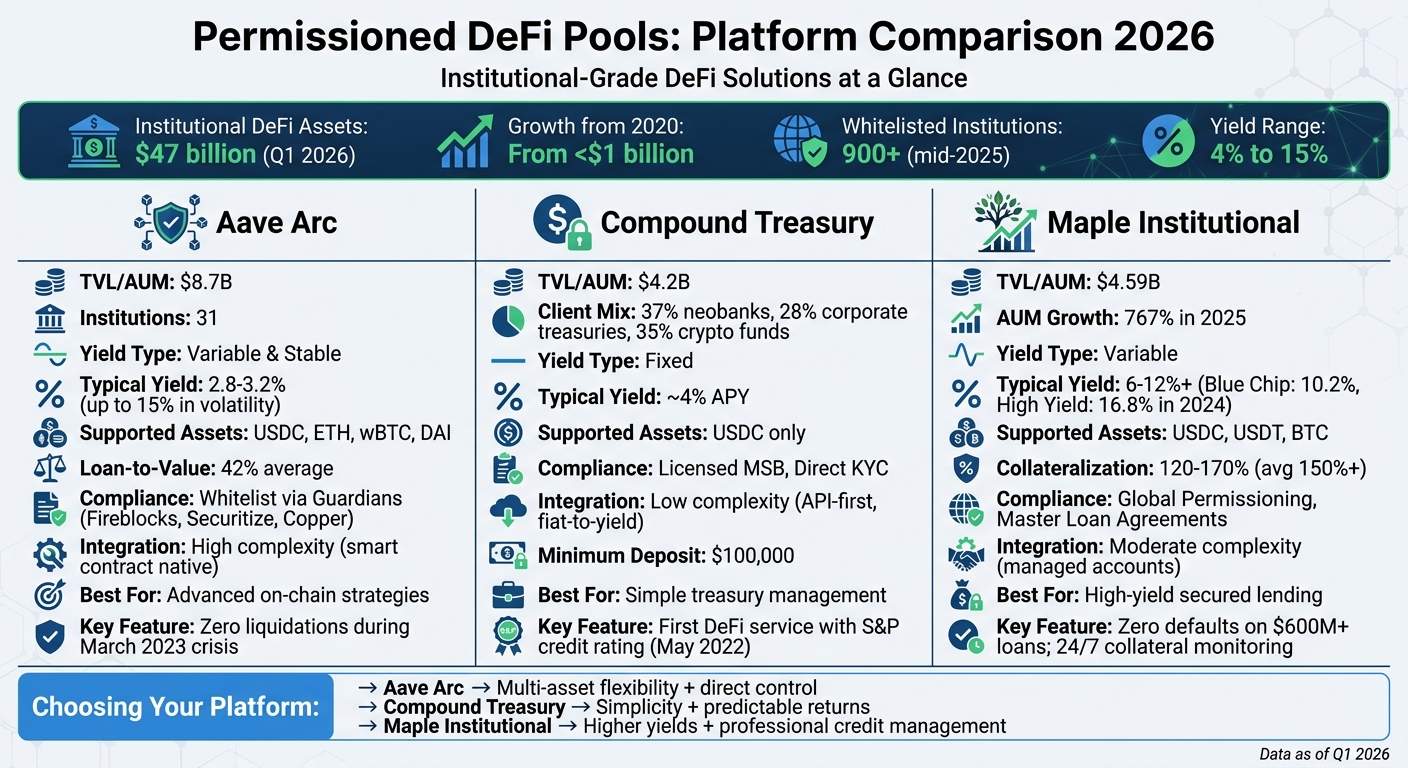
Comparison of Top Permissioned DeFi Platforms: Aave Arc, Compound Treasury, and Maple Institutional
Digital Assets 101: Intro to Permissioned DeFi | Fireblocks Academy

sbb-itb-7e716c2
1. Aave Arc
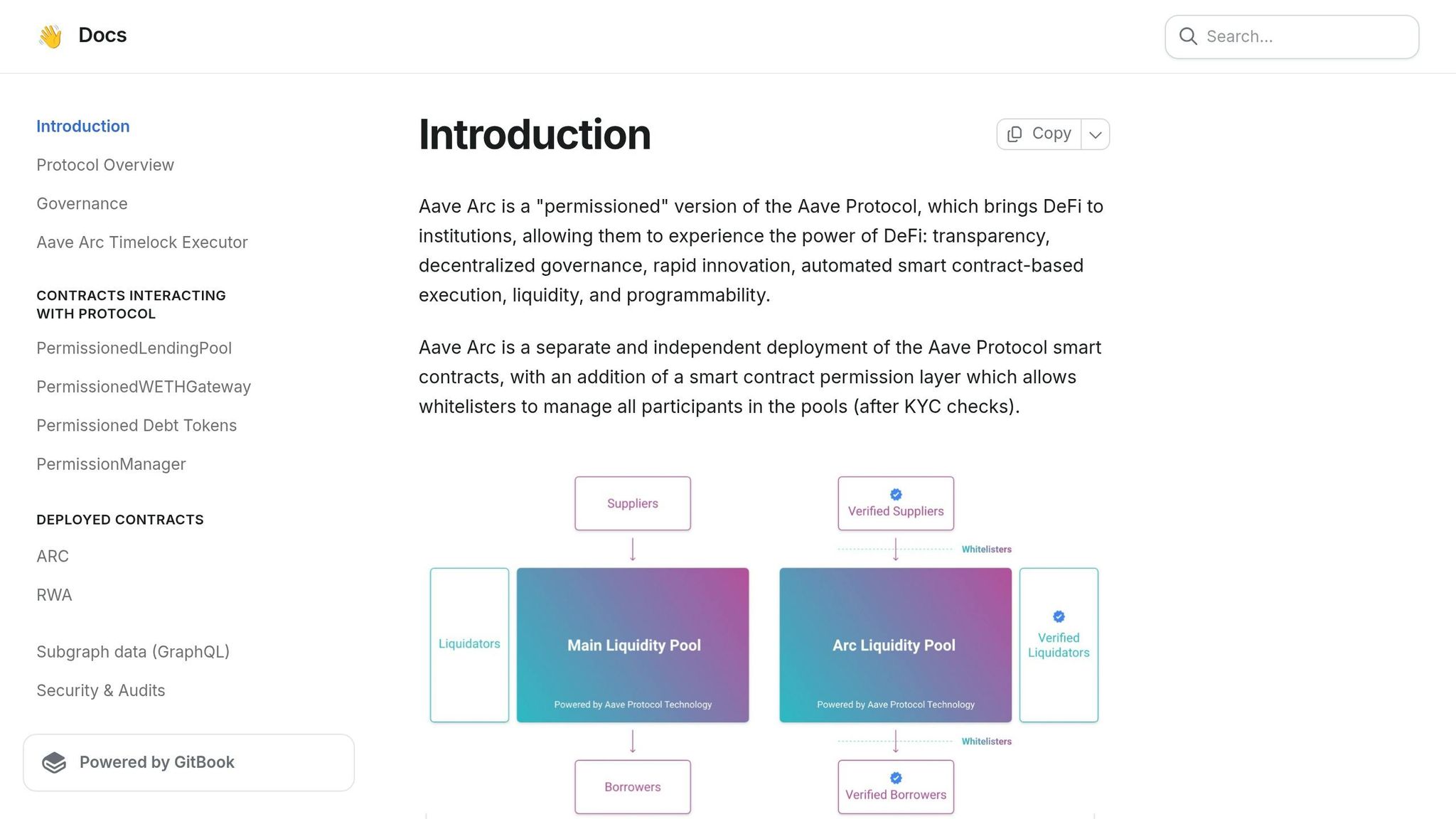
Aave Arc operates as an independent branch of the Aave Protocol, designed specifically to ensure compliance through a smart contract-based permission layer. This system relies on whitelisting, managed by "Permission Admins" (also known as Guardians) such as Fireblocks, Securitize, and Copper. These Guardians, chosen through Aave Governance, are responsible for enforcing KYC/AML compliance. By March 2026, this framework had drawn in 31 whitelisted institutions, collectively managing $8.7 billion in deposits. Participants in Aave Arc are assigned specific roles, including Depositor, Borrower, Liquidator, or Stable Rate Manager, ensuring a clear and organized structure.
"Aave Arc is a separate and independent deployment of the Aave Protocol smart contracts, with an addition of a smart contract permission layer which allows whitelisters to manage all participants in the pools (after KYC checks)." – Aave Arc Documentation
In line with its institutional focus, Aave Arc maintains a cautious financial strategy, reflected in its average loan-to-value ratio of 42%, significantly lower than the 67% seen in retail Aave pools. This conservative approach proved effective during the March 2023 banking crisis, during which Aave Arc recorded zero liquidations. By early 2026, Goldman Sachs reportedly utilized Aave Arc’s permissioned pools to process $2.4 billion monthly for treasury operations and collateralized lending.
The platform supports a variety of assets, including ETH, wBTC, USDC, and DAI, offering both variable and stable rate options. USDC yields typically range from 2.8% to 3.2%, with rates occasionally spiking to 15% during periods of high market volatility. Additionally, all transactions are fully transparent and recorded on-chain, ensuring the auditability that institutions require while maintaining a permissioned environment. These features make Aave Arc a compelling choice for institutional investors seeking a secure and compliant DeFi solution.
2. Compound Treasury
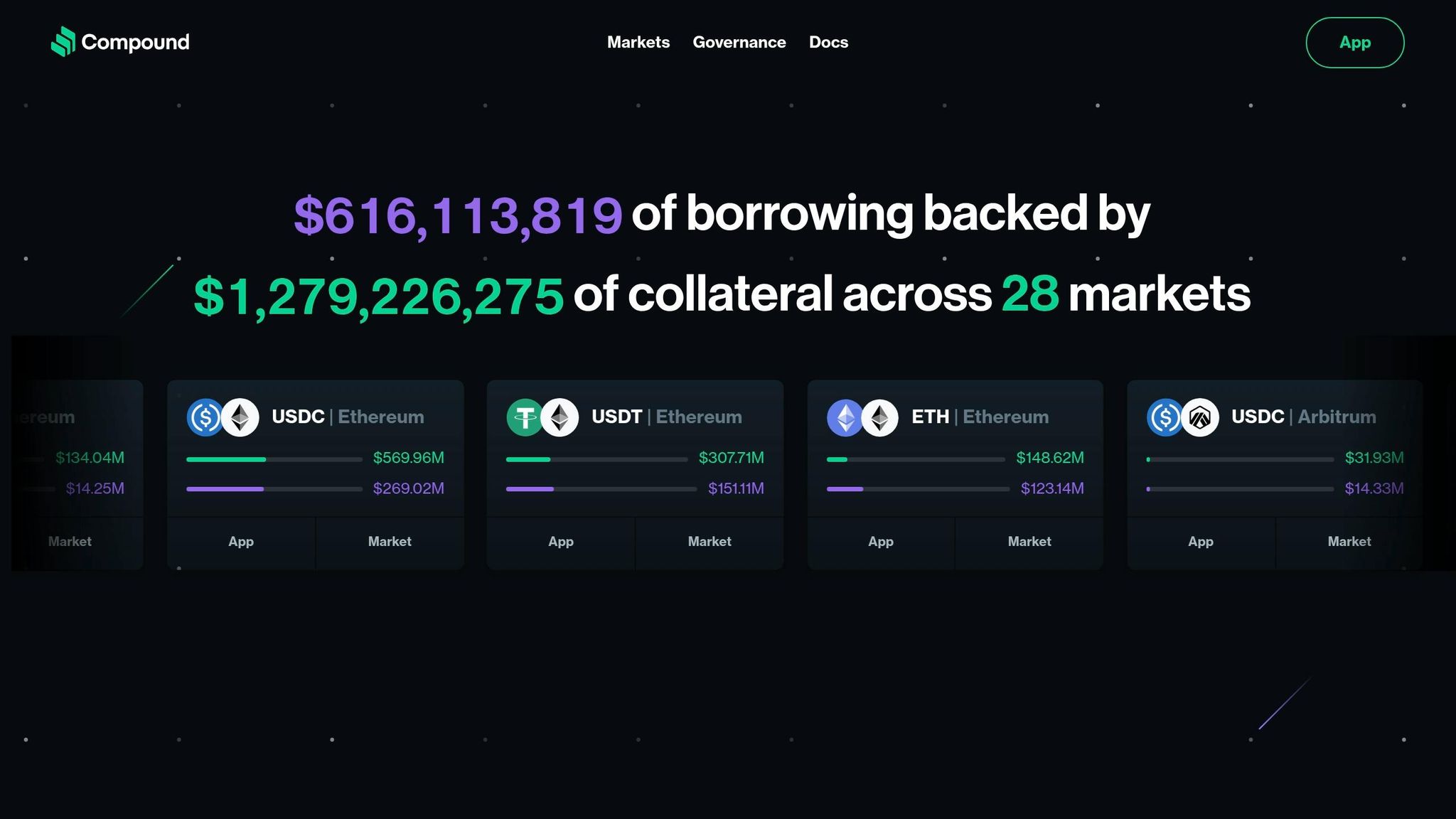
Compound Treasury stands apart from platforms like Aave Arc by operating as a managed service rather than offering a direct interface with smart contracts. Created by Compound Prime, LLC, a subsidiary of Compound Labs, this service allows institutions to deposit U.S. dollars and earn yield without needing to interact directly with blockchain protocols. By the first quarter of 2026, Compound Treasury oversaw $4.2 billion in deposits. Its clientele includes neobanks (37%), corporate treasuries (28%), and crypto-native funds (35%). The platform emphasizes permissioned access, ensuring it meets the regulatory standards expected by institutional clients. This managed approach highlights its focus on regulatory compliance and stable yield generation.
In May 2022, Compound Treasury made history as the first DeFi-backed service to receive a credit rating from a major agency – S&P Global – marking a shift toward greater institutional accountability. To ensure transparency and security, all client funds are held in segregated custody through Anchorage Digital. Accessing the platform requires a minimum deposit of $100,000 and completing KYC/AML verification, often facilitated by providers like Fireblocks.
"Compound Treasury can now address demand for liquidity with a simple, reliable borrowing solution, while continuing to provide the same trusted service we’ve delivered to clients earning interest over the past year." – Reid Cuming, VP of Compound Treasury
These safeguards make Compound Treasury a reliable option for institutions looking for compliant and predictable yield opportunities in the DeFi space.
Unlike the variable rates often seen in public DeFi protocols, Compound Treasury offers a fixed yield, providing stability for its clients. The targeted yield is 4.00% APR on USD and USDC, with an average of 3.7% recorded in early 2026. This approach mitigates rate fluctuations, offering corporate treasuries the certainty they need. For example, in April 2026, Figure Technologies leveraged Compound Treasury by depositing customer USDC balances to generate yield for its blockchain-based Home Equity Line of Credit (HELOC) products. Additionally, in September 2022, the platform expanded its services, allowing accredited institutions to borrow USD or USDC at fixed rates (starting at 6% APR) by using assets like Bitcoin, Ether, or other ERC-20 tokens as collateral.
3. Maple Institutional
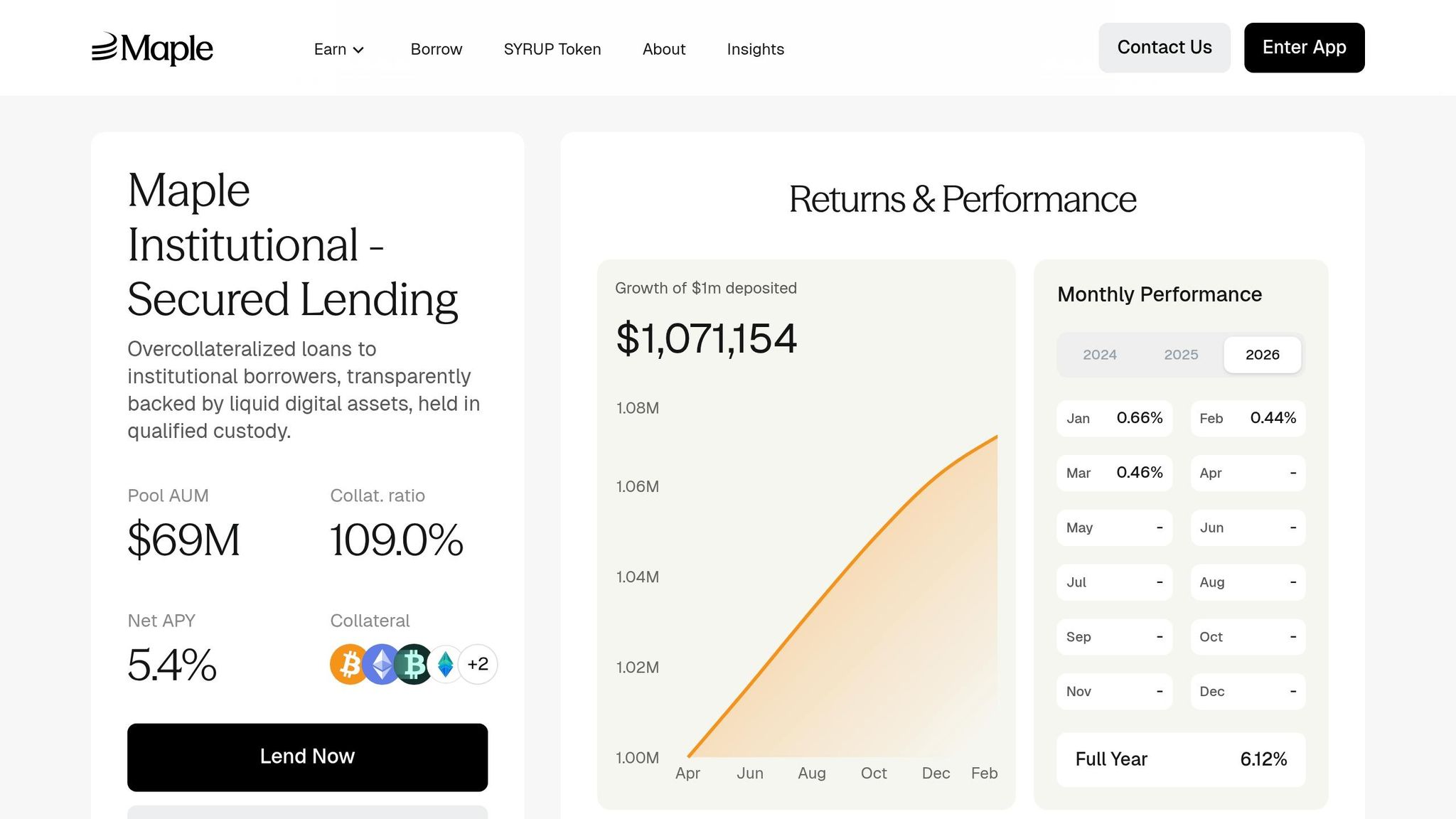
Maple Institutional takes a proactive approach to lending, standing out as a direct lender rather than a passive protocol. Through its in-house credit arm, Maple Direct, the platform conducts thorough evaluations of a borrower’s financials, management, and operations before approving loans. By April 2025, Maple had exceeded $1 billion in total value locked (TVL), with its institutional-focused pools accounting for around $400 million of that total.
One of Maple’s defining features is its fixed-rate, fixed-term loan structure, which contrasts with the variable rates typical in DeFi. This setup offers predictability, with terms like 30-day durations and predefined interest rates, making it easier for institutional treasuries to manage their financial planning. For instance, in 2024, the Blue Chip Secured pool delivered a net annual percentage yield (APY) of 10.2%, while the High Yield Secured pool achieved 16.8%. Loans are generally overcollateralized, ranging from 120% to 170%, with collateral securely held by institutional custodians like Anchorage, BitGo, and Copper under tri-party agreements. This meticulous structure aligns with the compliance-driven approach seen in other permissioned pools.
While compliance is a priority, Maple Institutional goes a step further with its legal safeguards. Unlike many DeFi platforms that depend solely on smart contracts, Maple uses Master Loan Agreements (MLAs) governed by real-world jurisdictions. Each lending pool is structured as a bankruptcy-remote Special Purpose Vehicle (SPV), shielding lender funds from platform-wide risks. Additionally, Maple employs a 24/7 monitoring system to track collateral levels through custodian APIs. If collateral values drop below agreed thresholds, the system issues margin calls and can liquidate assets within 24 hours if borrowers fail to act – an approach that has resulted in zero loan defaults across more than $600 million in cumulative loan originations by the end of 2024.
"Maple brings institutional standards to DeFi credit markets. Their hands-on underwriting and risk management give us confidence to operate at scale with transparency and control." – John Gu, Founder and CEO, AlphaLab Capital
Maple’s growing reputation among institutions was underscored in March 2025, when Bitwise, an asset manager overseeing more than $12 billion in assets, joined the platform. Earlier that year, Maple introduced its BTC Yield product in collaboration with the Core Foundation. This product, which offered a 5% APY on Bitcoin held in time-locked institutional custody, quickly scaled to over $100 million in TVL within two months. Maple also simplifies access for verified institutions through its global permissioning system, which uses on-chain wallet bitmaps to allow KYC-approved participants to move effortlessly between lending pools. These advancements highlight Maple’s role in connecting institutional finance with decentralized solutions.
Advantages and Disadvantages
Permissioned DeFi pools offer institutions a way to balance regulatory compliance with the attractive yields of decentralized finance. However, each platform comes with its own strengths and trade-offs, making them better suited for different institutional needs.
Aave Arc stands out for its on-chain flexibility and support for multiple assets, including USDC, ETH, wBTC, DAI, and AAVE. This variety allows institutions to diversify their exposure. However, the platform’s operational complexity – requiring wallet management, gas fee handling, and direct interaction with smart contracts – can be a hurdle for institutions seeking simplicity. Despite being built on a protocol with over $10 billion in historical mainnet TVL, its intricate setup has limited its adoption among institutions that prefer more straightforward options.
Compound Treasury, on the other hand, simplifies the process by removing blockchain complexity. Its centralized, API-driven interface allows institutions to deposit USD directly via bank transfers. This ease of use has made it a popular choice for corporate treasuries new to crypto, offering a fixed 4% APY on USDC. With $4.2 billion in deposits – 37% from neobanks and 28% from corporate treasuries – it has gained significant traction. However, its single-asset focus (USDC only) and reliance on a centralized structure as a licensed money service business introduce concentrated counterparty risk.
Maple Institutional offers a middle ground by combining on-chain efficiency with professional risk management. Its Global Permissioning system allows KYC-verified institutions automatic access to all lending pools, eliminating the need for pool-specific whitelisting while maintaining compliance. This approach has driven growth, with its AUM increasing by 767% in 2025 to reach $4.59 billion. Offering variable yields between 6% and 12%+, and supporting assets like USDC, USDT, and BTC, Maple Institutional’s Blue Chip Secured pool has outperformed Aave supply rates 80% of the time since inception. However, the platform requires moderate technical knowledge and exposes lenders to credit risk, even with conservative collateralization ratios averaging over 150%.
| Feature | Aave Arc | Compound Treasury | Maple Institutional |
|---|---|---|---|
| TVL/AUM (2026) | See platform section | $4.2B | $4.59B |
| Compliance Model | Whitelist via Guardians | Direct KYC; Licensed MSB | Global Permissioning |
| Supported Assets | See platform section | USDC only | USDC, USDT, BTC |
| Yield Type | Variable & Stable rates | Fixed (approx. 4% APY) | Variable (6-12%+) |
| Integration Complexity | High (smart contract native) | Low (API-first, fiat-to-yield) | Moderate (managed accounts) |
| Best For | Complex on-chain strategies | Simple treasury management | High-yield secured lending |
Each platform serves a specific purpose. Aave Arc is ideal for institutions needing advanced on-chain strategies. Compound Treasury works well for those looking for simplicity and predictable returns. Meanwhile, Maple Institutional caters to those seeking higher yields with a focus on professionally managed credit markets. As Maple Finance puts it:
"Global Permissioning is an innovative feature that we hope can start breaking down the barriers for compliant capital to move around the DeFi ecosystem in a seamless way."
Conclusion
Permissioned DeFi pools have emerged as a tailored solution for institutions navigating the blockchain space, offering varying levels of control, yield, and operational complexity to meet diverse requirements. Aave Arc stands out for institutions seeking multi-asset flexibility and direct on-chain management. While it demands higher technical expertise, it’s particularly suited for intricate treasury strategies. On the other hand, Compound Treasury simplifies the process with a fixed yield of approximately 4% APY on USDC deposits, making it attractive for corporate treasuries prioritizing ease of use over maximizing returns. Meanwhile, Maple Institutional caters to those aiming for higher, variable yields through expertly managed credit markets.
The growth in institutional participation has been striking. Between mid-2025 and Q1 2026, institutional capital in DeFi expanded from $41 billion to $47 billion. Individual platforms have also seen remarkable growth, such as Maple Protocol’s 767% rise in assets under management (AUM) to $4.59 billion and Compound Treasury’s $4.2 billion in deposits, showcasing a strong appetite for institutional DeFi solutions. This rapid expansion has laid the foundation for clearer regulatory guidelines.
Recent legislative developments, like the 2025 GENIUS Act and the 2026 bipartisan crypto regulations, have further solidified institutional trust in DeFi. As Mike Belshe, Co-founder and CEO of BitGo, highlighted:
"Maple is raising the bar for onchain asset management by integrating qualified custody and rigorous credit practices – bringing the standards institutions expect to DeFi lending."
Each platform addresses unique institutional needs, reflecting the ecosystem’s maturity. The future seems to point toward a hybrid environment where permissioned pools provide a secure space for regulated capital, while permissionless protocols continue to fuel innovation for retail users. With over 900 institutions whitelisted across platforms by mid-2025, permissioned DeFi has transitioned from a concept to an essential part of financial infrastructure, opening the door to a trillion-dollar opportunity that bridges traditional finance and blockchain technology.
FAQs
Do permissioned DeFi pools reduce legal risk for U.S. institutions?
Permissioned DeFi pools offer a way for U.S. institutions to navigate the decentralized finance space while staying within the bounds of regulatory standards. By incorporating strict access controls – like Know Your Customer (KYC) and Anti-Money Laundering (AML) procedures – these pools ensure that participants meet compliance requirements. This approach reduces legal risks and makes it possible for institutions to engage in DeFi without stepping outside the law.
What’s the real difference between whitelisting, global permissioning, and a managed service?
The key distinction here is in scope and control.
- Whitelisting involves manually approving specific wallet addresses one by one.
- Global permissioning streamlines the process by granting verified institutions access to multiple pools without added hassle, cutting down on operational barriers.
- Managed services take it a step further by automating compliance, onboarding, and permission management, providing institutions with an all-in-one solution.
Each method caters to different requirements within permissioned DeFi protocols.
What risks remain in permissioned DeFi even after KYC and custody safeguards?
Permissioned DeFi, despite implementing KYC protocols and custody safeguards, isn’t without its challenges. Risks like flaws in smart contract code, governance hurdles, and cross-border compliance difficulties remain significant concerns. These factors emphasize the importance of maintaining strict vigilance and implementing strong security practices.