Blockchain is reshaping carbon markets. It solves issues like double-counting, slow transactions, and lack of transparency by tokenizing carbon credits. These digital tokens represent 1 metric ton of CO₂, making credits traceable, tradable, and easier to manage. The result? More reliable and efficient carbon offset systems.
Here’s a quick look at the platforms leading this change:
- Toucan Protocol: Bridges carbon credits to Ethereum/Polygon, offering tokenized credits like BCT for fractional ownership.
- KlimaDAO: Operates as a DAO on Polygon, locking carbon credits to increase their value and incentivize offset projects.
- AirCarbon Exchange (ACX): A regulated exchange for tokenized carbon credits, ensuring secure, licensed trading.
- Poseidon Foundation: Uses Stellar blockchain to integrate carbon offsets directly into retail transactions.
- Carbonplace: Simplifies credit trading with direct registry connections and automatic credit retirement.
- Menthol Protocol: Automates carbon neutrality for dApps and blockchain transactions across multiple chains.
- Topl: Focuses on ESG tracking and smallholder farmers, enabling traceable carbon credits in agriculture.
Each platform has unique strengths, from retail integration to institutional-grade compliance. Whether you’re a developer, trader, or business, the right platform depends on your goals and operations.
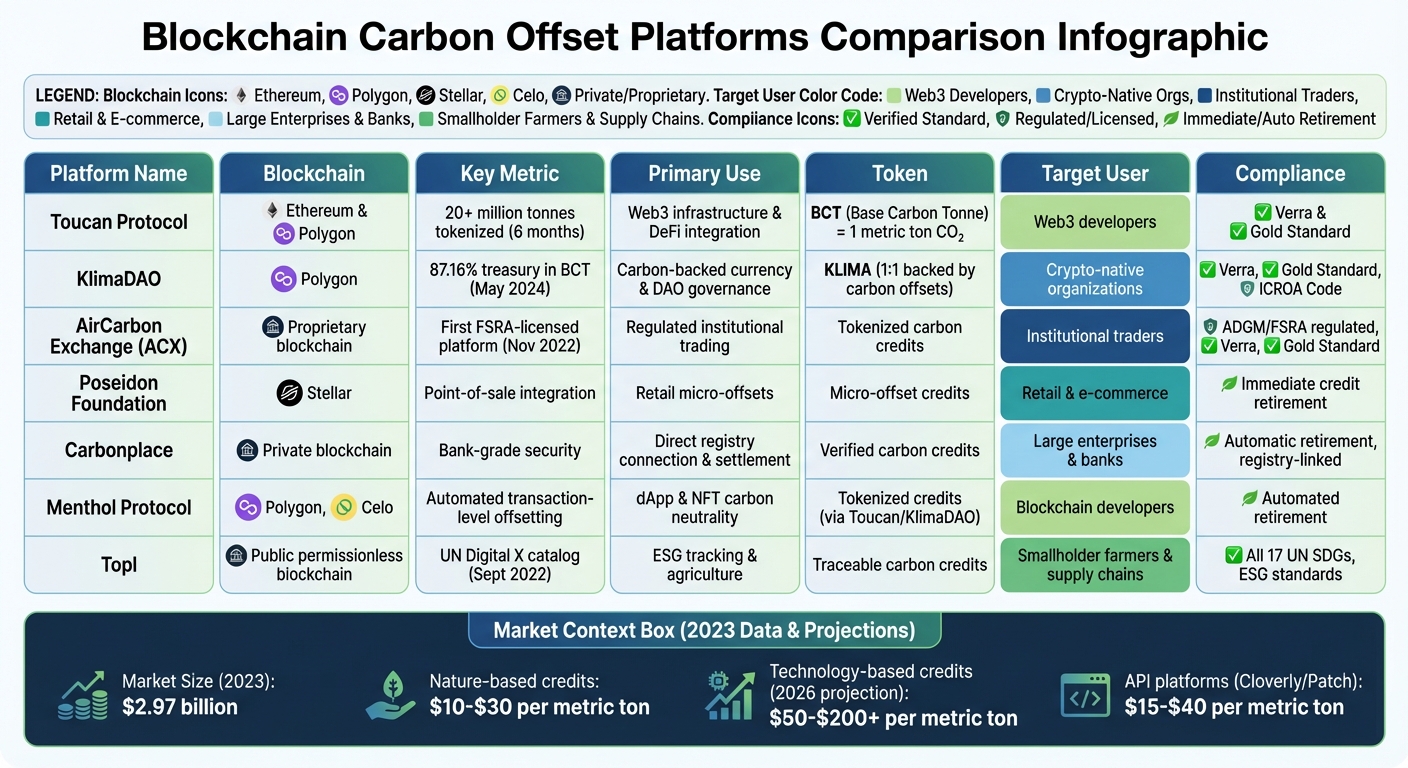
Blockchain Carbon Offset Platforms Comparison: Features, Use Cases, and Specifications
1. Toucan Protocol
Blockchain Foundation
Toucan Protocol operates on the Ethereum and Polygon blockchains. The platform transforms verified, real-world carbon credits into digital tokens on the blockchain. Each Base Carbon Tonne (BCT) token corresponds to one metric ton of carbon offset. This setup bridges traditional carbon credits with decentralized finance.
Primary Use Case
Toucan Protocol provides infrastructure to bring traditional carbon credits into the decentralized finance space. It achieves this by creating Carbon Pools, such as the Base Carbon Tonne (BCT), which group similar credits together. These pools offer deep liquidity and allow fractional ownership – down to 0.01 credit – making the market more accessible.
"Toucan Protocol is the first bridge that enables the trading of real-world carbon credits on the blockchain." – Coinroop
Since its launch in October 2021, the platform has tokenized over 20 million tonnes of carbon credits within just six months. However, in 2023, Toucan faced a significant setback when KlimaDAO accepted 670,000 Verified Carbon Units from a controversial HFC-23 industrial gas project in China through Toucan’s bridge. Experts raised concerns about the project’s lack of environmental impact, causing KLIMA token prices to plummet by 80% in a matter of weeks. In response, both Toucan and KlimaDAO tightened their third-party audit requirements and raised project standards.
Trading Model
Toucan relies on decentralized liquidity pools and automated market tools. Smart contracts manage the issuance, trading, and retirement of carbon credits. Once a credit is retired, it’s permanently marked as used, ensuring transparency and preventing double-counting.
Compliance Focus
Toucan Protocol only accepts carbon credits from registries that meet the Verified Carbon Standard (Verra) or Gold Standard. By aligning with these respected registries, the platform ensures the quality and legitimacy of the credits it handles, maintaining trust and transparency in the carbon offset market.
sbb-itb-7e716c2
2. KlimaDAO
Blockchain Foundation
KlimaDAO operates as a decentralized autonomous organization (DAO) built on the Polygon blockchain, leveraging Toucan Protocol’s Web3 carbon infrastructure. Its economic model draws inspiration from OlympusDAO, with every KLIMA token backed 1:1 by verified carbon offset tokens – primarily Base Carbon Tonnes (BCT) – stored in its treasury. As of May 2024, BCT accounted for 87.16% of the treasury’s holdings. This structure positions KlimaDAO to play a transformative role in carbon markets.
Primary Use Case
At its core, KlimaDAO functions as a carbon-backed currency that removes offsets from circulation, effectively driving up their prices. The platform achieves this by purchasing and permanently locking tokens in its treasury, creating scarcity and incentivizing the creation of new carbon offset projects.
"Klima’s treasury functions as a blackhole for BCT and carbon offsets, removing them from the market and pushing the real-world carbon price higher." – Global Carbon Fund
In addition to locking tokens, KlimaDAO offers staking and governance opportunities for its community. Token holders can participate in decision-making through Klima Improvement Proposals.
Trading Model
KlimaDAO’s trading model is designed to maintain liquidity and stabilize prices. It employs a bonding curve mechanism to regulate market prices. Smart contracts handle bonding, staking, and liquidity pool operations seamlessly. The platform also connects with various carbon bridges, such as Toucan (TCO2), C3 (C3T), and Moss (MCO2), to bring verified credits on-chain. These credits retain critical metadata, including project name, serial number, vintage year, and verification standard.
Compliance Focus
KlimaDAO ensures that all carbon credits are sourced from internationally recognized registries, adhering to standards like the Verified Carbon Standard (Verra) and the Gold Standard. The platform also follows the International Carbon Reduction & Offsetting Alliance (ICROA) Code of Best Practice, guaranteeing that credits are real, measurable, permanent, additional, independently verified, and unique. When a credit is retired through KlimaDAO, its token is permanently destroyed on-chain, eliminating any risk of double-counting. This rigorous approach reflects KlimaDAO’s commitment to fostering transparency and reliability in carbon markets.
3. AirCarbon Exchange
Blockchain Foundation
AirCarbon Exchange (ACX) leverages blockchain technology to record carbon credits in real time. By functioning as a regulated exchange and clearinghouse, the platform ensures an unchangeable record of ownership and transactions through blockchain. This secure custody model allows participants to hold and trade carbon credits and renewable energy certificates tied to key registries.
ACX takes it a step further by tokenizing carbon offset projects, enabling sector-specific trading. In November 2022, it became the first organization licensed by the FSRA under the Abu Dhabi Global Market (ADGM) framework for carbon credits. This strong foundation supports ACX in delivering efficient and secure trading operations.
Trading Model
The platform offers a secure and efficient trading environment using blockchain for settlement. With regulatory licenses from the FSRA, ACX provides global access to tokenized carbon credits, including in regions like Canada, while also acting as a custodian for participants’ assets. This approach aligns ACX with a broader movement among financial institutions to adopt blockchain-powered settlement systems, offering clients access to high-quality credits. At the same time, ACX adheres to strict compliance protocols to maintain trust and reliability.
Compliance Focus
To ensure the environmental integrity of its credits, ACX maintains connections with original registries such as Verra and Gold Standard. By using blockchain, the platform creates an unalterable ledger for transactions, addressing concerns like double-counting that have historically undermined trust in traditional carbon markets. With the voluntary carbon market projected to reach $2.97 billion in 2023, ACX’s system is designed to reinforce confidence in this growing sector. Businesses interested in participating should engage early with regulatory authorities to navigate the shifting legal environment.
4. Poseidon Foundation
Blockchain Foundation
The Poseidon Foundation runs on the Stellar blockchain, chosen for its ability to handle high transaction volumes at minimal cost. This distributed ledger ensures that carbon credits are permanently retired as soon as they are purchased. By doing so, it eliminates the risk of double-counting and ensures that each credit is used only once. This solid blockchain framework is the backbone of Poseidon’s approach to carbon offsetting.
Primary Use Case
The platform’s standout feature is its ability to integrate carbon offsets directly at the point of sale. Through what Poseidon calls "micro-offsets", it facilitates small-scale carbon credit purchases tied to individual products. Here’s how it works: when a customer completes a purchase, the system calculates the carbon footprint of the item and immediately offsets it. This seamless process turns everyday transactions into opportunities for environmental impact, without requiring extra steps or effort from shoppers.
Target Industries
Poseidon Foundation primarily focuses on retail and e-commerce. By embedding carbon offset functionality into checkout processes, the platform allows businesses to offer climate-conscious solutions directly to their customers. This strategy opens the door to millions of everyday transactions, making carbon markets more accessible to individuals rather than being limited to large corporations or institutional players.
5. Carbonplace
Blockchain Foundation
Carbonplace uses blockchain technology to ensure carbon credit transactions are secure, transparent, and unchangeable. By connecting directly to registries, the platform automatically retires credits as soon as they’re purchased, eliminating the risk of double counting. This setup allows every transaction to be traced from the moment credits are issued to their retirement, building trust and accountability.
Primary Use Case
As a global marketplace, Carbonplace simplifies the trading of carbon credits by allowing buyers and sellers to interact directly. This approach cuts out intermediaries, reducing unnecessary complications while maintaining the integrity of every trade. The platform exclusively deals with verified carbon credits from certified sources, guaranteeing that each offset reflects genuine environmental contributions.
Compliance Focus
Carbonplace tackles the issue of double counting with its blockchain-based system. Each credit is permanently recorded, making it impossible to claim it more than once. By linking directly to registries, the platform ensures credits are automatically retired after use, removing them from circulation. This level of transparency and accountability meets the demands of regulators and corporate sustainability teams, helping them accurately track and report carbon reduction efforts.
6. Menthol Protocol
Blockchain Foundation
Menthol Protocol acts as a multi-chain middleware designed to address carbon emissions on platforms like Polygon and Celo. Its system automatically calculates the carbon footprint of decentralized applications (dApps), non-fungible tokens (NFTs), and individual blockchain transactions. By purchasing and retiring tokenized carbon credits, it ensures carbon neutrality through a "set-and-forget" mechanism, eliminating the need for manual oversight.
Primary Use Case
This protocol simplifies carbon offsetting by automating the process at the transaction level, seamlessly integrating into blockchain activities. Each transaction triggers the purchase and retirement of tokenized carbon credits, such as those provided by Toucan Protocol or KlimaDAO. This automation is especially useful in areas like agriculture, where credit systems can reward farmers for carbon sequestration efforts. Menthol Protocol underscores how blockchain technology can streamline the journey toward carbon neutrality across various industries.
7. Topl
Blockchain Foundation
Topl is a blockchain protocol tailored for climate-focused applications and ESG tracking. Unlike centralized traceability systems, Topl operates as a public and permissionless blockchain, offering transparency and enabling cross-verification among all participants in the supply chain. Its lightweight design ensures accessibility, even on basic feature phones – a game-changer for smallholder farmers in remote regions, allowing them to join the carbon economy. In recognition of its impact, the United Nations Development Programme (UNDP) added Topl to its Digital X catalog in September 2022. This catalog highlights tools addressing climate challenges and global inequalities. With this foundation, Topl plays a vital role in impact tracking and transparent tokenization.
Primary Use Case
Kim Raath, Founder and CEO of Topl, describes the platform’s capabilities:
"The Topl Blockchain can track, tokenize, and transact impact, including carbon credits".
Topl provides the technology to monitor activities like tree planting or using cover crops for carbon removal. These activities are then converted into digital assets and traded in digital markets. By consolidating data on funds, goods, and certification claims into a single blockchain transaction, Topl ensures the creation of an unchangeable record, from the issuance of credits to their retirement.
Target Industries
Topl’s primary focus is agriculture, particularly empowering smallholder farmers to access carbon markets through its user-friendly design. This approach demonstrates how blockchain can make environmental impact efforts more inclusive. Beyond agriculture, Topl supports industries like mining, energy, and complex supply chain management. The platform’s capabilities extend to tracking non-traditional assets as well, such as COVID-19 test kits and conflict-free diamonds. Notably, Topl addresses "Scope 3" emissions – an area often overlooked – helping organizations gain a clearer understanding of their broader energy footprint.
Compliance Focus
Topl adheres to all 17 UN Sustainable Development Goals (SDGs) and upholds strict ESG reporting standards. Its blockchain ledger ensures transparent and auditable records, which are crucial for corporate social responsibility and sustainability initiatives. Through smart contracts, Topl automates compliance processes, reducing manual effort and mitigating risks like fraud or double-counting. Erin Murphy, Chief Growth Officer at Topl, highlights the platform’s aspirations:
"We want to see more competition, more scientific rigor in this space".
How to Build a Carbon Credit Tokenization Platform [2026] | Carbon Credit Tokenization Development
Platform Comparison
Each platform in the carbon credit space builds on secure blockchain technology but tailors its offerings to meet specific market demands. Toucan Protocol, for instance, provides essential infrastructure for Web3 developers. It focuses on "bridging" traditional carbon credits from registries like Verra onto the blockchain, enabling programmable climate finance. Toucan quickly brought traditional credits into the Web3 space. On the other hand, KlimaDAO operates as a decentralized liquidity hub, offering enhanced market accessibility and retirement infrastructure for Web3 through its treasury-backed model.
For institutional traders and corporations, AirCarbon Exchange (ACX) stands out as the first licensed entity by the Financial Services Regulatory Authority in Abu Dhabi for tokenized carbon trading. It provides a regulated environment for high-volume settlement and custody. Similarly, Carbonplace, supported by major banks, caters to banking customers and large enterprises by simplifying settlement and custody processes.
Moving away from infrastructure-heavy solutions, API-first platforms focus on integrating carbon offsetting directly into business operations. Platforms like Cloverly and Patch are designed for industries such as e-commerce, logistics, and SaaS. They embed automated carbon offsetting into customer transactions, charging between $15 and $40 per metric ton, with some also requiring subscription fees. These platforms enable businesses to offer real-time offsetting through seamless integration.
In 2023, the global voluntary carbon credit market was valued at approximately $2.97 billion. Nature-based credits were priced between $10 and $30 per metric ton, while technology-based removals were projected to cost between $50 and over $200 per metric ton by 2026.
Choosing the right platform depends on specific needs. Web3 developers might lean toward Toucan for its bridging infrastructure, institutional traders could prefer ACX’s regulated environment, and e-commerce businesses might find API-first platforms like Cloverly or Patch ideal for automated offsetting. These distinctions help organizations align their platform choice with their operational goals and sustainability objectives.
Conclusion
Blockchain technology is reshaping carbon markets by introducing greater transparency and efficiency to this rapidly expanding sector. With a variety of platforms offering tailored solutions, organizations can now find options that meet their specific needs.
Choosing the right platform depends on what you’re looking for. Toucan Protocol, for instance, has made a significant impact by tokenizing over 20 million metric tons of carbon credits within just six months of its launch in October 2021, making it a strong choice for Web3 developers. For crypto-native organizations, KlimaDAO stands out with its decentralized governance model. Meanwhile, institutional traders looking for regulatory compliance may find AirCarbon Exchange appealing, as it is the first carbon exchange licensed under the Abu Dhabi Global Market framework.
Industry-specific needs also play a major role. Agricultural businesses might opt for Topl, which connects smallholder farmers to carbon markets through user-friendly technology. On the other hand, enterprises handling large transactions may prefer Carbonplace, which offers bank-grade security and is supported by leading financial institutions.
As Pallavi Jayaraman from Idea Usher explains:
"Blockchain technology is transforming this market by ensuring transparency, traceability, and efficiency in carbon credit trading".
The industry’s shift from focusing on liquidity to prioritizing integrity highlights a growing commitment to environmental quality over sheer trading volume. Businesses should consider platforms that maintain strong ties to traditional registries to ensure the quality of their carbon credits.
Tokenization has also made carbon markets more accessible, enabling smaller businesses and even individuals to participate in offsetting emissions – something that was once the domain of large corporations. Whether you’re a Web3 developer, an institutional trader, or a business aiming to incorporate carbon offsetting, understanding the unique strengths of each platform can help you align your choice with both your sustainability goals and compliance needs.
FAQs
How do tokenized carbon credits prevent double-counting?
Tokenized carbon credits address the issue of double-counting by leveraging blockchain technology. Blockchain creates a transparent and unchangeable record of ownership and transactions. This means every credit is uniquely identifiable and can only be claimed or retired once, effectively eliminating the chance of duplicate claims.
How can I tell if an on-chain carbon credit is high quality?
When evaluating the quality of an on-chain carbon credit, start by checking for verification and certification from reputable registries. This ensures the credits are backed by thorough audits and represent genuine, lasting emissions reductions. Next, examine the transparency and traceability of the credit – details about the project’s origin, goals, and measurable impact should be easy to access. Focus on credits linked to impactful projects, such as reforestation or renewable energy initiatives. Finally, consider the platform’s reputation and its compliance with international standards to gauge its reliability.
Which platform fits my use case: DeFi, enterprise trading, or retail offsets?
The best blockchain platform depends entirely on what you’re looking to achieve. For those diving into DeFi, Carbonmark stands out with its API integrations and access to over 20 million verified carbon credits – perfect for managing automated transactions. If your focus is enterprise trading, Carbonmark also excels by enabling secure and interoperable asset trading. On the other hand, platforms like Regreener or Moss are better options for retail offsets. They cater to individuals or small businesses with easy-to-use interfaces and transparent projects.