The Federal Reserve‘s decisions directly impact cryptocurrency markets. Here’s how:
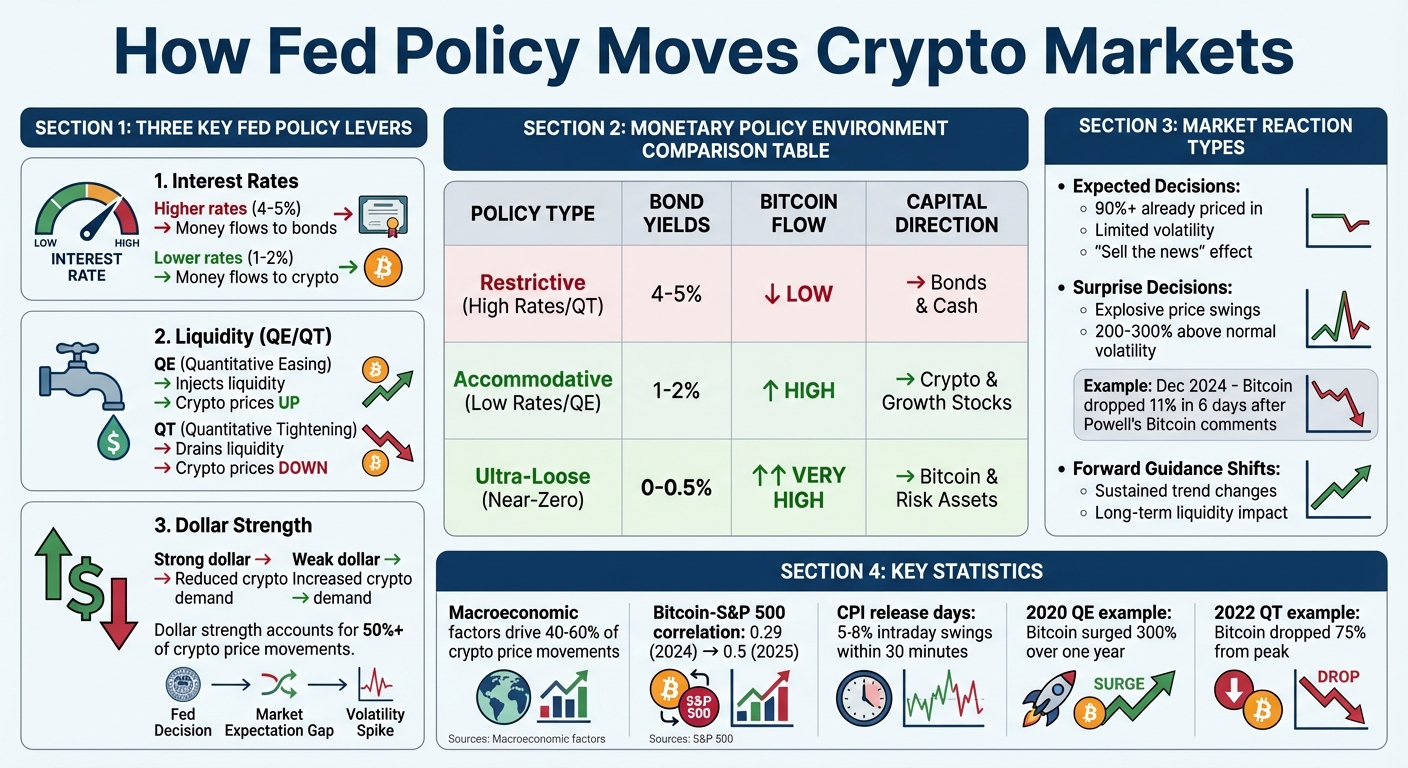
- Interest Rates: Higher rates make bonds more attractive, pulling money out of crypto. Lower rates encourage investment in riskier assets like Bitcoin.
- Liquidity (QE/QT): Quantitative easing (QE) injects liquidity, boosting crypto prices. Quantitative tightening (QT) does the opposite.
- Dollar Strength: A strong dollar reduces global demand for crypto, while a weaker dollar increases it.
- Market Reactions: Crypto markets often react sharply to Fed announcements, especially when outcomes differ from expectations.
Understanding these connections helps investors navigate crypto volatility during monetary policy shifts.
How Federal Reserve Monetary Policy Impacts Cryptocurrency Markets
How Fed Policies Create Crypto Market Volatility
Interest Rate Announcements and Price Movements
Federal Reserve interest rate decisions often cause immediate and sometimes dramatic price fluctuations in cryptocurrency markets. Here’s why: when the Fed raises interest rates, traditional fixed-income investments, like bonds, start offering yields of 4–5%. This makes them more attractive compared to cryptocurrencies, which don’t generate income. The higher opportunity cost of holding non-yielding assets like Bitcoin or Ethereum leads investors to pull capital out of crypto and redirect it toward safer, income-producing options. This systematic liquidity drain directly impacts crypto prices.
On the flip side, rate cuts tend to boost the appeal of digital assets. For example, after the Federal Open Market Committee (FOMC) announced a 25 basis-point rate cut on December 18, 2024, Bitcoin surged toward $94,000 as traders adjusted their outlook for a lower-rate environment. However, policy signals can be just as impactful as the decisions themselves. When Federal Reserve Chair Jerome Powell clarified in December 2024 that the Fed had no intention of accumulating Bitcoin, the market reacted sharply, with Bitcoin losing approximately 11% of its value in just six days. Similarly, Consumer Price Index (CPI) release days often bring heightened volatility, with Bitcoin and Ethereum experiencing intraday price swings of 5–8% within just half an hour of the announcement.
This relationship between Fed actions and crypto price movements highlights the sensitivity of digital assets to broader economic policy changes.
Why Crypto Is Considered a Risk-On Asset
Cryptocurrencies’ classification as "risk-on" assets further explains their heightened volatility. Risk-on assets are those investors tend to sell during periods of financial uncertainty and buy when market conditions improve. Unlike income-generating investments, Bitcoin and Ethereum rely entirely on investor sentiment, making them particularly vulnerable to shifts in risk appetite influenced by Federal Reserve policies.
This risk-on behavior also explains why crypto often moves in tandem with other speculative assets during times of financial stress. For instance, hawkish signals from the Fed typically prompt institutional investors to liquidate volatile positions, either to meet margin calls or to shift portfolios toward safer assets. Additionally, events like large-scale derivative settlements – such as the $2.2 billion in Bitcoin and Ethereum options settled in early 2026 – can amplify these price movements.
When the Fed pursues an easing policy, liquidity tends to flow first into major cryptocurrencies like Bitcoin and Ethereum before trickling down to smaller altcoins and speculative tokens. Conversely, tighter monetary policy often leads to a significant exodus of capital from these riskier, low-cap assets. This predictable flow of funds underscores how closely crypto market dynamics are tied to changes in liquidity and investor risk tolerance.
sbb-itb-7e716c2
3 Ways Fed Policy Affects Crypto Markets
Liquidity: QE and QT Effects on Crypto Prices
The Federal Reserve’s actions, particularly its quantitative easing (QE) and quantitative tightening (QT) programs, have a direct impact on the flow of money, which crypto markets tend to reflect almost immediately. QE is essentially a "liquidity booster." By increasing the money supply and lowering borrowing costs, this policy encourages investments in riskier assets like Bitcoin and Ethereum. A great example of this occurred in 2020, when emergency rate cuts and liquidity injections fueled a massive Bitcoin rally, with the cryptocurrency surging by 300% over the next year. Similarly, in December 2024, a 25 basis-point rate reduction combined with a $13.5 billion repo injection expanded the money supply and pushed Bitcoin close to $94,000.
On the flip side, QT does the opposite. By draining liquidity and increasing borrowing costs, QT redirects investments away from volatile crypto assets into safer options like government bonds. The aggressive rate hikes of 2022 are a prime example of this: Bitcoin’s value plunged by over 75% from its previous high. It’s worth noting that not all cryptocurrencies are affected equally. Typically, new capital flows first into Bitcoin and Ethereum before trickling down to major altcoins and eventually smaller-cap tokens. This pattern can sometimes trigger what’s known as an "Altcoin Season". Beyond liquidity shifts, Federal Reserve policies also influence how investors perceive and manage risk.
Risk Appetite and Opportunity Cost of Capital
Interest rate changes by the Fed play a big role in how investors decide between safety and potential returns. When rates rise, bonds and treasuries start offering returns in the 4–5% range, making them attractive alternatives to non-yielding assets like Bitcoin. As a result, investors often move their money into these safer, income-generating options, reducing demand for cryptocurrencies. Moreover, the tone of Fed announcements matters a lot. Hawkish signals tend to increase risk aversion, while more accommodative signals encourage risk-taking, drawing more investments into volatile markets. Macroeconomic factors such as these are estimated to drive 40–60% of cryptocurrency price movements.
Here’s a breakdown of how different monetary environments influence crypto markets:
| Monetary Policy Environment | Bond Yields | Bitcoin Attractiveness | Capital Flow Direction |
|---|---|---|---|
| Restrictive (High Rates/QT) | 4–5% | Low | Bonds and Cash |
| Accommodative (Low Rates/QE) | 1–2% | High | Growth Stocks and Crypto |
| Ultra-Loose (Near-Zero) | 0–0.5% | Very High | Risk Assets and Bitcoin |
Dollar Strength and Crypto Demand
Changes in the U.S. dollar’s strength, driven by Federal Reserve policies, also play a significant role in shaping crypto demand. When the Fed raises rates, the dollar strengthens, which reduces global buying power for cryptocurrencies. In fact, fluctuations in the dollar’s value account for more than 50% of cryptocurrency price movements. A stronger dollar makes dollar-denominated safe assets like bonds more appealing, increasing the opportunity cost of holding Bitcoin. On the other hand, when the Fed lowers rates and the dollar weakens, capital often shifts from low-yielding traditional assets into higher-risk options like cryptocurrencies, as investors seek better returns.
"USD appreciation typically correlates with lower crypto prices, as stronger dollars reduce buying power for digital assets." – Gate.com Crypto Wiki
Bitcoin’s growing correlation with traditional markets has further amplified the impact of dollar strength. For instance, the correlation between Bitcoin and the S&P 500 rose to 0.5 in 2025, up from 0.29 in 2024. This indicates that crypto assets are increasingly influenced by the same macroeconomic forces driving traditional equities. As a result, Federal Reserve policies that impact the dollar now play an even more critical role in shaping cryptocurrency valuations.
How Markets React: Expectations vs. Actual Announcements
Forward Guidance and Market Positioning
Crypto traders often try to predict the Federal Reserve’s moves weeks ahead of time. They base their strategies on Jerome Powell’s comments and the Fed’s dot plot, which tend to spark bigger price swings than the actual rate decisions themselves. In fact, during Fed announcement windows, cryptocurrency volatility can skyrocket to 200%-300% above daily averages, with most of the action happening before the official announcement. Once a decision is made, over 90% of the expected rate move is typically already priced in. This leads to what traders call "selling the news", where volatility tapers off.
"The Fed interest rate cuts and Bitcoin price correlation strengthened considerably in 2025, as demonstrated by the market’s visible positioning ahead of FOMC meetings." (Gate Wiki)
Take December 10, 2025, for example. The Federal Reserve made a widely expected 25 basis-point rate cut. Bitcoin prices had already surged to $95,000 in anticipation, so when the announcement came, the market barely flinched – prices hovered around $94,000. Instead, traders focused on the Fed’s forward guidance, which hinted at pausing further cuts. This illustrates how future policy signals often overshadow the immediate rate decision. On the flip side, when guidance deviates from market expectations, reactions can be much more dramatic.
When Markets Get It Wrong
While anticipated moves shape much of the market’s volatility, surprises can send shockwaves through the system. When the Fed delivers unexpected news, it forces a rapid repricing of risk assets across the board.
A prime example occurred in December 2024. On December 18, Jerome Powell made a surprising statement – not about rates, but about regulation. He clarified that the Fed had no authority or plans to hold Bitcoin, likening it to gold rather than a currency. This unexpected commentary caused Bitcoin to plunge by roughly 11% over the following week, from December 18 to December 24. Traders had clearly miscalculated how the market would interpret Powell’s remarks.
A similar scenario unfolded in April 2026. Bitcoin fell below $71,000 after Powell’s forward guidance took an unexpected turn. Traders had positioned for multiple rate cuts throughout the year, but the Fed’s signal of a "Powell pause" caught them off guard, leading to a sharp retracement. These moments highlight how deviations between market expectations and actual policy can ignite sudden and severe volatility, as traders scramble to adjust their positions.
| Announcement Type | Market Impact | Why It Happens |
|---|---|---|
| Expected Decision | Limited/Muted Volatility | Pricing already reflects anticipated moves |
| Surprise Decision | Explosive Price Swings | Forces immediate repricing of risk assets |
| Forward Guidance Shift | Sustained Trend Change | Indicates long-term changes in liquidity or costs |
What This Means for Crypto Investors and Institutions
Managing Volatility During Fed Policy Shifts
Navigating the Federal Reserve’s influence on crypto markets calls for active and strategic portfolio management, especially during policy changes. A key strategy is portfolio rebalancing. During rate hike cycles, reducing exposure to high-risk altcoins and leverage while increasing allocations to stablecoins and "store-of-value" assets like Bitcoin and Ethereum can help stabilize portfolios. For instance, during the 2022 Fed tightening, Bitcoin experienced a steep drop, highlighting the significant impact of such policy shifts. Investors who moved capital into stablecoins early on managed to preserve their purchasing power and retained liquidity to capitalize on market dips.
It’s also wise to reduce position sizes in the 24–48 hours surrounding Federal Open Market Committee (FOMC) announcements. Setting stop-loss and take-profit levels in advance can help avoid the pitfalls of emotional trading during volatile periods. Professional traders often rely on leading indicators – gold, for example, has historically acted as a precursor to Bitcoin by about three months during critical liquidity turning points.
For long-term investors, dollar-cost averaging (DCA) during Fed-driven market dips can help smooth out volatility over time. Institutions, on the other hand, increasingly turn to options and futures to hedge their exposure in anticipation of FOMC meetings. A notable example occurred in early 2026, when $2.2 billion in Bitcoin and Ethereum options were settled to manage uncertainties around Fed policy. In such scenarios, specialized services like those offered by BeyondOTC become essential for handling large-volume trades and minimizing the risks posed by market volatility.
How BeyondOTC Helps Navigate Market Challenges

Periods of Fed-driven volatility present unique challenges, particularly for institutions executing large transactions. Thin order books and sudden price swings can lead to significant slippage, making it difficult to complete sizable trades without disrupting the market. BeyondOTC’s OTC Trading Solutions address this issue by connecting clients with established OTC desks, institutional investors, and liquidity providers. This setup allows institutions to manage large-volume cryptocurrency transactions more efficiently, avoiding the dramatic price movements often seen on public exchanges during high-volatility periods.
BeyondOTC also keeps a close eye on key indicators like the Fed’s Dot Plot (which outlines future rate paths), the Summary of Economic Projections (covering growth and inflation trends), and the US Dollar Index, which typically moves inversely to Bitcoin. This analysis proves especially useful during Quantitative Tightening phases, when the Fed reduces its balance sheet and withdraws liquidity, often putting bearish pressure on risk assets.
For institutional clients looking to expand their market involvement, BeyondOTC offers access to early-stage investments, Total Value Locked (TVL) opportunities, and secondary market transactions. Additionally, its networking services connect clients with centralized exchanges, decentralized exchanges, launchpads, and market makers. These resources become highly valuable when Fed policy changes cause rapid shifts in market structure and liquidity flows.
Why Bitcoin dropped – what a Fed rate hike actually means for crypto

Conclusion
The Federal Reserve’s policies play a major role in shaping global liquidity, directly influencing the flow of capital into cryptocurrency markets. By understanding how these policies work – from interest rate changes that increase the cost of holding non-yielding assets to quantitative easing (QE) cycles that inject liquidity – investors can gain a significant advantage. Research highlights this connection, showing that macroeconomic factors drive roughly 40–60% of cryptocurrency price movements. Additionally, Bitcoin’s correlation with the S&P 500 rose from 0.29 in 2024 to 0.5 in 2025, underscoring the growing ties between crypto and traditional markets.
Market volatility often spikes when there’s a gap between what investors expect and the Federal Reserve’s actual announcements. For instance, Fed rate decisions can lead to price swings far beyond normal daily fluctuations. Similarly, Consumer Price Index (CPI) release days have triggered intraday movements of 5–8% within just half an hour. These rapid adjustments occur as markets recalibrate in response to unexpected shifts in Fed guidance.
In such a volatile environment, strong risk management becomes essential. Monitoring key cross-market indicators and understanding lead–lag patterns can help investors navigate uncertainty. For example, gold prices have historically led Bitcoin by approximately three months during pivotal liquidity shifts, offering early warning signals. Notably, Federal Reserve officials increasingly compare Bitcoin to gold, emphasizing its emerging role as a store-of-value asset, especially during monetary expansion periods.
For institutional investors handling large positions, these Fed-driven price swings highlight the need for effective risk controls and execution strategies. Those who stay attuned to Federal Open Market Committee (FOMC) schedules, separate meaningful signals from market noise, and adjust portfolios strategically during policy changes will be better equipped to seize new opportunities while mitigating the risks of extreme volatility.
FAQs
Which Fed events move crypto the most?
The Federal Reserve’s decisions on interest rates, particularly increases and decreases, play a major role in shaping cryptocurrency markets. When rates go up, the dollar tends to gain strength, borrowing becomes more expensive, and liquidity tightens – factors that often push crypto prices downward. On the flip side, rate cuts usually lead to higher liquidity and greater risk-taking, which can drive more investments into cryptocurrencies.
Key moments to watch are the Federal Open Market Committee (FOMC) meetings. These gatherings determine interest rate policies and include statements that reveal the Fed’s perspective on the economy.
Why does a strong U.S. dollar hurt Bitcoin?
When the U.S. dollar gains strength, it can make Bitcoin and other cryptocurrencies less attractive as alternative investments. A stronger dollar, often driven by higher interest rates or tighter Federal Reserve policies, tends to push investors toward safer assets. This shift can reduce demand for riskier options like Bitcoin, potentially driving its price down.
How can investors reduce FOMC-day risk?
When the Federal Open Market Committee (FOMC) makes announcements, crypto markets tend to get a bit wild. To navigate this turbulence, investors should steer clear of rash decisions. Instead, they can focus on strategies like:
- Holding positions: Sometimes, doing nothing is the best move. Sitting tight can help avoid unnecessary losses during volatile swings.
- Using limit orders: Setting predefined entry or exit points ensures trades only happen at prices you’re comfortable with.
- Hedging with options: Options can act as a safety net, providing protection against sharp price movements.
Another smart approach? Stay on top of macroeconomic trends. Understanding the bigger picture can help you anticipate market reactions. And don’t put all your eggs in one basket – diversify into assets that aren’t as affected by interest rate changes. These steps can make navigating FOMC days a lot less stressful.