Vendor-related breaches are a growing threat, especially for cryptocurrency projects. Here’s what you need to know:
- 60% of data breaches involve third parties, and breaches cost an average of $4.52 million.
- Regulations like GDPR, HIPAA, PCI DSS, and DORA impose strict requirements for managing vendor risks.
- Poor vendor management can lead to regulatory penalties, cyber insurance hikes, and even business shutdowns.
- Key steps include creating a vendor inventory, performing risk assessments, and implementing strong contracts with breach notification timelines, audit rights, and data protection clauses.
- Continuous monitoring and secure offboarding are essential to prevent lingering risks.
Your security depends on your weakest vendor. This guide explains how to manage vendor risks, comply with regulations, and protect your project from costly breaches.
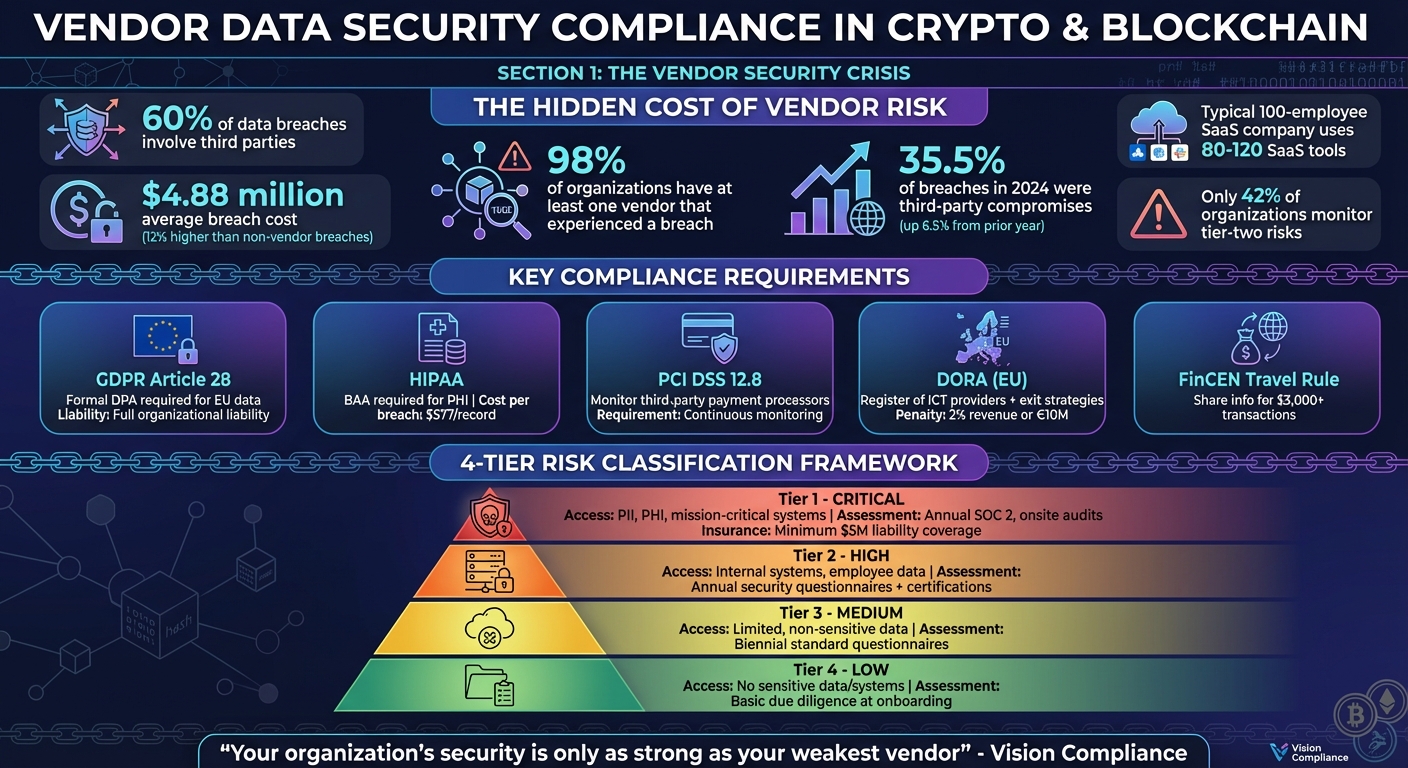
Vendor Data Security Compliance: Key Statistics and Risk Tiers
Vendor Risk Management – How to Evaluate Third-Party Security Before You Buy
sbb-itb-7e716c2
Key Data Security Regulations You Need to Know
Cryptocurrency projects must navigate a maze of regulations when working with vendors. The type of data your vendors handle determines your legal responsibilities, and non-compliance can lead to serious consequences. For instance, under GDPR, your organization is fully liable if a vendor fails to meet compliance standards.
The regulatory framework spans several key areas. GDPR Article 28 mandates a formal Data Processing Agreement (DPA) with any vendor handling personal data of EU residents. In the healthcare sector, HIPAA requires a Business Associate Agreement (BAA) for vendors accessing Protected Health Information (PHI). For payment security, PCI DSS Requirement 12.8 (updated in version 4.0) obliges organizations to monitor third-party service providers managing payment card data.
If your crypto project operates in the EU, the Digital Operational Resilience Act (DORA) introduces additional requirements, such as maintaining a "Register of Information" for all third-party ICT providers and planning exit strategies for critical vendors. Similarly, the NIS2 Directive Article 21(11)(d) highlights supply chain security as a critical part of cybersecurity risk management.
In the U.S., regulations add another layer of complexity. Crypto entities classified as Money Services Businesses must comply with FinCEN‘s Travel Rule, which requires sharing specific personal information for transactions of $3,000 or more. Broker-dealers must also adhere to SEC Rule 3110, governing third-party activity supervision, and Rule 15c3-3, which addresses the handling of crypto asset securities.
The risks are real. A staggering 98% of organizations report having at least one vendor that has experienced a breach. By 2025, the average cost of a data breach reached $4.88 million, with breaches involving third-party vendors costing around 12% more. For healthcare data under HIPAA, the cost per breached record is $577.
HIPAA and Business Associate Agreements
For crypto projects dealing with health-related data, HIPAA compliance is non-negotiable. Whether you’re processing healthcare payments or managing medical records, these regulations directly impact how you oversee vendors. The HIPAA Security Rule requires a Business Associate Agreement (BAA) with any vendor accessing PHI.
A BAA isn’t just a formality – it’s a legally binding document that ensures vendors implement security measures aligned with the HIPAA Security Rule. It covers breach notifications, liability for subcontractors, and audit rights. If your vendor uses subcontractors, they must also agree to the same terms, a concept known as "flow-down" liability.
Consider the Change Healthcare attack in February 2023 as a cautionary tale. A vendor-managed API lacked multi-factor authentication, leading to a ransomware attack that disrupted billing for millions of patients. The fallout included breach notifications, regulatory scrutiny, and significant legal costs.
Your BAA should specify incident notification timelines (usually 24–72 hours), grant audit rights, and outline data return or deletion requirements upon contract termination. Don’t just take a vendor’s word for their compliance – review their SOC 2 Type II reports and scrutinize any exceptions or qualifications in the auditor’s findings.
PCI DSS Compliance for Payment Security
If your crypto platform processes fiat payments, accepts credit cards for token purchases, or operates payment gateways, PCI DSS Requirement 12.8 applies to you. This standard requires you to actively manage third-party access to cardholder data.
Key steps include maintaining an updated list of service providers, defining responsibilities in written agreements, and conducting ongoing due diligence. The updated PCI DSS version 4.0 raises the bar, requiring continuous monitoring of third-party compliance. This includes reviewing breach histories, incident response plans, and security certifications – not just checking a box annually.
It’s easy to overlook that subcontractors are also part of the compliance equation. For example, if your payment processor uses a cloud provider to store cardholder data, you need visibility into that relationship. The same data protection standards must apply throughout the vendor chain.
General Data Protection Regulation (GDPR)
For crypto projects serving EU customers, GDPR sets the standard for vendor data management. GDPR Article 28 is central to ensuring vendor data security. It requires a binding DPA between you (the controller) and any vendor (the processor) handling personal data of EU residents.
Compliance involves documenting security certifications, penetration test results, and incident response procedures. Alarmingly, 54% of organizations fail to assess third-party security before onboarding vendors, a critical misstep under GDPR.
Cross-border data transfers add another layer of complexity. If your vendor processes EU personal data outside the European Economic Area, you must use mechanisms like Standard Contractual Clauses or Binding Corporate Rules. Post-Schrems II, Transfer Impact Assessments (TIAs) are also necessary to evaluate the recipient country’s laws on government access to data.
For crypto projects, the stakes are even higher. Blockchain transactions are irreversible, so GDPR violations involving wallet addresses or transaction data cannot be undone.
Your DPA should include prior written authorization for subprocessors, mandatory breach notifications (typically within 72 hours), and clear audit rights. Under GDPR’s joint liability framework, you remain accountable for your vendors’ actions – if they fail, the responsibility falls on you.
Building a Vendor Risk Management Framework
To comply with strict regulations, companies need a solid vendor risk management framework. Consider this: a typical 100-employee SaaS company uses between 80 and 120 SaaS tools, yet only 42% of organizations actively monitor tier-two risks. Meanwhile, in 2024, third-party compromises accounted for 35.5% of breaches – a 6.5% jump from the prior year.
A strong framework starts with three key steps: creating a complete vendor inventory, conducting thorough risk assessments, and tiering vendors based on risk levels. As Lorikeet Security aptly states:
"Vendor management is not about eliminating vendor risk. It is about demonstrating that you understand your vendor risk, have a process for managing it, and can show evidence that the process works".
Creating a Vendor Inventory
Your vendor inventory forms the backbone of your risk management strategy. Begin by pulling vendor lists from accounts payable and credit card records. To uncover unauthorized tools (commonly referred to as "Shadow IT"), examine SSO logs, DNS records, browser extensions, and CI/CD pipelines. Additionally, reach out to department heads to identify any unregistered tools.
For each vendor, document essential details like the services they provide, the types of data shared (e.g., customer PII, employee records, payment tokens), and how they integrate with your systems – whether via APIs, VPNs, or other methods. Assign a business owner for each vendor relationship to ensure accountability. Track contract start and renewal dates to trigger security reassessments before agreements are extended. Keep all this data in a centralized system to stay audit-ready and avoid scattered spreadsheets.
| Essential Inventory Field | Description |
|---|---|
| Vendor Name & Contact | Legal entity name and primary security/business contact |
| Service Description | Plain-language description of the service provided |
| Data Types Shared | Categories of data, such as customer PII, employee records, or payment tokens |
| Integration Method | How the vendor accesses your data (e.g., API, VPN, file transfer) |
| Risk Tier | Classification based on data sensitivity and business criticality |
| Compliance Status | Certifications held (e.g., SOC 2, ISO 27001, HIPAA) |
| Business Owner | The internal person responsible for the vendor relationship |
Conducting Vendor Risk Assessments
Once your inventory is complete, the next step is evaluating each vendor’s security posture. Use standardized questionnaires like SIG Lite for lower-risk vendors or CAIQ for cloud-specific, high-risk vendors to establish a baseline. For critical vendors, validate their responses with third-party audits, such as SOC 2 Type II or ISO 27001 certifications.
Pay special attention to SOC 2 reports, particularly the Complementary User Entity Controls (CUECs), which outline the security practices your organization must follow. Confirm that the audit was conducted by a reputable firm, such as a Big 4 accounting firm or a specialized security auditor.
Be cautious of "carve-out" reports, where vendors exclude subprocessors (e.g., AWS) from their audits. In such cases, you may need to request additional reports. For critical vendors, identify their subprocessors to assess potential extended supply chain risks. Evaluate both inherent risk (risk before controls are applied) and residual risk (risk after accounting for the vendor’s security measures). This approach helps you prioritize vendors effectively.
A case in point: the MOVEit file-transfer breach in 2023 affected over 2,600 organizations worldwide, underscoring how a single supply chain vulnerability can ripple across industries.
Risk Tiering and Prioritization
Not all vendors pose the same level of risk, so categorizing them is essential. Divide vendors into four tiers based on the sensitivity of the data they access and their importance to business operations:
- Tier 1 (Critical): Vendors with access to highly sensitive data, like PII or PHI, and those supporting mission-critical systems. These require the most rigorous oversight, including SOC 2 reviews, contract assessments, and possibly onsite audits, conducted annually.
- Tier 2 (High): Vendors accessing internal systems or employee data. These should undergo detailed security questionnaires and annual certification reviews.
- Tier 3 (Medium): Vendors with limited access to non-sensitive data. Biennial assessments using standard questionnaires or self-attestations are sufficient.
- Tier 4 (Low): Vendors without access to sensitive data or systems. Basic due diligence, such as a website review and business verification during onboarding, is adequate.
To streamline this process, you could implement a 100-point scoring system that evaluates factors like certifications, security practices, access control measures, business continuity plans, and financial stability.
The stakes are high. Vendor-related breaches cost organizations an average of $4.52 million in detection, response, and recovery. As Vision Compliance puts it:
"Your organization’s security is only as strong as your weakest vendor".
Key Contract Provisions for Compliance
Once you’ve assessed vendor risk, the next step is to tighten your contracts. This ensures clear security obligations, reporting protocols, and oversight rights are in place. Michael Berman from Ncontracts emphasizes the importance of this:
"If it’s not in writing, it’s not enforceable. Use the bargaining power you have before signing a contract to ensure you have all the monitoring tools you need".
Considering that over 60% of data breaches involve a third party and 98% of organizations have at least one vendor that has experienced a breach, these contract provisions are essential for bridging the gap between risk assessment and ongoing vendor management.
Breach Notification and Reporting
Contracts should require vendors to notify you of breaches within a specific timeframe – typically 24 to 72 hours after discovery. It’s critical to define what "discovery" means to prevent delays caused by internal investigations.
Vendors should also provide a detailed incident report that includes:
- A timeline of events
- Root cause analysis
- Details on the data affected (e.g., number of records, types of data)
- Planned remediation steps
Designate a specific point of contact, like a 24/7 security operations center or your CISO, to streamline communication. Contracts should also include subprocessor flow-down clauses, requiring vendors to notify you if their subcontractors experience a breach. Additionally, vendors should report any "material changes" to their security posture, such as losing key certifications like SOC 2 or ISO 27001.
Audit and Monitoring Rights
Your contracts should grant you the right to verify vendor security controls regularly. For critical (Tier 1) vendors, annual audits or evidence reviews are ideal; for high-risk (Tier 2) vendors, biennial reviews may suffice. Specify the types of evidence required, such as:
- SOC 2 Type II reports
- ISO 27001 certifications
- Penetration test results
- Cyber insurance certificates (set a minimum of $5 million in liability coverage for critical vendors)
Since many SaaS vendors won’t allow on-site inspections, negotiate access to their independent audit reports instead. When reviewing SOC 2 reports, pay special attention to Complementary User Entity Controls (CUECs) – these outline the security tasks your organization must handle. Your contract should acknowledge your responsibility for these controls.
Include ad-hoc audit triggers to allow immediate reassessments if a vendor experiences a breach, a financial rating drop, or repeated SLA failures. Contracts should also give you oversight of the vendor’s subprocessor management practices, including advance notice before they engage new third parties with access to your data.
Data Protection and Confidentiality Clauses
Ensure vendors implement robust technical safeguards, such as:
- AES-256 encryption for data at rest
- TLS 1.2+ for data in transit
- Multi-Factor Authentication (MFA)
- Role-Based Access Control (RBAC)
For GDPR compliance, include a Data Processing Agreement (DPA) that outlines the scope of data processing, data types, and categories of data subjects.
Contracts should also address ownership of derivative data, specifying that embeddings and fine-tuning outputs remain your property. Include clauses that restrict vendors from using your data to train general-purpose AI models. For international data transfers outside the EU/EEA, ensure Standard Contractual Clauses (SCCs) are in place, supplemented by a Transfer Impact Assessment (TIA).
Add a "permitted purpose" clause to limit vendors to using your data solely for the agreed-upon services. Upon contract termination, vendors must return or delete all data within a strict timeline (usually 30 days) and provide a Certificate of Deletion. This prevents "zombie data" from lingering in their systems.
Finally, include liability carve-outs to remove standard liability caps for data breaches, intellectual property infringement, and regulatory fines. Poor contract management can cost organizations an average of 9% of their annual revenue.
Implementing Vendor Security Audits
Once you’ve established solid contracts and validated your digital asset infrastructure, the next step is conducting thorough vendor security audits. These audits are essential for confirming that the controls vendors claim to have in place are actually effective. Think of them as the practical follow-up to your contract clauses, ensuring vendors live up to their security promises.
Defining Audit Scope and Checklist
Start by defining the scope of your audit based on the vendor’s risk level. Critical (Tier 1) vendors, who handle sensitive data or provide mission-critical services, require in-depth checks. This typically involves reviewing SOC 2 Type II or ISO 27001 reports, validating evidence, and conducting virtual audits on an annual basis. For high-risk (Tier 2) vendors, detailed questionnaires and certification reviews are key. Medium-risk vendors can often be assessed using standardized tools like SIG Lite (75 questions) or CAIQ (197 questions for cloud providers).
Your checklist should cover seven main areas: Security, Privacy, Operational, Compliance, Financial, Reputational, and Strategic. When it comes to technical controls, verify specific measures such as Multi-Factor Authentication (MFA), Role-Based Access Control (RBAC), AES-256 encryption for data at rest, and TLS 1.2+ for data in transit. Watch out for vague claims like "we follow industry standards" – instead, ask for concrete evidence like documented encryption policies, penetration test summaries, or incident response plans.
Don’t overlook Complementary User Entity Controls (CUECs), which outline the security tasks your organization must handle. For instance, if a vendor’s SOC 2 report states that access control depends on your team managing user permissions, that responsibility falls squarely on you.
Once you’ve assessed the controls, move on to a detailed review of vendor policies and certifications.
Reviewing Vendor Policies and Certifications
When analyzing a SOC 2 Type II report, check that the auditor is reputable, such as a Big 4 firm, as this adds credibility. Ensure the report covers at least six months and includes the specific services you use. Be on the lookout for "qualified opinions" or exceptions, which indicate that certain controls weren’t fully effective during the testing period.
If there’s a gap between the SOC 2 report period and the current date, request a bridge letter from the vendor’s management to confirm that controls remain effective. For ISO 27001 certifications, ask for the latest surveillance audit report to check for non-conformities. If a vendor doesn’t have major certifications, review alternative evidence like penetration test summaries, business continuity plans, or cyber insurance certificates with at least $5 million in liability coverage.
To stay on top of things, use calendar reminders or governance, risk, and compliance (GRC) tools to track when SOC 2 reports and ISO certifications expire. Outdated compliance data can be misleading and even riskier than having no data at all.
Once you’ve verified policies and certifications, it’s time to address any gaps or issues you’ve identified.
Addressing Non-Compliance Issues
When you find gaps, take a collaborative approach to fix them. Work with vendors to address issues like outdated software or missing controls. Create a remediation plan that includes specific actions, assigns responsibilities, and sets deadlines – typically 30 to 60 days for high-risk issues.
Focus on the most critical vulnerabilities first. For example, if a vendor doesn’t enforce MFA, that’s a higher priority than a missing policy document. Use follow-up vulnerability scans to confirm that fixes have been implemented effectively.
If a vendor fails to resolve critical issues, consider implementing compensating controls – like restricting vendor access or limiting them to read-only permissions – or start a secure offboarding process. Document everything: identified risks, action plans, progress updates, and outcomes. This audit trail is crucial for regulatory compliance.
The stakes are high. In 2023, 61% of companies experienced a third-party data breach or cybersecurity incident, marking a 49% increase from the previous year. This makes addressing gaps and keeping thorough records absolutely essential.
Ongoing Monitoring and Vendor Offboarding
Continuous Monitoring Practices
Audits give you a snapshot, but continuous monitoring fills in the gaps. How often and how thoroughly you monitor a vendor depends on their risk level. For example, critical (Tier 1) vendors usually need quarterly reviews, while low-risk vendors might only require reviews triggered by specific events.
Tools like BitSight and SecurityScorecard can help by offering real-time insights into a vendor’s external security posture between formal audits. Beyond scheduled reviews, you should act immediately when certain events occur – like a vendor experiencing a data breach, a sharp decline in their financial health, a merger or acquisition, or repeated SLA failures. Subscribing to vendor status pages and security advisories can also keep you informed about outages or vulnerabilities. Meanwhile, conducting quarterly access reviews ensures vendor permissions align with the Principle of Least Privilege.
The risks are real: 62% of data breaches involve third-party vendors, and breaches through these channels cost, on average, 12% more than others, with total costs reaching $4.88 million.
While continuous monitoring safeguards active partnerships, securely ending vendor relationships is just as important.
Secure Vendor Offboarding
Proper offboarding is critical to prevent lingering risks once a vendor relationship ends. Start by immediately revoking all access credentials and connections. Then, take stock of all digital and physical assets the vendor used, ensuring everything is accounted for. Retrieve your data in the agreed-upon format and verify it against your records.
For vendors with higher risk profiles, request a formal Certificate of Deletion. This document confirms that all your data has been removed from their systems, including backups, which are often tricky to erase.
"The most neglected part of the lifecycle of a third-party relationship is the goodbye. The termination of the relationship." – Michael Rasmussen, Founder, GRC 2020
In critical cases, consider conducting an on-site audit after termination to confirm all data has been wiped and physical assets, like badges or hardware, have been returned. Update your vendor risk register to mark the vendor as "Inactive", and document the reasons for termination for future reference. Also, remember that some contractual obligations – like confidentiality and privacy clauses – remain enforceable even after the relationship ends, so reinforce these terms during the offboarding process.
Using Legal Consultancy for Compliance
Role of Legal Advisors in Compliance
Vendor compliance isn’t just about technology – it’s deeply tied to legal obligations. Legal advisors play a key role in bridging the gap between blockchain innovations and traditional financial regulations, ensuring your vendor contracts are legally sound and protective.
Their work often starts during the contract drafting phase. Advisors review critical elements like security requirements and breach notification timelines, which are typically set at 24–72 hours for reporting incidents. They also align regulatory requirements with your vendor relationships, identifying overlaps such as where GDPR intersects with NIS2 or where DORA demands additional ICT provider documentation.
For projects dealing with payments or sensitive customer data, legal advisors assist with licensing and registration processes. This could involve navigating FinCEN MSB registration, obtaining State Money Transmitter Licenses, or securing the New York BitLicense. They also design risk-based onboarding frameworks for Virtual Asset Service Providers (VASPs), analyzing jurisdictional footprints and identifying licensing gaps before partnerships are finalized.
Non-compliance with DORA can lead to severe penalties, including fines of 2% of global annual revenue or €10 million, whichever is higher. Individual business leaders may also face personal fines of up to €1 million. Considering that 62% of data breaches involve third-party vendors and cost an average of $4.88 million – 12% higher than other breaches – legal expertise becomes a critical part of any vendor compliance strategy.
Partnering with BeyondOTC for Compliance Support

Beyond legal advisory, working with specialized services like BeyondOTC can further enhance your compliance efforts. BeyondOTC connects cryptocurrency projects with legal firms that specialize in blockchain compliance and data security. Instead of managing vendor compliance independently, projects can tap into BeyondOTC’s network of pre-vetted legal professionals who understand both financial regulations and the unique challenges of decentralized systems.
Through its Legal Consultancy services, BeyondOTC provides regulatory guidance and links projects to top legal firms across more than 50 countries. This global reach is especially helpful for projects operating in multiple jurisdictions, where vendor agreements must address varying data protection laws, licensing requirements, and operational standards.
For institutional clients exploring DeFi opportunities, BeyondOTC’s TVL funding advisory offers comprehensive solutions, including vetting protocols and conducting thorough risk assessments. This level of due diligence extends to vendor relationships, ensuring that third-party DeFi protocols meet institutional security and compliance standards before any capital is committed.
Additionally, BeyondOTC supports term sheet negotiations during fundraising and vendor onboarding. This ensures agreements include critical elements like data return/deletion clauses, clear liability terms for vendor-caused breaches, and well-defined exit strategies – areas often overlooked without legal guidance.
With over $2 billion raised for clients and $5 billion in institutional TVL investments facilitated, BeyondOTC’s network brings a wealth of experience to the table. This expertise helps projects achieve faster vendor onboarding, stronger contractual safeguards, and reduced risk of regulatory penalties, ensuring smoother operations even in complex compliance landscapes.
Conclusion and Key Takeaways
Securing vendor data compliance is a must for cryptocurrency projects. Third-party breaches are not only frequent but also come with a hefty price tag – averaging $4.52 million for detection, response, and recovery. The real challenge lies in how well you manage vendor-related risks.
Here’s a quick recap of the framework: start by creating a thorough inventory of all vendors, including shadow IT. Categorize vendors by their risk level, perform in-depth security assessments for high-risk partners, and ensure your contracts include strong protective measures. But don’t stop there – compliance is an ongoing process. With 46% of IT and business leaders reporting vendor breaches after partnerships began, it’s clear that continuous monitoring, regular reviews, and secure offboarding are essential.
"Your organisation’s security is only as strong as your weakest vendor." – Vision Compliance
For projects navigating regulations like DORA, GDPR, or the upcoming UK FSMA 2026 rules, having expert legal guidance can make all the difference. Legal advisors can ensure your contracts include critical elements like breach notification timelines (usually within 24–72 hours), audit rights, and data deletion clauses. These measures are your safety net when issues arise.
If you’re looking to simplify the compliance process, BeyondOTC’s Legal Consultancy services can help. They’ll not only reduce your regulatory risks but also free up your team to stay focused on driving innovation.
FAQs
Which vendors should I assess first?
When evaluating third-party vendors, begin by focusing on those that present the greatest potential risks to your organization. Pay particular attention to vendors involved in handling sensitive information, managing financial transactions, or delivering essential services like cloud infrastructure or payment processing. These vendors play a central role in your operations, meaning any disruptions or vulnerabilities could have a major impact on your security and compliance efforts. By addressing high-risk vendors first, you can quickly uncover and address potential issues, aligning with effective risk management practices.
What should a vendor contract include for compliance?
When drafting a vendor contract for compliance, it’s crucial to include elements that address both risk management and regulatory requirements. Key components to consider are:
- Security and privacy requirements: Clearly outline the measures vendors must take to protect sensitive data.
- Audit and review rights: Grant your organization the ability to audit the vendor’s compliance practices as needed.
- Incident response and breach notification procedures: Define how the vendor will handle and report security incidents or data breaches.
- Ongoing monitoring and reporting: Establish protocols for regular updates and performance reviews.
Additionally, ensure the contract confirms compliance with relevant laws and regulations. If sensitive data, such as protected health information, is involved, include business associate agreements (BAAs) to meet specific legal obligations.
How do I monitor vendors after onboarding?
To keep track of vendors after onboarding, it’s crucial to set up a structured process that involves regular evaluations, risk checks, and security assessments. Here are some important steps to follow:
- Schedule periodic reviews to confirm vendors meet compliance and security requirements.
- Monitor for risks continuously and tackle any vulnerabilities promptly.
- Keep a current and detailed vendor inventory to ensure effective oversight.
- Review security reports frequently and plan audits to confirm compliance remains intact.