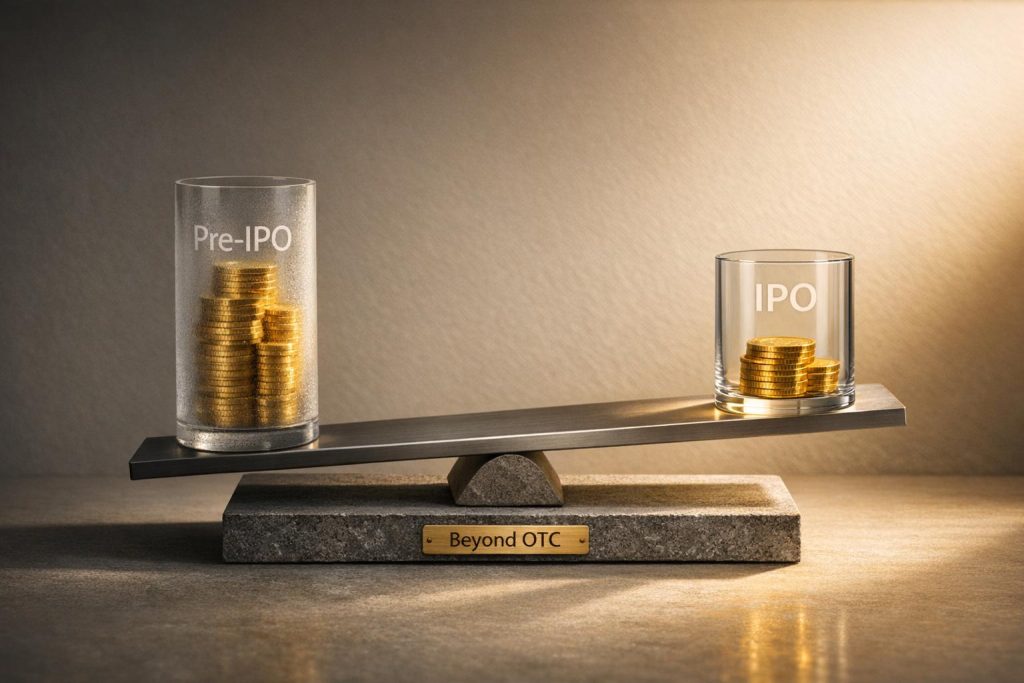
Should you invest in pre-IPO shares or IPO allocations? The answer depends on your risk tolerance, liquidity needs, and financial goals. Pre-IPO investments offer the potential for high returns but come with significant risks, limited transparency, and long lock-in periods. IPO allocations, on the other hand, provide easier access, better liquidity, and more regulatory oversight but often deliver more moderate, market-driven returns.
Key Takeaways:
- Pre-IPO Investments: High risk, high reward. Suitable for accredited investors willing to accept illiquidity and speculative outcomes.
- IPO Allocations: Lower risk, more liquidity. Accessible to retail investors but often with less upside as companies go public later in their lifecycle.
Quick Comparison:
| Feature | Pre-IPO Allocation | IPO Allocation |
|---|---|---|
| Risk Level | High to Very High | Moderate |
| Return Potential | Potentially very high | Moderate, market-driven |
| Liquidity | Low (years-long lock-up) | High (daily trading after lock-up) |
| Transparency | Limited | High (SEC filings and disclosures) |
| Investor Type | Accredited investors | Retail and institutional investors |
| Valuation | Negotiated, often discounted | Market-clearing price |
Bottom Line: Pre-IPO investments are speculative and best kept as a small, high-risk portion of your portfolio. IPOs, while more stable, often offer lower returns due to companies going public later in their growth cycle. Choose based on your ability to handle risk, need for liquidity, and long-term financial objectives.
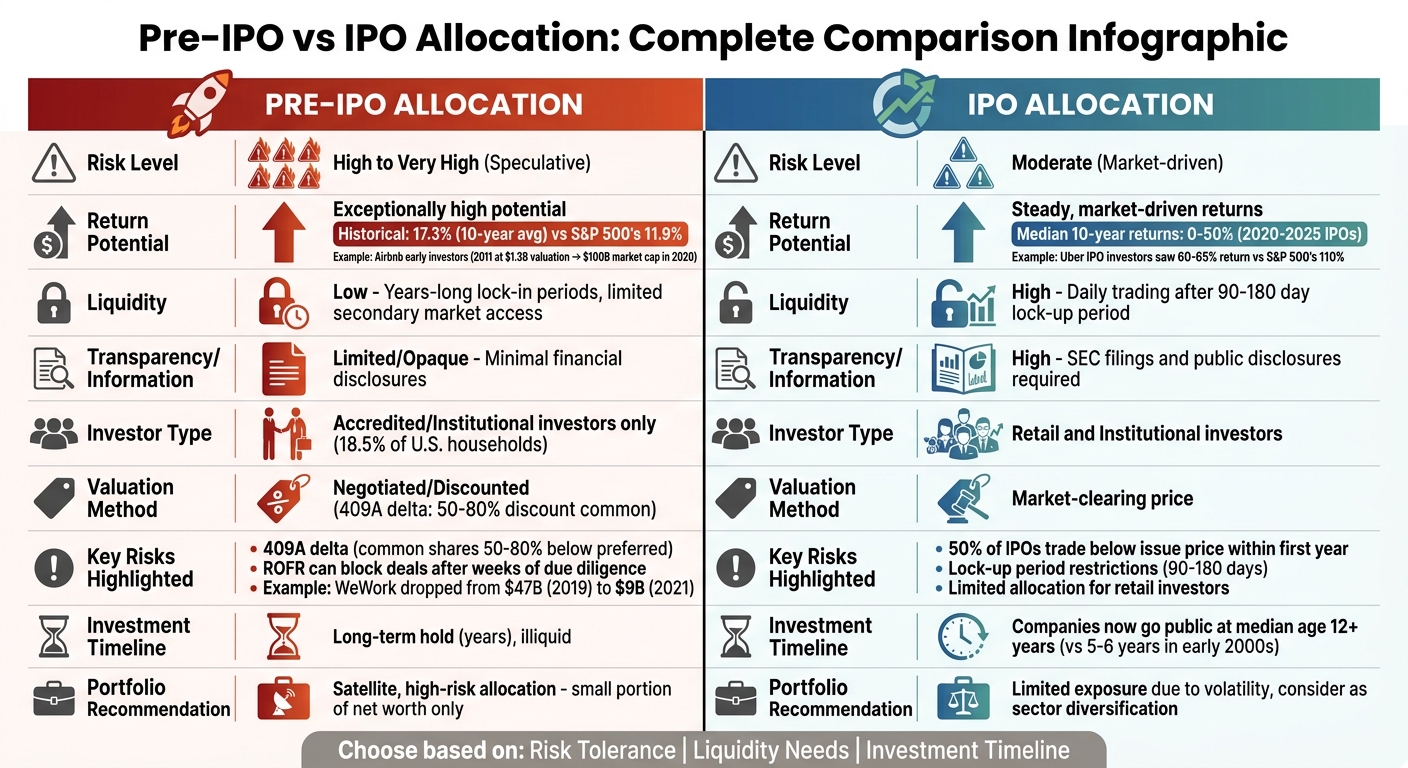
Pre-IPO vs IPO Investment Comparison: Risk, Returns, and Liquidity
Pre-IPO investments look exciting, but valuation, liquidity and regulatory risks are often ignored.!
1. Pre-IPO Allocation
Pre-IPO allocation involves purchasing shares in a company before it becomes publicly traded. This strategy focuses on capturing growth during the private phase of a company’s lifecycle, which has become increasingly appealing as more value is created in private markets before companies reach public exchanges.
Risk Profiles
Understanding the risks tied to pre-IPO investments is essential. These investments carry higher risks due to limited transparency – private companies disclose significantly less financial information compared to public firms. This lack of detail can leave investors with an incomplete picture of key metrics like revenue trends, debt levels, and governance practices.
Another critical risk is the "409A delta", which measures the price gap between what preferred shareholders (like venture capitalists) and common shareholders (often secondary market buyers) pay. This gap can range from 50% to 80%. For instance, in 2026, SpaceX common shares in the secondary market cleared at $85, a 23% discount compared to the $110 Series J preferred price. This discount reflects the lower priority of common stock in the liquidation hierarchy – if the company underperforms, preferred shareholders are paid first, leaving common shareholders with little or nothing.
"For most portfolios, pre-IPO exposure works best as a satellite, high-risk allocation, not a core holding." – Global Banking & Markets
Additionally, many pre-IPO deals fall through when companies exercise their Right of First Refusal (ROFR), which allows existing investors 30 to 60 days to match the terms of a proposed deal. This means weeks of due diligence can go to waste if the transaction is blocked at the last moment.
Return Potential
The potential for high returns is one of the main draws of pre-IPO investments. Historically, private equity investments have provided a 10-year average return of 17.3%, compared to 11.9% for the S&P 500. A notable example is Airbnb’s IPO in December 2020, where its share price opened at $146 – more than double its $68 IPO price – leading to a $100 billion market cap on day one. Early investors who backed Airbnb in 2011, when it was valued at $1.3 billion, achieved returns that public market investors could not match.
However, not all outcomes are as favorable. For example, WeWork‘s valuation dropped dramatically from $47 billion in private markets in early 2019 to around $9 billion when it went public in 2021, causing significant losses for late-stage pre-IPO investors. The success of such investments often hinges on the accuracy of the entry valuation and the company’s ability to deliver on its growth projections.
Liquidity
One of the biggest challenges with pre-IPO shares is their lack of liquidity. Investors usually have limited chances to sell these shares before the IPO. Even after going public, shares are often subject to a lock-up period, typically lasting 90 to 180 days, during which sales are restricted. This can tie up your capital for an extended period, limiting your ability to access funds or adjust your portfolio. While secondary marketplaces offer some liquidity options, they often come with transaction fees and require finding a willing buyer.
Portfolio Strategies
Pre-IPO investments should be treated as a high-risk, satellite allocation rather than a core component of your portfolio. Limit your exposure to a small portion of your net worth – think of it as a venture capital-style investment for your personal finances, not a cornerstone of your retirement plan. Diversification is key; spreading investments across multiple companies and industries can help balance the inherent risks tied to individual startups.
If you’re using Special Purpose Vehicles (SPVs), be aware of the associated fees, which typically include 3%-5% upfront, 1%-2% annual management fees, and 10%-20% carried interest.
Before investing, it’s crucial to examine the liquidation waterfall to understand how preferences impact payouts. In moderate exit scenarios, venture capitalists’ liquidation preferences can consume over 75% of the proceeds, leaving common shareholders with far less than the headline valuation suggests. Use multiple data points – such as mutual fund marks (Tape D) and IRS-compliant 409A valuations – to determine a fair entry price.
Next, we’ll dive into how IPO allocations compare in terms of risk, return, and liquidity.
2. IPO Allocation
IPO allocation involves purchasing shares at their offering price before they begin trading on public markets. Unlike pre-IPO investments, IPOs provide access to companies that are already preparing to operate under public market regulations, including standardized financial disclosures and regulatory oversight. This approach offers a different level of transparency, pricing structure, and liquidity compared to earlier-stage investments.
Risk Profiles
IPO allocations come with their own set of risks. While companies must file detailed disclosures with the SEC before going public, which increases visibility, these investments can still be volatile. In fact, about 50% of IPOs trade below their issue price within the first year of listing. That initial "pop" in stock price on day one doesn’t necessarily translate to long-term success.
One significant risk is the lock-up period, which usually lasts 90 to 180 days. During this time, you can’t sell your shares, even if the stock price begins to drop. Once these lock-ups expire, the market often sees a surge in available shares, which can drive prices down.
Although IPOs offer more transparency than pre-IPO deals, information gaps still exist. Institutional investors often receive more detailed insights and direct access to company management, while retail investors – especially those using platforms like Robinhood or SoFi – may only get small allocations and limited information. Additionally, brokerages tend to prioritize IPO shares for clients with larger accounts or higher trading activity, making it challenging for smaller investors to secure meaningful allocations in high-demand offerings.
Return Potential
The potential returns from IPOs have shifted over the years. Companies now go public much later in their lifecycle, typically at a median age of 12+ years, compared to 5-6 years in the early 2000s. They also tend to have annual sales between $500 million and $1 billion+, compared to $50-100 million in the past. This means IPO investors are buying into well-established businesses rather than fast-growing startups.
"By the time companies become publicly available, the Innovation Premium has largely been captured by private capital." – AltStreet Briefing
The numbers back this up. Median 10-year post-IPO returns have dropped significantly, from 200-500% during the 1960-2000 period to just 0-50% for IPOs between 2020 and 2025. Take Uber as an example: its valuation skyrocketed from $4 million in its 2010 seed round to $82 billion at its May 2019 IPO. However, public investors who bought at the IPO and held until early 2025 saw returns of only 60-65% (roughly 8-9% annualized), far below the S&P 500’s 110% return during the same period.
First-day stock price surges, or "pops", can be misleading. For instance, Figma’s IPO saw its shares climb to $124 on opening day – 275% above the $33 offering price. However, this often reflects supply-demand imbalances rather than the company’s actual value. The median float for technology IPOs has dropped from 35-40% in the 1990s to around 15% by 2020, creating artificial scarcity that inflates prices temporarily.
Liquidity
One clear advantage of IPO allocations over pre-IPO investments is liquidity. Once the stock starts trading and the lock-up period ends, you can sell shares on major exchanges like the NYSE or Nasdaq during market hours. This eliminates the need for secondary approvals or the extended waiting periods common with pre-IPO investments.
The public float – the shares available for trading – plays a big role in liquidity. A larger float generally means more stable prices and easier trade execution. Direct listings offer even faster liquidity since they typically don’t have lock-up periods, allowing shareholders to sell immediately after the stock starts trading.
That said, it’s essential to keep track of lock-up expiration dates. When these periods end, insiders and early investors often sell large quantities of shares, which can lead to significant price drops – even if the company’s fundamentals remain strong.
Portfolio Strategies
Using IPO allocations effectively requires a balanced approach. Limit your exposure to IPOs to a small portion of your portfolio to manage the inherent volatility. Before committing to an allocation, evaluate the company’s leadership, governance, and path to profitability rather than focusing solely on revenue growth.
Pay attention to the size of the public float. A smaller float combined with high demand can lead to extreme price fluctuations, which might create short-term opportunities but increases risks for medium-term stability. IPOs can be a way to gain exposure to emerging sectors or industries that aren’t yet well-represented in major stock indices.
However, keep in mind the costs involved. Underwriters typically charge fees ranging from 3% to 7% of the offering proceeds, and there’s a 25-day "quiet period" during which investment banks are prohibited from issuing research reports on the stock.
In 2026, with the risk-free rate sitting at about 4.5% (based on Treasury Bonds), the opportunity cost of tying up capital in volatile IPOs is higher than it was during previous low-rate environments. Be sure the potential returns justify the risks you’re taking.
sbb-itb-7e716c2
Pros and Cons
Deciding between pre-IPO and IPO allocations requires a clear understanding of their differences. Here’s a practical breakdown to highlight the key contrasts:
| Feature | Pre-IPO Allocation | IPO Allocation |
|---|---|---|
| Risk Level | High to Very High (Speculative) | Moderate (Market-driven) |
| Return Potential | Exceptionally high return potential | Steady, market-driven returns |
| Liquidity | Low (Years-long lock-in) | High (Daily trading) |
| Information | Limited/Opaque | High (SEC/Public filings) |
| Investor Type | Accredited/Institutional | Retail and Institutional |
| Valuation | Negotiated/Discounted | Market-clearing price |
This comparison makes it clear: pre-IPO investments can deliver massive returns but come with significant risks and long-term illiquidity. On the other hand, IPO allocations provide more stability and liquidity, thanks to daily trading and standardized disclosures.
Pre-IPO investments, while enticing due to their potential for high returns, are inherently speculative. The risks are amplified by limited information and the possibility of a complete loss of capital. For example, Global Banking & Markets describes pre-IPO investments as a "satellite, high-risk allocation, not a core holding". This means they are better suited for accredited investors who can afford to take on significant risk and wait out long lock-in periods.
In contrast, IPO allocations are designed for those seeking a more regulated and liquid investment. With access to public filings and daily trading, IPOs cater to both retail and institutional investors looking for steady, market-driven returns. Ultimately, the choice between these two options depends on an individual’s risk tolerance, investment timeline, and preference for liquidity.
Conclusion
Deciding between pre-IPO and IPO allocations isn’t about choosing the "better" option – it’s about aligning the investment with your personal goals and risk tolerance. Pre-IPO investments cater to long-term investors who can handle significant risk and the lack of liquidity. While the potential rewards can be substantial, the risks are equally high due to limited transparency and complex liquidation structures that may leave common shareholders with little to no return.
On the other hand, IPO allocations offer a different mix of risk and liquidity. These investments provide easier access for retail investors, benefit from SEC oversight, and offer liquidity once lock-up periods end. However, with companies staying private for an average of 11 years, much of their rapid growth may occur before they go public. Additionally, nearly 50% of IPOs trade below their issue price within the first year, proving that going public doesn’t always equate to guaranteed profits.
To make an informed choice, tailor your strategy to your financial situation. For accredited investors – about 18.5% of U.S. households – it’s wise to limit pre-IPO exposure and diversify across different asset classes. Before investing, conduct a "waterfall" analysis to understand how liquidation preferences could impact your returns, and check the company’s history with Right of First Refusal (ROFR) to avoid deals that might fall through.
For those who value stability, IPO allocations through brokerage accounts offer a simpler option with T+1 settlement and daily price updates. The tradeoff is settling for moderate, market-driven returns instead of the potentially higher gains from a company’s private growth phase. With over $3 trillion in late-stage private companies preparing to go public, opportunities are available in both spaces – just ensure your choice aligns with your timeline, risk appetite, and liquidity needs.
FAQs
How do I know if I’m eligible to buy pre-IPO shares?
To purchase pre-IPO shares, you generally need to qualify as an accredited investor. This means meeting certain income or net worth thresholds defined by regulatory guidelines. Beyond meeting these financial criteria, gaining access often involves having connections within private markets or utilizing specialized platforms designed for secondary market transactions. In short, eligibility hinges on both accreditation and having the right networks or tools to access these opportunities.
What should I check in a company’s liquidation preferences before buying pre-IPO?
When evaluating an investment, it’s crucial to review the liquidation preference amount. This outlines how much investors receive before common shareholders during a liquidation event. Pay attention to whether the preference is participating or non-participating, as this affects how proceeds are distributed. Additionally, check for any multiple or cap applied to the preference. These factors significantly impact the potential payout and help you gauge the balance between risk and return in your investment.
When can I sell IPO shares, and how do lock-ups affect price?
When the lock-up period for IPO shares ends – typically lasting between 90 and 180 days – you’re free to sell your shares. However, it’s worth noting that when insiders start selling large amounts of shares during this time, it can lead to downward pressure on the stock price. Keep this in mind as you map out your investment strategy.