Lock-up periods are agreements that prevent insiders – like founders, executives, and early investors – from selling their shares for a set time after an IPO, usually 90 to 180 days. These restrictions help stabilize stock prices by avoiding an oversupply of shares in the market immediately after the IPO. However, when lock-up periods expire, stock prices often drop by 1% to 3%, and trading volume can increase by 40%.
Key Points:
- Purpose: Prevent price volatility and build investor confidence.
- Duration: Typically 90–180 days, with 180 days being the standard.
- Impact: Stock prices may dip, and trading activity spikes after expiration.
- Investor Tips: Review S-1 filings for lock-up details, monitor insider activity (Form 144 filings), and plan for potential tax implications.
Understanding lock-up periods can help you anticipate market changes and manage your investments effectively.
How Lock-Up Agreements Work
Preventing Price Volatility After IPO
Lock-up agreements play a key role in controlling the supply of shares after an IPO, ensuring the market isn’t overwhelmed. Without these restrictions, a sudden sell-off by insiders could cause the stock price to drop sharply.
Typically lasting between 90 and 180 days, lock-up periods give the market time to gauge the stock’s value based on public demand, rather than the influence of insider sales. The 180-day timeframe is particularly useful, as it spans about two earnings cycles, allowing investors to evaluate the company’s performance more thoroughly.
For underwriters, lock-ups are essential for maintaining market stability and safeguarding their reputations. As the LegalClarity Team puts it:
"Underwriters insist on lock-ups for a straightforward reason: if insiders dump shares on day one, the stock price craters and the underwriter’s reputation takes the hit".
In addition to stabilizing prices, these agreements demonstrate insiders’ confidence in the company’s future.
What Lock-Ups Signal About Insider Confidence
When company founders and executives agree to lock-up terms, they send a message of long-term commitment to the market. By contrast, selling shares immediately after an IPO can indicate a lack of faith in the company’s prospects, potentially harming its reputation and stock value.
Lock-up agreements also align insiders’ goals with those of new investors, encouraging leadership to prioritize steady growth over quick profits. As SoFi explains:
"When company insiders hold onto their shares, it can signal to investors that they have faith in the strength of the company".
Additionally, these agreements protect new investors by preventing scenarios where insiders take an overvalued company public, sell off their shares, and walk away with the profits.
sbb-itb-7e716c2
IPO Share Lock Up Period Explained
Lock-Up Period Lengths and Types
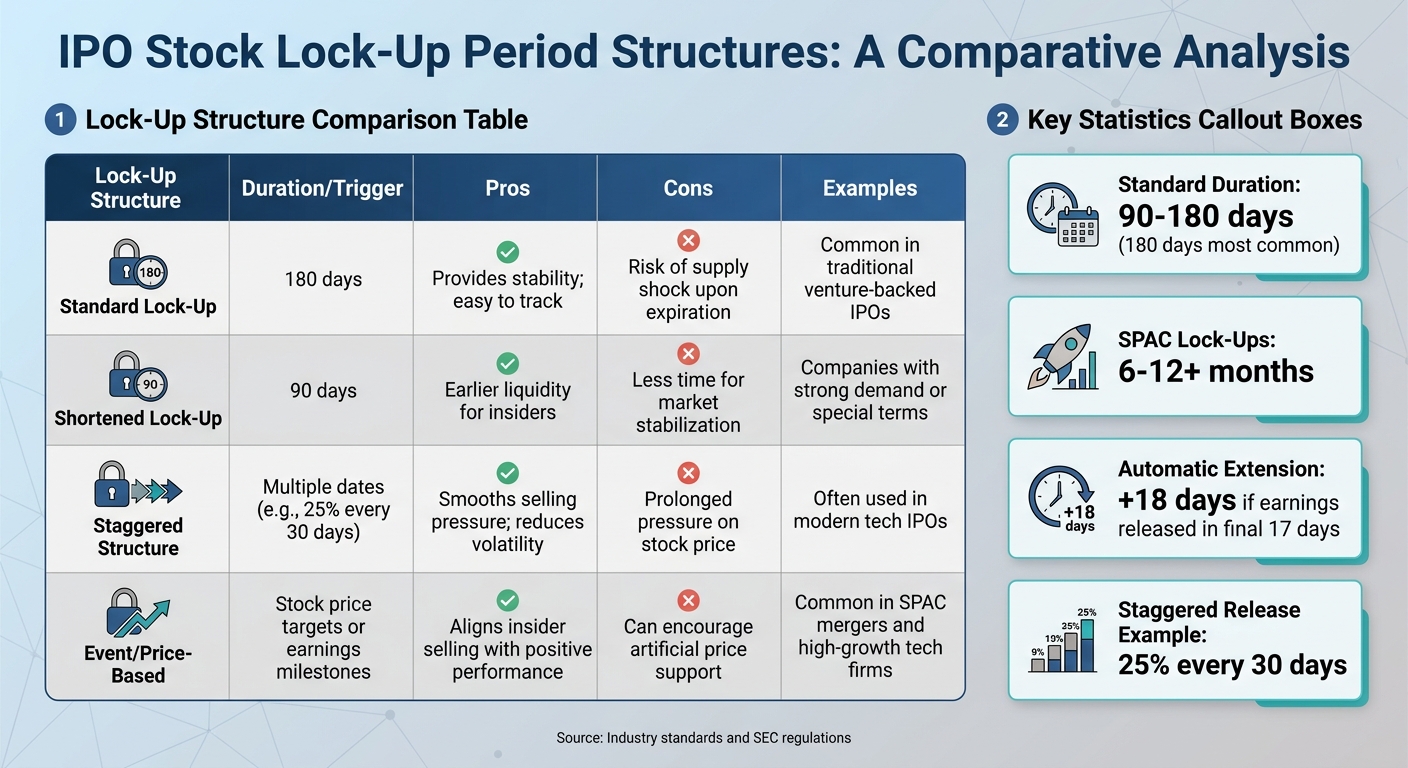
Lock-Up Period Structures and Impact on IPO Stocks
To better understand how lock-up agreements help manage market volatility, it’s essential to look at their durations and structures, which play a key role in shaping post-IPO market behavior.
Common Lock-Up Durations
Typically, lock-up agreements last anywhere from 90 to 180 days, with 180 days being the most common duration. Interestingly, this timeframe isn’t mandated by the SEC or federal law – it’s a negotiated term between the company and its underwriting investment bank.
Why 180 days? This period spans two earnings cycles, giving investors enough time to evaluate the company’s financial performance. As the LegalClarity Team puts it:
"The 180-day standard has become industry convention because it roughly spans two earnings cycles, giving investors enough financial data to form independent views on the company’s value."
Some agreements take a more flexible approach by staggering share releases. For example, 25% of shares might be sold every 30 days, which spreads out the selling pressure and avoids a sudden market shock. There are also event-triggered lock-ups, which shorten automatically if certain conditions – like the stock price maintaining a specific level – are met. These are especially common in SPAC mergers.
Additionally, many agreements include an automatic extension clause. If earnings or other significant news is announced during the final 17 days of the lock-up, the period extends by 18 days to account for the potential impact of that news.
For investors, these differences in lock-up structures can directly affect liquidity and stock price dynamics.
Lock-Up Structure Comparison
The structure of a lock-up agreement can significantly influence how the market reacts once the lock-up expires. Here’s a breakdown of the key types:
| Lock-Up Structure | Duration/Trigger | Pros | Cons | Examples |
|---|---|---|---|---|
| Standard Lock-Up | 180 days | Provides stability; easy to track | Risk of supply shock upon expiration | Common in traditional venture-backed IPOs |
| Shortened Lock-Up | 90 days | Earlier liquidity for insiders | Less time for market stabilization | Companies with strong demand or special terms |
| Staggered Structure | Multiple dates (e.g., 25% every 30 days) | Smooths selling pressure; reduces volatility | Prolonged pressure on stock price | Often used in modern tech IPOs |
| Event/Price-Based | Stock price targets or earnings milestones | Aligns insider selling with positive performance | Can encourage artificial price support | Common in SPAC mergers and high-growth tech firms |
In SPAC mergers, sponsor lock-ups often last longer than those in traditional IPOs, frequently extending 6 to 12 months or more. On the other hand, companies that choose direct listings instead of IPOs may skip lock-up periods entirely, allowing shareholders to sell their shares on the very first day of trading.
Each structure has its own advantages and trade-offs, making it crucial for investors to evaluate how these agreements might impact stock liquidity and price stability.
What Happens When Lock-Ups Expire
When a lock-up period ends, it can shake up market dynamics, often compelling investors to rethink their strategies.
Selling Pressure After Lock-Up Expiration
The end of a lock-up period often introduces a sudden influx of shares into the market. In venture-backed IPOs, this can mean over 50% of the company’s shares are newly available for trading. Early investors and employees, many of whom acquired shares at lower costs, may rush to sell, creating a supply-demand imbalance.
Research indicates that stock prices typically drop by 1%–3% – a decline that is often permanent – while trading volume can spike by around 40% following a lock-up expiration. In anticipation of this, traders may start selling early or increase short positions in the days leading up to the expiration.
A notable example is Shake Shack Inc. In July 2015, the company saw its stock price jump more than 30% after its first lock-up expiration, driven by a short squeeze.
Several factors can shape the market’s reaction. If prominent venture capitalists indicate they plan to hold onto their shares, the price drop may be less severe. Similarly, strong financial results can help attract institutional buyers, absorbing the extra supply. On the other hand, high levels of short interest can amplify volatility.
Beyond these price and volume changes, the issue of liquidity also plays a critical role in managing pre-IPO shares.
Limited Liquidity During Lock-Up Periods
During the lock-up, liquidity is tightly restricted. Typically, only about 20% of a company’s shares are publicly traded during this time. This limited float means early investors and employees are unable to sell their holdings, leaving them unable to diversify their portfolios or meet personal financial needs.
After the lock-up expires, liquidity improves, but some restrictions remain. For example, company affiliates – like directors and officers – are still bound by Rule 144. This rule caps their sales at 1% of outstanding shares or the average weekly trading volume over the prior four weeks. Non-affiliates who have held shares for at least six months, however, are generally free of these volume limits.
Investors should pay close attention to Form 144 filings in the days before the lock-up ends. A surge in these filings from company insiders could signal upcoming sales activity. Additionally, if earnings are released late in the lock-up period, the expiration could be delayed by 18 days.
The combined effects on price and liquidity highlight the need for investors to carefully analyze lock-up terms and prepare for the changes that follow.
How to Manage Lock-Up Periods as an Investor
Navigating lock-up periods effectively can help you make the most of your pre-IPO investments. By understanding the terms and planning ahead, you can avoid costly mistakes and take advantage of opportunities once the restrictions lift.
Reviewing Lock-Up Terms Before IPO
Before making an investment, it’s crucial to examine the S-1 filing available on the SEC’s EDGAR database. Pay close attention to the "Shares Eligible for Future Sale" section and the underwriting agreement exhibit. These documents outline key details, including the exact expiration date, the number of shares being released, and any conditions that might extend the lock-up period.
One important detail to watch for is automatic extension clauses. For example, if the company releases earnings or other significant news within the final 17 days of the lock-up period, the restriction could be extended by an additional 18 days. Checking the earnings calendar can help you anticipate and plan for potential delays. Additionally, most agreements include restrictions on hedging, meaning you can’t sell, short-sell, or purchase put options against your locked shares during the lock-up period.
Once you’ve reviewed these terms, you can start crafting a strategy for when the lock-up period ends.
Strategies After Lock-Up Expiration
When the lock-up period expires, you have several options for managing your investments. One popular approach is setting up a 10b5-1 trading plan. These plans allow you to schedule sales in advance, which can protect you from insider trading allegations. However, under the SEC’s 2023 rules, officers and directors must wait 90 to 120 days after adopting a 10b5-1 plan before making their first trade. To avoid delays, it’s smart to establish these plans early.
If you’re considering selling immediately after the 180-day mark, be aware that this might result in short-term capital gains taxes. Holding your shares for more than a year can qualify you for lower long-term capital gains rates.
Another strategy is to stagger your sales over time. This approach can prevent a sudden influx of shares hitting the market, which might drive down the stock price. For large positions, secondary markets and over-the-counter (OTC) deals can provide liquidity without causing public market disruptions. Platforms like BeyondOTC specialize in matching buyers and sellers for pre-IPO and recently unlocked shares.
It’s also helpful to monitor Form 144 filings on the SEC’s EDGAR database. A surge in these filings before the lock-up expiration often signals that insiders are preparing to sell their restricted shares, which could lead to increased supply and potential price pressure.
Risk Management and Opportunity Comparison
If you’re concerned about market volatility or a potential price drop, derivatives like put options can help hedge your position. This strategy can be particularly useful if you’re not ready to sell but want to protect against downside risk.
Here’s a quick comparison of strategies to manage risks effectively:
| Strategy | Timing | Risks Mitigated | BeyondOTC Relevance |
|---|---|---|---|
| 10b5-1 Trading Plans | During Lock-Up | Insider trading allegations; emotional selling | Helps pre-IPO holders exit compliantly |
| Secondary Market Sales | During/After | Liquidity risk; price depreciation | Connects buyers and sellers for private transactions |
| Tax-Loss Harvesting | After Expiration | Capital gains tax liability | Improves net returns from pre-IPO investments |
| Monitoring Form 144 | Pre-Expiration | Market supply shock; price slippage | Offers insights for better timing of trades |
Lastly, consider diversifying your portfolio before the lock-up period ends. If your pre-IPO shares make up a large portion of your net worth, rebalancing after restrictions lift can help reduce your exposure to a single stock.
Conclusion: What Investors Need to Remember About Lock-Up Periods
Lock-up periods are agreements lasting between 90 and 180 days after an IPO that restrict insiders – like founders, employees, and venture capitalists – from selling their shares. While not required by the SEC, these restrictions are set by underwriters and companies to avoid overwhelming the market with shares and to help stabilize stock prices during the early trading period. This directly influences market volatility, liquidity, and overall investment strategies.
Once the lock-up period ends, it’s common to see increased selling pressure. Studies show that stock prices often drop 1%–3% immediately following the expiration, and companies may underperform by as much as 5.6% over the next six months. To anticipate this, you can monitor Form 144 filings on the SEC’s EDGAR database – an uptick in these filings usually signals that insiders are preparing to sell.
Planning ahead is crucial. Reviewing the S-1 filing and keeping an eye on Form 144 filings are key steps. The S-1 filing provides critical details like the exact expiration date, the number of shares being unlocked, and any automatic extension clauses that could delay the unlock by up to 18 days. For those looking to buy or sell shares during this time, platforms like BeyondOTC can connect buyers and sellers of pre-IPO and unlocked shares.
Lock-up expirations can also open doors for investors. If a company has strong fundamentals, the price dip caused by insider selling might offer a chance to buy shares at a lower price. On the other hand, if you already own shares, diversifying your portfolio and keeping an eye on short interest as the expiration date approaches can help you manage potential risks. Don’t overlook tax considerations – holding shares for over a year could qualify you for lower long-term capital gains tax rates instead of higher ordinary income rates.
FAQs
How can I find the exact lock-up expiration date for a specific IPO?
To pinpoint the lock-up expiration date for an IPO, start by reviewing the company’s IPO prospectus filed with the SEC. This document usually specifies the lock-up period, which typically lasts between 90 and 180 days. You can also turn to lock-up tracker databases, financial news websites, or IPO calendars. These sources often highlight upcoming lock-up release dates, offering a dependable way to stay informed about expiration timelines.
Can insiders sell before the lock-up ends, and what exceptions apply?
In rare situations, insiders may sell shares before the lock-up period ends, but this usually requires negotiating specific exceptions. For instance, a company might permit early sales if it faces an urgent need for capital. However, these cases are rare and come with strict conditions.
What should I watch for right before a lock-up expires?
As a lock-up expiration approaches, be prepared for possible drops in stock prices, increased market swings, and spikes in trading volume. When insiders sell shares, it can influence liquidity and put pressure on share prices. Keep an eye on these developments and consider how they might shape your investment decisions.