
KYC-gated DeFi pools are reshaping decentralized finance by combining compliance with institutional-level efficiency. These pools require identity verification (KYC) before allowing participation, ensuring only verified users can engage. By embedding regulatory checks directly into smart contracts, they create a safer space for institutions like banks and hedge funds to operate within decentralized systems.
Key highlights:
- Identity Verification: Users complete KYC off-chain and receive digital credentials (e.g., Soulbound Tokens or Verifiable Credentials) to access pools.
- Efficiency Gains: Permissioned pools reduce capital requirements (150–200% vs. 400%+ in public DeFi) and trading spreads (under 5 basis points).
- Privacy & Compliance: Tools like zero-knowledge proofs enable compliance without exposing personal data.
- Institutional Adoption: By Q1 2026, $47 billion in institutional assets flowed into DeFi, driven by regulatory clarity and robust risk controls.
These pools bridge decentralized systems and institutional needs, offering faster settlements, transparency, and legal safeguards while maintaining user control over assets.
How Permissioned Liquidity Works
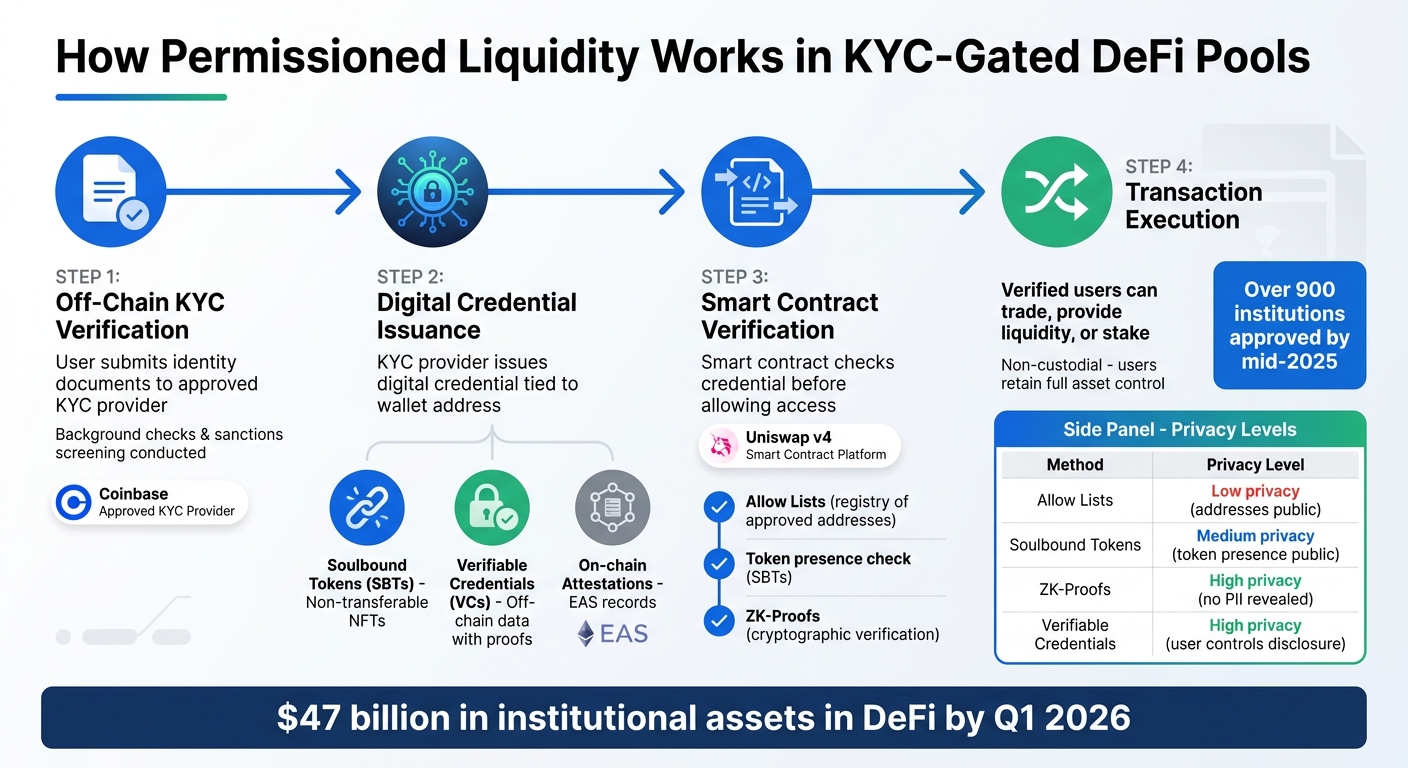
How KYC-Gated DeFi Pools Work: From Verification to Transaction
Permissioned pools operate through a multi-step process that combines off-chain identity checks with on-chain access control. First, users undergo KYC (Know Your Customer) verification with an approved provider. Once verified, they receive a digital credential – this could be a Soulbound Token (SBT), an on-chain attestation, or a Verifiable Credential (VC). These credentials are then checked by smart contracts before users can engage in trading or liquidity provision.
The technical setup can vary depending on the platform. For example, Coinbase Verified Pools on the Base network use the Ethereum Attestation Service (EAS) to record KYC status directly on-chain, while Uniswap v4 hooks trigger compliance checks based on these attestations. Liquid Collective employs an Allowlister smart contract to manage a registry of approved wallet addresses for ETH staking. Meanwhile, Keyring Connect uses zero-knowledge proofs (ZKPs) to verify institutional users, safeguarding $105 million in TVL by October 2025 without exposing sensitive personal data on-chain. Below, we’ll dive deeper into the off-chain and on-chain mechanisms that make this system work.
KYC Integration in DeFi
The process begins with off-chain identity verification. Users provide documents to a KYC provider, which conducts background checks and screens for sanctions. Once cleared, the provider issues a digital credential tied to the user’s wallet address.
On-chain access is managed through several mechanisms:
- Allow Lists: Smart contract registries that store approved wallet addresses.
- Soulbound Tokens (SBTs): Non-transferable NFTs minted to verified wallets, serving as digital badges recognized by smart contracts.
- Verifiable Credentials: These keep identity data off-chain, using cryptographic proofs to verify compliance without exposing personal information.
Uniswap v4’s hook system integrates compliance directly into liquidity pools. Before any transaction (like a swap or deposit) is executed, the hook checks if the wallet holds a valid KYC credential. Compliance oracles, such as Chainlink’s Automated Compliance Engine (ACE), allow smart contracts to query off-chain KYC databases and receive a simple yes/no response. Zero-knowledge proofs further enhance privacy by letting users prove eligibility (e.g., accredited investor status) without revealing raw personal data. By mid-2025, over 900 institutions had been approved across various permissioned platforms, highlighting the scalability of these solutions.
Balancing Decentralization with Compliance
Despite the gated access, permissioned pools maintain a non-custodial framework, allowing users to retain full control of their assets. For instance, Coinbase Verified Pools rely on decentralized AMMs like Uniswap v4 for settlement, ensuring no centralized entity can freeze funds or reverse transactions. This approach blends regulatory compliance with the core principles of DeFi.
On-chain attestations provide transparency without compromising privacy. While anyone can verify which addresses are approved, personal data remains off-chain. The KYC provider, or trust anchor, remains auditable and replaceable, preventing long-term centralization.
"The goal is not to abandon decentralization but to build bridges that allow regulated capital to flow safely into DeFi." – CryptoRank
Smart contracts automate compliance checks, eliminating the need for manual intervention. If a wallet lacks the required credentials, the transaction automatically fails – no human gatekeepers involved. This setup transforms compliance from a hurdle into an integrated feature of the protocol.
The level of composability depends on the implementation. For example, Liquid Collective’s LsETH token can circulate freely across DeFi, but only approved addresses can mint or redeem it. Other systems may restrict all transfers to verified participants. These rules are encoded transparently and enforced consistently by smart contracts.
| Gating Mechanism | Technical Implementation | Privacy Level |
|---|---|---|
| Allow Lists | Smart contract registry of approved addresses | Low – addresses are public |
| Soulbound Tokens | Non-transferable NFTs (SBTs) | Medium – token presence is public |
| ZK-Proofs | Cryptographic proofs of off-chain data | High – no PII revealed on-chain |
| Verifiable Credentials | Off-chain data with on-chain proofs | High – user controls data disclosure |
This hybrid model allows institutions to meet regulatory requirements while benefiting from DeFi’s advantages, like 24/7 settlement, transparent auditing, and automated execution. It demonstrates that compliance and decentralization can coexist within the same public infrastructure.
sbb-itb-7e716c2
Regulatory Drivers for KYC-Gated Pools
KYC-gated DeFi pools have emerged as a response to increasing regulatory scrutiny and the need for clearer legal frameworks. U.S. institutions, in particular, operate under the watchful eyes of the SEC, the Treasury, and other federal agencies. The risks associated with engaging anonymous wallets or platforms lacking strong anti-money laundering (AML) measures are simply too high for boards of directors to ignore. Below, we explore how AML and KYC regulations are shaping these protocols.
In July 2025, the U.S. government passed the GENIUS Act, marking a pivotal moment for stablecoins. This law introduced comprehensive federal oversight, requiring full reserve backing, transparency, and federal licensing for stablecoin issuers. These provisions elevated stablecoins to institutional-grade assets, further driving interest in regulated, permissioned platforms.
AML and KYC Compliance in DeFi
AML and KYC regulations are at the core of how permissioned pools operate. The U.S. Department of the Treasury’s DeFi Risk Review underscored how weak AML controls create vulnerabilities, allowing illicit funds to infiltrate the financial system. Protocols that fail to address these risks face "indirect shutdowns", where critical infrastructure like stablecoin issuers, bridges, or oracles stop interacting with them.
"The challenge isn’t whether to have compliance. It’s about how compliance frameworks can grow while keeping decentralization intact." – Phalcon Compliance, BlockSec Blog
The Digital Asset Market Clarity Act provided much-needed direction on counterparty verification, KYC standards, and reporting obligations, reducing uncertainties for institutional participants. Additionally, updated SEC custody rules clarified how institutions can meet fiduciary responsibilities and manage risks when dealing with digital assets. These developments have pushed platforms to embed identity verification, sanctions screening, and transaction monitoring directly into their smart contracts.
Securities law compliance adds another layer of complexity. Tokens resembling equity or debt instruments are treated as securities under U.S. law, meaning platforms must limit access to accredited investors or whitelisted institutions. Permissioned structures also enable the detailed, automated transaction histories required for tax reporting.
Building Institutional Confidence Through Regulation
This compliance-heavy approach doesn’t just deter illicit activity – it also fosters trust among institutional players. Regulatory clarity has been a cornerstone for building confidence, as demonstrated by initiatives like BlackRock‘s BUIDL fund and Aave‘s Aave Horizon. In late 2025, BlackRock launched the BUIDL fund via Securitize on Ethereum, using permissioned tokens restricted to investors who pass KYC/AML checks. Similarly, Aave Horizon introduced a market for institutional participants to use tokenized real-world assets as collateral for borrowing stablecoins.
The numbers speak for themselves. In 2025, permissioned stablecoin strategies delivered returns of 8–15%, far outpacing U.S. Treasury yields of 2–4%. Meanwhile, GUSD token minting exceeded 171 million units. This shift highlights how regulatory clarity has made DeFi participation both attractive and legally viable.
"Institutional migration to permissioned pools is a necessity." – CryptoRank
The industry is also transitioning from a "Know Your Customer" model to a "Know Your Transaction" approach. Instead of relying solely on identity checks, platforms now use on-chain analysis to monitor fund flows and identify links to sanctioned entities or hacks. This balance between compliance and operational efficiency allows institutions to meet legal requirements while preserving the speed and transparency that make DeFi so appealing.
Benefits and Use Cases for Institutions
Risk Mitigation and Legal Compliance
KYC-gated pools provide institutions with a way to earn on-chain yields while minimizing legal risks. By ensuring that all participants are whitelisted and verified, these pools eliminate interactions with anonymous or sanctioned wallets. This level of counterparty verification helps institutions avoid pitfalls like unintentional money laundering or sanctions violations, which could lead to regulatory penalties or damage to their reputation.
The numbers back this up: in 2025, permissioned institutional protocols accounted for just $67 million of the $1.4 billion lost in DeFi exploits. Additionally, on-chain analytics show that only 0.34% of DeFi volume involved illicit actors, compared to 0.15% for centralized exchanges. Institutions operating in these permissioned environments also benefit from higher collateral buffers than retail platforms, offering a cushion against market volatility.
"Aave Arc allows institutions to interact with the Aave Protocol the same way any other user would, but on their own separate and permissioned liquidity pool where every user has been verified." – Stani Kulechov, Founder & CEO, Aave
These permissioned pools integrate advanced features like robust custody solutions, insurance, and automated audits, helping managers meet their fiduciary responsibilities while leveraging DeFi. Tools like the Ethereum Attestation Service provide real-time sanctions screening, ensuring compliance at all times. Plus, detailed transaction histories make tax reporting and regulatory disclosures much easier.
This combination of risk controls and compliance measures creates a secure foundation for institutions to deploy large-scale liquidity confidently.
Institutional Liquidity Provisioning
With enhanced risk controls in place, institutions are now deploying billions of dollars in on-chain liquidity, all while maintaining compliance. By Q1 2026, institutional assets in DeFi protocols surged to $47 billion, with major financial players actively managing significant sums.
For example, Goldman Sachs processes around $2.4 billion monthly using Aave Arc’s permissioned pools. JPMorgan’s Onyx Digital Assets platform handles $1.7 billion daily in tokenized repo transactions, while Fidelity Digital Assets oversees $14 billion in staked Ethereum across more than 4,200 institutional clients. These figures show the scale of real institutional capital being managed through these systems.
To ensure operational security, institutions rely on advanced infrastructure like MPC wallets, hardware modules, and secure RPC nodes. For large transactions, private mempools and MEV protection tools – such as Flashbots Protect – are used to prevent front-running and slippage. In 2025 alone, MEV protection saved institutions an estimated $890 million by mitigating exploitation on large transactions.
"We spent $3.2 million building our DeFi infrastructure, but it paid for itself within 7 months through yield optimization and reduced operational overhead compared to traditional fixed income operations." – Head of Digital Assets, European Asset Manager
In Q1 2026, Arrakis Finance managed $1.4 billion in institutional liquidity spread across 47 vaults. Their USDC/USDT vault, which uses Uniswap v3’s concentrated liquidity, achieved a 14.7% APY with a maximum drawdown of just 0.3%. This performance not only outpaces traditional fixed-income returns but also demonstrates how compliance frameworks can support institutional-grade risk management.
These real-world examples highlight how institutions are successfully navigating the DeFi space.
Examples of KYC-Gated Platforms
Several platforms illustrate how compliance and liquidity provisioning work together to create institutional-grade solutions. In January 2022, Fireblocks introduced Aave Arc, a permissioned version of the Aave V2 protocol. Acting as the initial whitelister, Fireblocks approved 30 licensed financial institutions to participate as suppliers, borrowers, and liquidators. By March 2026, Aave Arc managed $8.7 billion in deposits across 31 whitelisted institutions, with an average yield of 3.2%. Its conservative approach – maintaining an average loan-to-value ratio of 42% compared to 67% for retail Aave – resulted in zero liquidations during the March 2023 banking crisis and the USDC depeg.
Coinbase also launched Verified Pools on the Base network, leveraging Uniswap v4’s hook architecture to create permissioned liquidity pools. These pools require participants to hold "Coinbase Verifications" – on-chain attestations through the Ethereum Attestation Service that confirm KYC completion and sanctions screening. Despite being non-custodial, these pools maintain trade eligibility and compliance.
| Protocol | TVL (March 2026) | Yield | Custody |
|---|---|---|---|
| Aave Arc | $8.7B | 3.2% | Fireblocks MPC |
| Compound Treasury | $4.2B | 3.7% | Anchorage Segregated |
| Maple Finance | $1.9B | 8.4% | Self-custody |
| TrueFi | $1.4B | 7.2% | BitGo Qualified |
Aave Arc also introduced an innovative "guardian" role, allowing whitelisters to veto proposals that could conflict with regulatory requirements. This hybrid approach blends decentralized protocol technology with centralized compliance, giving institutions access to DeFi benefits while ensuring regulatory alignment.
"We’re bringing the world of DeFi to the institutions because they can’t come to it in its decentralized form. It’s a hybrid solution and puts the protocol and all the interesting things it does as a centralized gateway to the protocol." – Jason Allegrante, Chief Legal and Compliance Officer, Fireblocks
Using KYC-Gated Pools in OTC Trading
KYC-gated pools bring a new level of efficiency to OTC trading by combining enhanced liquidity with streamlined execution. This approach underscores the growing role of permissioned liquidity in DeFi.
Facilitating Large-Volume Transactions
Large institutional trades often face challenges like price slippage or front-running. KYC-gated pools solve this by enabling trades in controlled environments with pre-verified participants. These "off-book" trades minimize the market impact typically seen when large orders hit public decentralized exchanges.
Modern OTC desks now serve as hybrid liquidity managers, combining traditional centralized sources with permissioned DeFi pools to secure better pricing. For example, when an institution needs to execute a high-value trade, liquidity can be pulled from multiple KYC-gated pools using tools like concentrated liquidity AMMs in Uniswap v4. This approach reduces slippage and allows for faster trade settlements – often available 24/7 – all while ensuring assets remain under the client’s control or in regulated safekeeping until the transaction is complete.
"The future of institutional trading lies in smart liquidity orchestration – where OTC and on-chain liquidity coexist to deliver better pricing, faster settlement, and reduced operational friction." – FinchTrade
Privacy and compliance are also critical. Zero-Knowledge Proofs (ZKPs) allow institutions to prove compliance without disclosing sensitive transaction details. For instance, Ripple’s "Credentials", introduced in September 2025, link to Decentralized Identifiers (DIDs) on the XRP Ledger. This system enables trusted issuers to verify a participant’s KYC status while supporting secondary markets for real-world assets and FX. By then, the XRP Ledger had surpassed US$1 billion in monthly stablecoin volume, largely driven by institutional settlement use cases.
Controlled environments also ensure compliance with sanctions. Features like "Deep Freeze" allow issuers to block flagged accounts instantly, reinforcing adherence to regulatory requirements. These frameworks thrive on robust capital participation, making them essential for institutions navigating this space.
Advisory Strategies for Institutional Clients
Efficient trade execution is just the beginning. Advisors play a pivotal role in helping institutional clients maximize their participation in this evolving landscape.
First, advisors should guide clients toward OTC desks with strong regulatory credentials. Providers registered with organizations like the SEC, FINMA, or FCA and with a proven history of handling high-value transactions offer the necessary oversight. For example, BeyondOTC connects clients with established OTC desks, institutional investors, and liquidity providers, all while maintaining rigorous KYC/AML standards.
Establishing a reliable identity infrastructure is equally important. Clients need reusable KYC credentials that work seamlessly across multiple permissioned pools. Decentralized Identifiers (DIDs) and on-chain attestations, such as those supported by the Ethereum Attestation Service (EAS), are key. Coinbase Verified Pools, launched on the Base network in early 2026, require participants to hold Coinbase Verifications – on-chain attestations registered in EAS – allowing regulated entities to trade with verified counterparties in a non-custodial environment.
Advisors should also encourage clients to use RFQ systems to streamline trade cycles and improve execution speed for large trades. Pools built on concentrated liquidity AMMs are especially effective at optimizing capital efficiency and minimizing slippage. Keyring Connect’s success with ZK-based verification further highlights the value of these technologies.
Finally, selective disclosure through ZKPs is a must. Clients should only reveal necessary attributes – like jurisdiction or accreditation status – without exposing sensitive data. This approach ensures compliance with regulations like GDPR while maintaining privacy. When advising on settlement options, platforms offering flexible arrangements can help optimize post-trade workflows and custody solutions.
"For institutions, regulatory compliance is not an optional layer, it is the gateway to adoption." – Team Ripple
Conclusion
KYC-gated DeFi pools are reshaping how institutions approach decentralized finance. By integrating identity verification and AML screening directly into smart contracts, these permissioned pools tackle the compliance and counterparty risks that have historically discouraged traditional capital from entering the DeFi space. The numbers speak volumes about the impact regulated capital can have on DeFi.
These pools bring tangible benefits: they shrink trading spreads from over 1,000 basis points in public DeFi to under 5 basis points for large institutional trades. They also improve capital efficiency, operating at 150–200% efficiency compared to the 400%+ over-collateralization typically seen in anonymous pools. Additionally, private mempools cut extractable value loss through MEV protection by 99%.
"Permissioned liquidity is where the efficiency of DeFi meets traditional finance’s regulatory safeguards, enabling efficient institutional participation." – Reef Chain News
OTC desks and advisors are also finding value in these pools, as they combine streamlined blockchain settlements with robust compliance measures. This ensures real-time settlement, transparent audit trails, and legal recourse – all while maintaining DeFi’s technological advantages. Importantly, zero-knowledge proofs enable privacy-preserving compliance, allowing institutions to verify credentials without revealing sensitive on-chain data.
The regulatory environment is also evolving to support these developments. Frameworks like the GENIUS Act of 2025 in the United States, MiCA in Europe, and VARA in Dubai have established clear guidelines, making permissioned pools not just an option but a necessity for regulated entities. As this infrastructure continues to mature, KYC-gated pools are set to bridge the gap between decentralized innovation and institutional requirements, proving that compliance and progress can work hand in hand. This alignment paves the way for wider institutional participation in the DeFi ecosystem.
FAQs
What gets stored on-chain after I pass KYC?
After completing KYC, only cryptographic proofs of your identity verification and eligibility are stored on-chain. This approach ensures compliance with regulations while safeguarding your personal information and privacy.
Can I use one KYC credential across multiple pools?
Yes, it’s possible to use a single KYC (Know Your Customer) credential across multiple permissioned DeFi pools. Onchain attestations, like Coinbase Verifications, make this process seamless. These attestations allow you to leverage the same verified identity to access several pools, eliminating the hassle of undergoing separate verification for each one. This approach simplifies participation and saves time for users.
How do KYC-gated pools prevent front-running and MEV?
KYC-gated pools help tackle front-running and MEV (Maximal Extractable Value) by restricting access to verified participants only. This approach limits the transparency that bots and front-runners typically exploit. These pools often incorporate privacy-focused features, such as private pools or protected RPC endpoints, to keep transaction details hidden from public mempools. By doing so, they make it significantly harder for MEV bots to track and manipulate trades.