
Stablecoins have emerged as a powerful tool for treasuries managing over $10 million, offering annual yields of 4–10% without the volatility of traditional crypto assets. With the stablecoin market now exceeding $312 billion and backed by regulatory clarity from the GENIUS Act of 2025, institutions can now safely leverage stablecoins for liquidity, efficiency, and higher returns compared to traditional banking options. Key platforms like Aave, Compound, and Curve offer tailored solutions for yield generation, while compliance and risk management ensure capital preservation.
Key Takeaways:
- Yields: Stablecoin yields range from 3–15% depending on strategy risk.
- Regulation: The GENIUS Act mandates 1:1 reserves and monthly attestations for stablecoins, enhancing trust and compliance.
- Platforms: Aave ($20B+ liquidity), Compound (regulatory focus), and Curve (swap efficiency) are top choices for institutional treasuries.
- Risk Management: Diversify across protocols and stablecoins, limit exposure to 40% per protocol, and monitor liquidity thresholds.
- Compliance Costs: Annual costs for regulatory compliance range from $96,000 to $720,000 depending on allocation size.
For treasuries, stablecoins provide a compelling alternative to idle cash, transforming unallocated funds into a reliable income source with proper strategy and safeguards.
Stablecoin Yields Strategy Guide💰How To Beat Your Bank with Passive Income🚨
sbb-itb-7e716c2
Risk-Adjusted Yield Benchmarks for Stablecoins
In today’s stablecoin market, the landscape for treasuries exceeding $10 million has shifted significantly. Gone are the days of easy double-digit returns, which ended in 2025. Instead, the market has settled into a more measured rhythm. By late April 2026, the Stablewatch Benchmark 7-day APY for stablecoins was 3.97%, a figure that reflects the maturity of a market now driven by institutional demand rather than speculative leverage.
Institutional yield strategies are typically categorized into four distinct risk tiers:
- Tier 1: Low-risk strategies like tokenized Treasury bills and vetted protocols such as Aave offer yields in the range of 3–5% APY.
- Tier 2: Moderate-risk strategies, including efficiency-focused lending vaults, deliver slightly higher returns of 5–8% APY.
- Tier 3: Higher-risk approaches like basis trading or using Pendle PT tokens can generate 8–15% APY but require active management.
- Tier 4: High-risk, complex strategies like recursive looping can exceed 15% APY but are generally unsuitable for core treasury allocations due to their elevated risk profile.
This tiered framework highlights how the origin of yields – whether structural or circular – plays a crucial role in determining their sustainability.
Structural vs. Circular Yields
Understanding the difference between structural and circular yields is key. Structural yields are backed by genuine borrower demand. For example, Morpho‘s deposits surged from $5 billion to $13 billion in 2025 as fintech companies like Coinbase sought Bitcoin-collateralized loans. These yields are more sustainable over time. Circular yields, however, rely on temporary protocol incentives and can drop sharply once those incentives fade. Ethena’s sUSDe yield, for instance, plummeted from double digits to 3.72% in 2026 as funding rates normalized.
For treasury allocations of $10 million, structural yields can generate annual returns between $400,000 and $900,000, far outpacing the $50,000 to $150,000 typically earned from traditional bank deposits.
The Role of Protocol Maturity
The maturity of a protocol is another critical factor, especially for large-scale allocations. Consider Aave: its reduced target borrow rate – from 9.50% to 6.50% – and its proven track record make it a reliable choice for institutions. With $20 billion in stablecoin deposits and years of operational history, Aave benefits from the Lindy effect, which emphasizes the strength of long-standing and efficient protocols.
As Aiden Bristow, Head of Fintech and Institutional Partnerships at Gauntlet, explains:
"For the first time, this cycle is very institutionally driven as opposed to retail driven… the second prices go down you just see kind of adoption drop off a cliff – that’s just not what’s happening here."
Regulatory Impact on Yield Benchmarks
Regulation has also played a pivotal role in shaping yield benchmarks. The GENIUS Act, passed in July 2025, brought significant clarity to the market. In its wake, over 200 institutional players deployed $4.7 billion into compliant stablecoin yield strategies. Regulatory guidelines now separate non-yielding payment stablecoins from yield-bearing ones, requiring treasuries to ensure their holdings qualify as liquid assets for compliance purposes. This clarity has created a yield premium of 100–400 basis points over traditional financial instruments.
These developments underscore how institutional demand, protocol reliability, and regulatory clarity are reshaping the stablecoin yield landscape.
Platforms for Stablecoin Yield Strategies
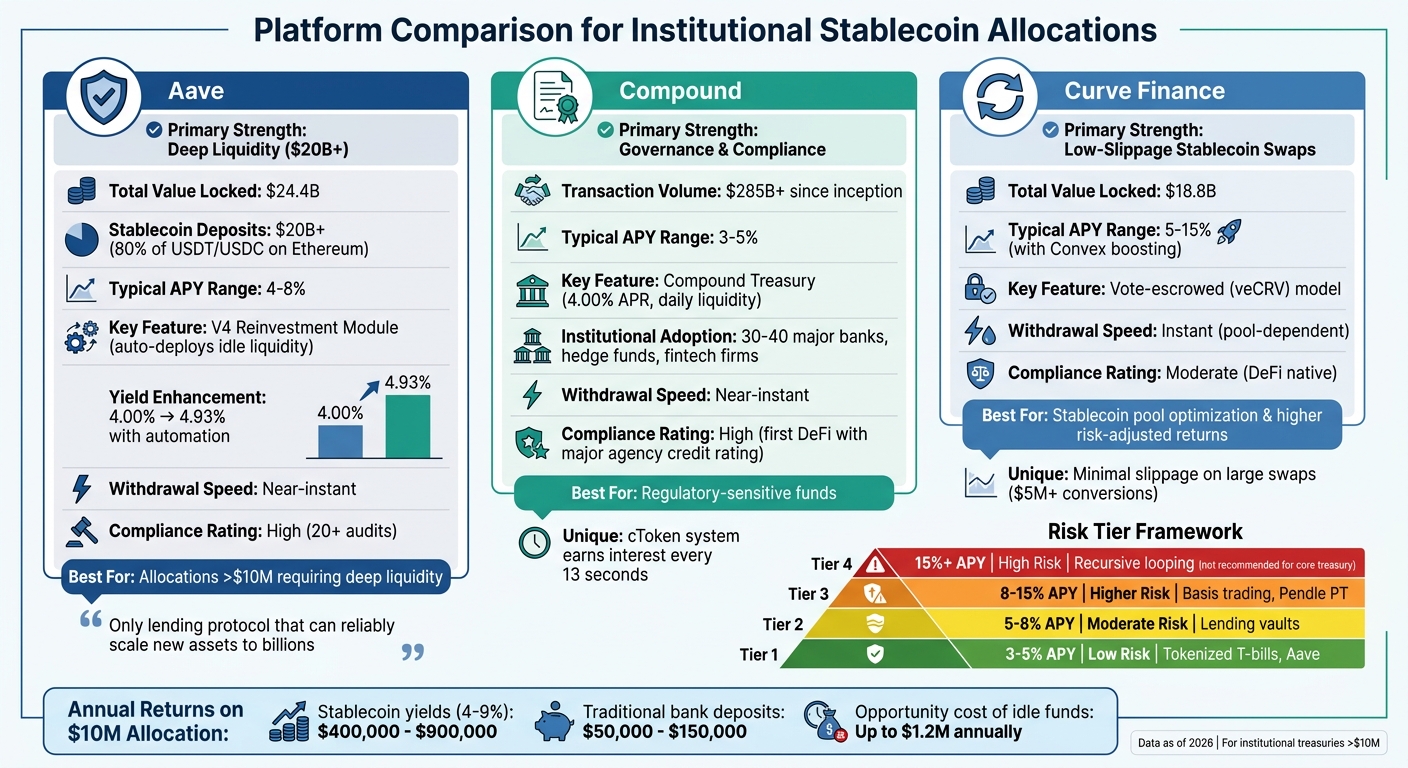
Stablecoin Yield Platform Comparison for Treasury Allocations Over $10M
For treasuries managing over $10 million, choosing the right platform comes down to critical factors like liquidity, withdrawal efficiency, and institutional-grade security. By 2026, the market has streamlined, with three key protocols dominating large-scale stablecoin allocations. These platforms cater to institutional needs, offering diversified yield options alongside compliance and speed.
Aave: Liquidity Powerhouse with Institutional Focus
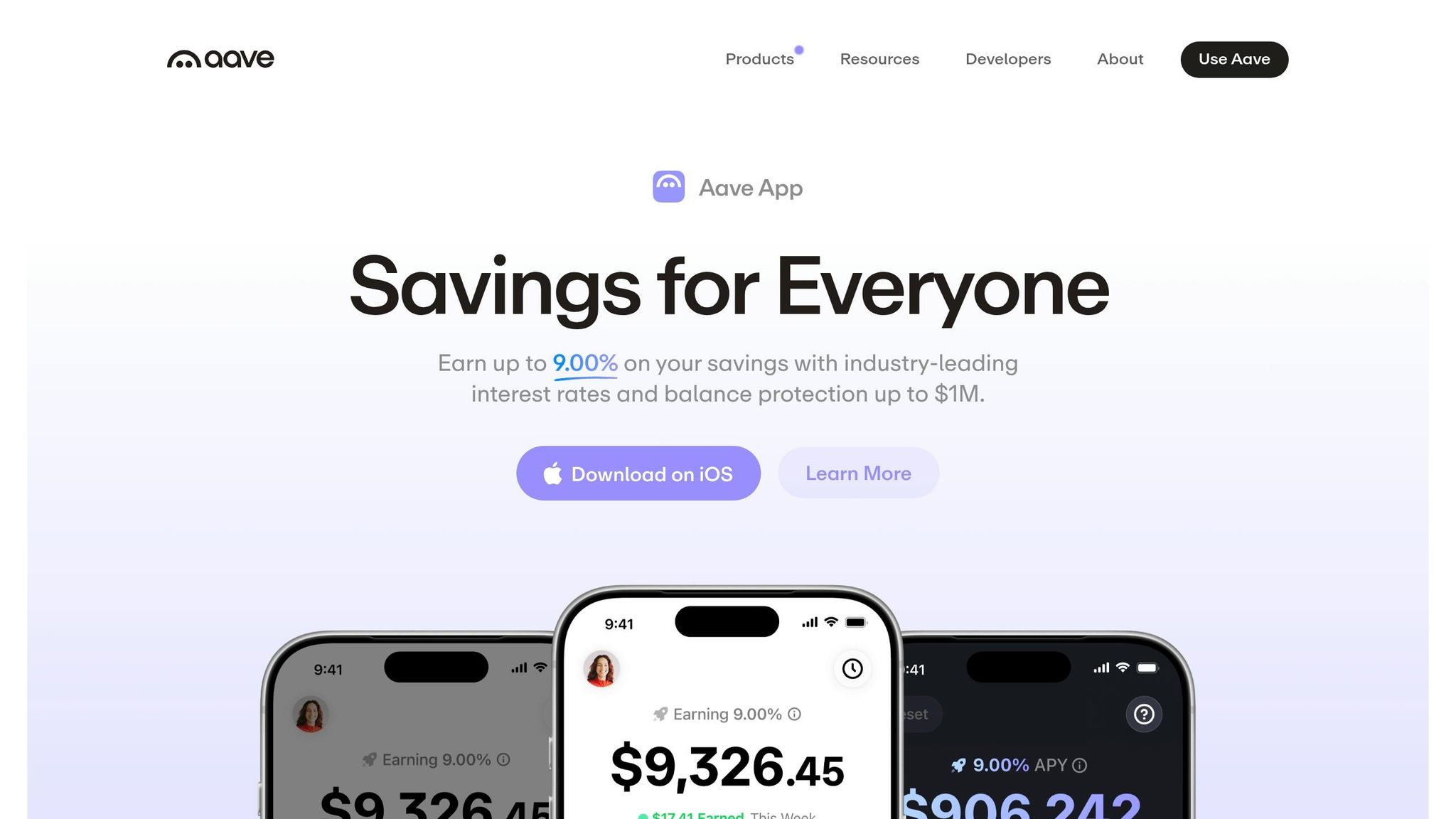
Aave has cemented itself as a leader in institutional lending, managing over $20 billion in stablecoin deposits and controlling 80% of USDT and USDC liquidity on Ethereum. Ripple‘s NYDFS-approved RLUSD, launched in December 2024, saw its supply multiply to $1.3 billion by the end of 2025, with nearly two-thirds deposited on Aave. Similarly, when PayPal‘s PYUSD became collateral-enabled in October 2025, its supply jumped by 50% to $3.6 billion, with $400 million flowing directly into Aave.
Aave’s appeal for treasuries managing $10 million or more lies in its advanced features. The V4 Reinvestment Module automatically deploys idle liquidity into pre-approved, low-risk strategies, potentially increasing yields from 4.00% to 4.93% for large-scale allocations. Additionally, Efficiency Mode enhances capital utilization by allowing higher loan-to-value ratios for stablecoin transactions.
"Aave is the only lending protocol that can reliably scale new assets to billions of dollars in liquidity." – Aave Labs
Aave’s risk management framework is another standout feature. For instance, when Paxos accidentally minted 300 trillion PYUSD in October 2025, Aave’s risk stewards acted swiftly, freezing markets to prevent disruptions and maintain stability.
Compound: Transparent Governance and Reliable Yields
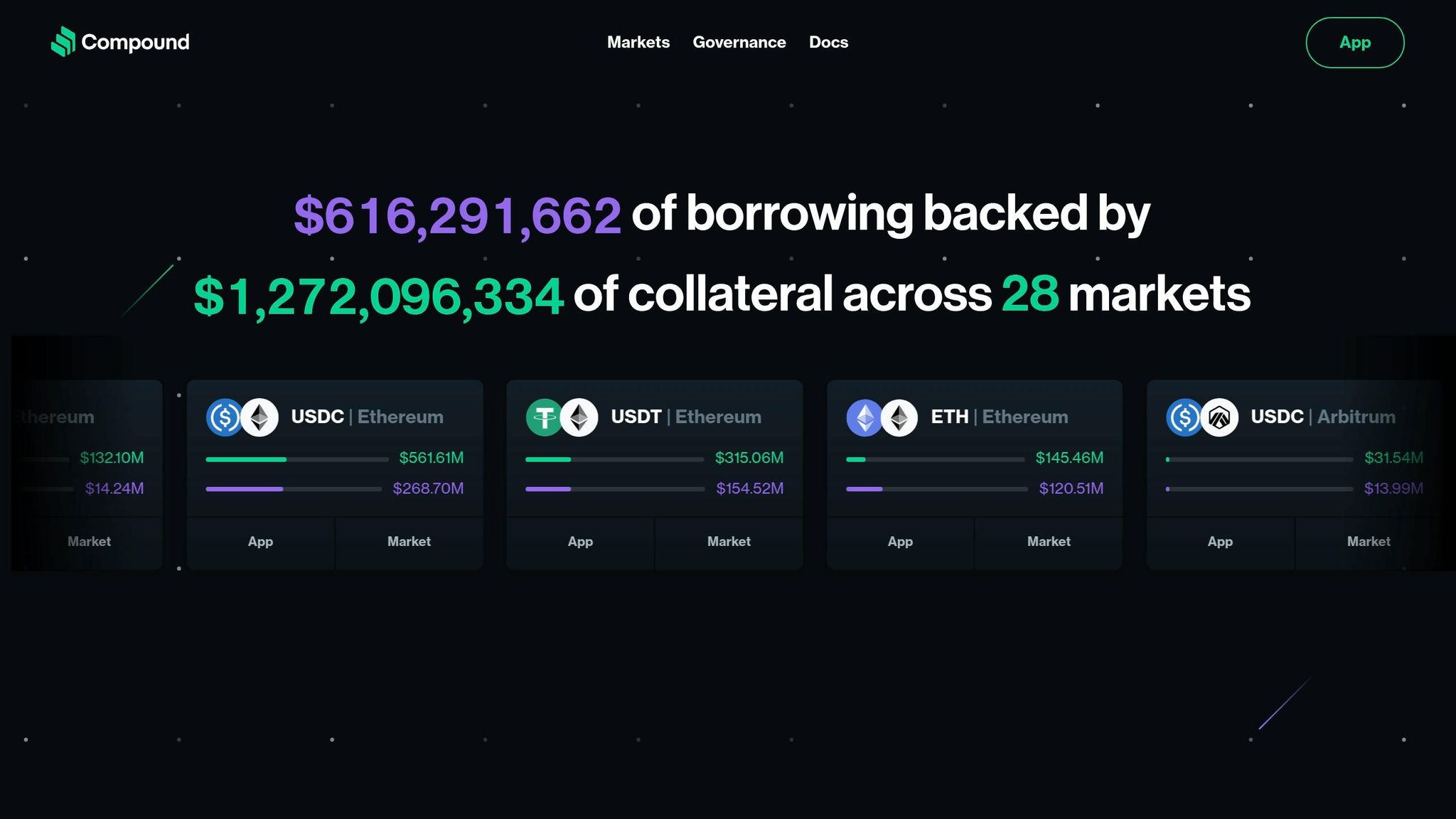
Compound has emerged as a preferred choice for organizations prioritizing regulatory alignment and governance transparency. Its cToken system ensures stablecoins earn interest automatically with every Ethereum block. Since its inception, Compound has handled over $285 billion in transaction volume.
One of its most attractive offerings is Compound Treasury, which provides a professional-grade service with a 4.00% APR on USD and USDC, coupled with daily liquidity. This has drawn participation from 30–40 major banks, hedge funds, and fintech firms looking for DeFi returns while adhering to compliance standards. Notably, Compound Treasury was the first DeFi entity to secure a major agency credit rating.
"Compound enables organizations to generate returns while keeping complete oversight of their assets via cTokens that compound interest automatically every 13 seconds." – Alex, Researcher at Stablecoin Insider
Compound’s algorithmic interest rate model adjusts dynamically to ensure constant liquidity, making it a reliable option for treasuries. Yields typically range from 3% to 5%, offering a balance of compliance and institutional-grade infrastructure.
Curve: Optimized Liquidity for Stablecoin Swaps
Curve Finance specializes in stablecoin-to-stablecoin swaps, delivering deep liquidity and minimal slippage for large-scale transactions. With $18.8 billion in Total Value Locked, pools like 3pool and fraxBP are tailored for institutional-scale operations.
The protocol’s vote-escrowed (veCRV) model incentivizes liquidity concentration, and when paired with Convex Finance, yields can climb to 5–15%. Without these additional incentives, base yields tend to be more modest. Curve’s ability to handle large swaps – such as converting $5 million from USDC to USDT with minimal slippage – offers execution quality that centralized exchanges often struggle to match.
Curve works best as part of a layered yield strategy. Institutions can deposit stablecoins into Curve pools, stake LP tokens on Convex Finance, and earn both trading fees and enhanced rewards. This approach suits treasuries seeking higher risk-adjusted returns, complementing the broader discussion on risk tiers rather than focusing solely on capital preservation.
| Protocol | Primary Strength | Key Feature | Typical Stablecoin APY |
|---|---|---|---|
| Aave | Deep liquidity ($20B+) | Aave Horizon (RWA Market) | 4–8% |
| Compound | Governance & compliance | Compound Treasury (KYC/AML) | 3–5% |
| Curve | Low-slippage stablecoin swaps | Convex Yield Boosting | 5–15% |
BeyondOTC: OTC Solutions for Institutional Stablecoin Management

BeyondOTC takes institutional stablecoin management to the next level by combining advanced yield strategies with customized OTC execution solutions.
For institutions handling $10 million or more in stablecoins, precise execution is just as important as generating yield. BeyondOTC connects these institutions with liquidity providers through a solver network model. In this setup, independent solvers compete in sealed auctions to execute trades, ensuring optimal pricing by tapping into global inventory instead of relying solely on a single desk’s holdings.
All trades settle atomically on-chain, meaning the output asset is delivered on the destination chain at the exact moment the input asset is sent – or the transaction is reversed entirely. This process eliminates counterparty credit risk. For large trades, programmable escrow is available, allowing funds to continue earning yield for both parties during the settlement period under mutually agreed terms.
"At $1M+ ticket sizes, execution is a critical component of treasury P&L and counterparty exposure." – Eco
TVL Funding Advisory and Tailored Solutions
BeyondOTC also offers TVL (Total Value Locked) funding advisory to help institutional clients allocate funds in DeFi while preserving capital efficiency. Their approach organizes liquidity into tiered buckets:
- Tier 1: Immediate liquidity.
- Tier 2: Yield opportunities with 24-hour withdrawal windows.
- Tier 3: Long-term, higher-yield strategies.
For operational float ranging from $5 million to $50 million, BeyondOTC deploys funds into protocols like Aave or Morpho, achieving 6–9% APY while maintaining instant access to liquidity. To put this into perspective, a desk holding $10 million in idle float could lose between $600,000 and $900,000 annually in missed yield opportunities. Automated sweeps transfer surplus funds into yield-generating protocols every few hours, while individual protocol exposure is capped at 60% to reduce smart contract risk.
KYC/AML Oversight for Large-Scale Transactions
For transactions exceeding $10 million, Enhanced Due Diligence (EDD) is required under 2026 regulatory standards. BeyondOTC integrates FATF-aligned Travel Rule solutions to ensure compliance for both domestic and international transfers, providing full audit trails and real-time monitoring in line with GENIUS Act requirements.
Liquidity Management and Capital Preservation
When it comes to treasury allocations, managing liquidity effectively and preserving capital are just as crucial as employing advanced yield strategies.
Treasury holdings can be divided into four main categories: operational reserves (40%), settlement float (30%), liquidity buffer (20%), and market-making inventory (10%).
A key metric to monitor is the hot wallet threshold, which should cover peak 24-hour withdrawals. Historical data suggests this typically falls between 15% and 25% of total balances. To ensure efficiency, automate the monitoring of these thresholds and redeem funds from yield protocols whenever liquid balances drop below predetermined levels.
To minimize risk, avoid allocating more than 40% of capital to any single protocol. Diversification is also essential – allocate across at least 2–3 stablecoin types, such as USDC, USDT, PYUSD, and USDS, and limit exposure to any single issuer to 40–50% of the total.
Set up triggers to redeem funds immediately if a stablecoin’s peg deviates by more than 0.5% from $1.00. Similarly, implement systems to automatically redeem funds if a protocol’s utilization rate exceeds 85%, as this can lead to illiquidity and withdrawal delays.
This structured approach to liquidity management complements yield strategies, ensuring capital is safeguarded while optimizing returns. These safeguards, paired with automated triggers, are particularly effective for treasury allocations exceeding $10 million.
Platform Comparison
The table below outlines how key platforms stack up in liquidity management features:
| Metric | Aave V3 | Compound V3 | Curve Finance |
|---|---|---|---|
| Liquidity Depth | Deepest ($12B+ TVL) | Moderate | High (Low slippage focus) |
| Typical APY Range | 3%–5% (USDC) | 3%–4% (USDC) | 5%–15% (Varies by pool) |
| Withdrawal Speed | Near-instant | Near-instant | Instant (Depends on pool balance) |
| Compliance Rating | High (Audited 20+ times) | High (Institutional focus) | Moderate (DeFi native) |
| Best Use Case | Allocations >$10M | Regulatory-sensitive funds | Stablecoin pool optimization |
For treasury allocations over $10 million, Aave V3 stands out with its deep liquidity and near-instant withdrawal options, making it a top choice for institutions. Compound V3 is ideal for regulatory-sensitive funds due to its streamlined governance and strong institutional adoption. On the other hand, Curve Finance offers higher yield potential through stablecoin pool liquidity but comes with increased risk from potential depegging in multi-asset pools.
Compliance and Reporting Standards for Institutional Treasuries
If your institution is deploying over $10 million in stablecoins, compliance with the GENIUS Act is non-negotiable. Signed into law on July 18, 2025, this act mandates that stablecoins maintain 1:1 reserves backed solely by high-quality liquid assets. These assets include U.S. Treasuries with maturities of 93 days or less, cash, or government money market funds.
"The GENIUS Act transformed stablecoin reserves from a ‘best practices’ aspiration into a strict legal mandate." – Chanté Eliaszadeh, Principal Attorney, Astraea Counsel
Institutions must also ensure transparency by verifying issuer reserves through monthly third-party attestations performed by registered public accounting firms. A notable example is Circle Internet Financial, which went public in June 2025 with $65.2 billion USDC in circulation. Circle holds 90% of its reserves in the Circle Reserve Fund (USDXX), a government money market fund registered with the SEC and managed by BlackRock. Deloitte & Touche LLP provides monthly attestations, setting the bar for compliance and transparency.
To stay audit-ready, treasury teams should reconcile daily on-chain activity with their ledger entries and supporting documents. A three-tier segregation model is recommended for managing funds effectively:
- Operating Cash: Funds for 0–30 days, kept in traditional bank accounts.
- Short-Duration Yield: Funds for 30–180 days, held in GENIUS Act-compliant stablecoins.
- Strategic Reserves: Funds for 180+ days, allocated to DeFi protocols with board approval.
This structured approach not only ensures compliance but also optimizes returns.
For KYC/AML compliance, transactions should be routed through Permitted Payment Stablecoin Issuers (PPSIs). These issuers must maintain strong sanctions programs and be equipped to block, freeze, or burn tokens when required by lawful orders. Additionally, the Travel Rule applies to transfers of $3,000 or more, requiring the collection and transmission of data about both the originator and the beneficiary. To enhance security, institutions should adopt multi-layered KYC procedures, including biometric verification and real-time monitoring to detect unusual activity, such as high transfer volumes or rapid wallet creation. These measures not only protect assets but also align with yield strategies.
Finally, compliance costs should be a key consideration in treasury planning. For allocations between $10 million and $100 million, monthly attestation fees range from $8,000 to $15,000, translating to annual costs of $96,000 to $180,000. For allocations exceeding $1 billion, annual compliance costs with Big Four accounting firms can climb to $360,000–$720,000. Factoring these expenses into your strategy is crucial for maintaining both compliance and financial efficiency.
Conclusion
Managing stablecoin treasury allocations over $10 million is a balancing act between maximizing returns and preserving capital. The tools to generate yields of 4–8% on idle funds are available today, but success hinges on selecting reliable platforms, enforcing strong risk controls, and adhering to regulatory standards.
When choosing platforms, institutions should focus on those with a solid track record and institutional-grade features. For example, Aave, with its $24.4 billion in total value locked, provides instant liquidity and transparent governance. Compound offers governance-driven yield opportunities, while Curve is ideal for optimizing stablecoin pools, particularly for large liquidity providers. For treasuries prioritizing regulatory clarity and same-day settlement, tokenized Treasury products like BlackRock’s BUIDL, which reached $2.9 billion in assets under management by June 2025, are emerging as a solid choice for conservative allocations.
Risk management is just as critical as platform selection. Institutions should limit exposure to any single protocol to 20–25% of total capital and maintain liquidity buffers covering 15–25% of potential peak withdrawals. To further mitigate risks, operational safeguards such as ring-fencing settlement and yield wallets can prevent disruptions in yield-generating activities. Automated alerts that trigger fund redeployment when protocol utilization exceeds 85% add an extra layer of protection. These strategies collectively ensure that idle funds are not just productive but also secure.
Infrastructure like BeyondOTC’s OTC solutions and KYC/AML oversight simplifies the deployment of large allocations. Their advisory services help structure yield strategies that blend instant-liquidity protocols with higher-yield options, while compliance automation ensures adherence to GENIUS Act requirements and the proper use of Permitted Payment Stablecoins.
The stakes are high – missing out on yields for idle stablecoin balances can cost institutions up to $1.2 million annually on a $20 million holding. By leveraging the right tools and strategies, institutions can turn idle capital into a reliable source of income without compromising settlement efficiency.
FAQs
Which stablecoins are safest for a $10M+ treasury allocation?
For treasury allocations surpassing $10 million, USDC and USDT stand out as the most reliable stablecoins. These two are among the largest and most commonly used, providing exceptional liquidity and strong security protocols. Their issuers also earn yield on reserves, which helps maintain stability and instills confidence for handling large-scale investments.
How do I split funds between liquidity and yield without risking withdrawals?
To manage liquidity and generate yield without compromising the ability to process withdrawals, it’s smart to segregate funds. Dedicate part of your treasury’s stablecoins to earning yield through low-risk platforms such as Aave or Compound, while keeping customer funds entirely liquid in separate wallets. Ensure withdrawal readiness by allocating idle stablecoins to protocols that offer fast withdrawal options, and maintain compliance by strictly separating these funds.
What risks can cause stablecoin yield to drop or fail suddenly?
Stablecoin yields aren’t guaranteed and can fluctuate – or even fail – due to a variety of risks. For starters, protocol issues can arise if platforms like Aave or Compound experience a collapse or see their value diminish. Then there’s market volatility, which can create liquidity challenges or lead to unexpected losses. On top of that, smart contract vulnerabilities or governance failures can expose investors to significant risks. Lastly, shifting regulatory landscapes can also disrupt yield stability.
Given these uncertainties, it’s crucial to conduct thorough due diligence and implement strong risk management practices – especially when managing large-scale treasury operations.