
Stablecoins are the backbone of DeFi, but when they lose their $1 peg (depegging), it can trigger major financial instability. For institutions managing large portfolios, this risk is critical. Recent examples, like USDC dropping to $0.87 in 2023 and USDe falling to $0.65 in 2025, highlight the dangers of liquidity mismatches, reserve mismanagement, and technical failures.
Key takeaways for managing stablecoin depeg risk:
- Diversify stablecoin holdings: Spread assets across fiat-backed, crypto-collateralized, and synthetic models to reduce correlated risks.
- Use hedging tools: Employ derivatives like perpetual swaps and put options to offset potential losses.
- Monitor risks in real time: Utilize platforms like DeFiLlama and Sentora for alerts on price deviations, liquidity issues, and whale movements.
- Adopt delta-neutral strategies: Balance long and short positions to minimize exposure while earning yield.
With stablecoin transaction volumes exceeding $33 trillion in 2025 and growing, institutions must prioritize these strategies to safeguard their portfolios.
How to Hedge Your Liquidity Pool Safely and Sustainably Using Perps
sbb-itb-7e716c2
Diversification Strategies for Stablecoin Holdings
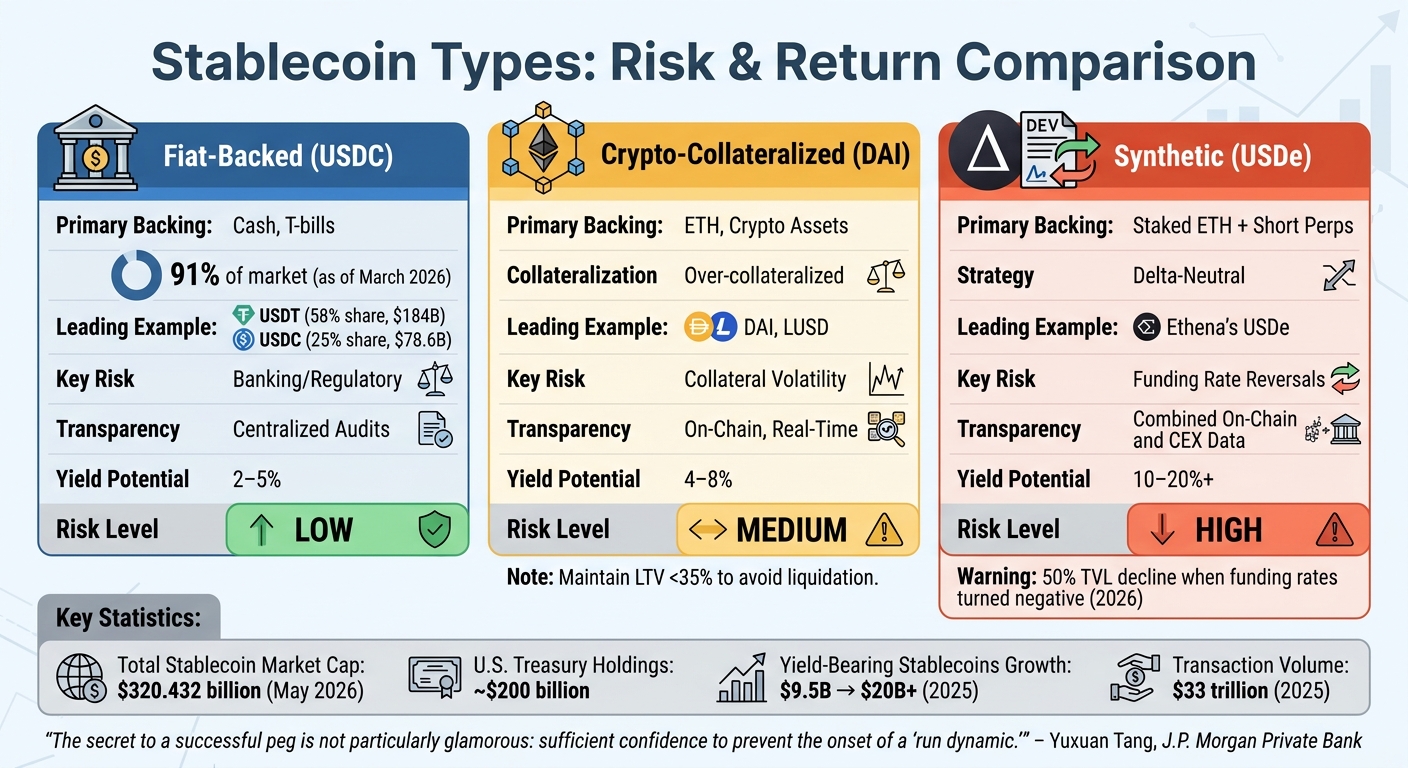
Stablecoin Types Comparison: Fiat-Backed vs Crypto-Collateralized vs Synthetic
To build a resilient portfolio of stablecoins, diversification involves more than just splitting assets between similar options like USDC and USDT. While this might look diversified on the surface, both coins share vulnerabilities tied to the banking system. True diversification means spreading risk across different collateral models, jurisdictions, and technical setups. This approach directly tackles the risks associated with stablecoin depegging.
Types of Stablecoins and Their Differences
Stablecoin depegging is a pressing concern, especially for institutions, making it essential to choose assets with varied risk profiles. Stablecoins generally fall into three categories, each with unique characteristics and challenges:
- Fiat-backed stablecoins: These include USDC and USDT, which dominate 91% of the market as of March 2026. Issued at a 1:1 ratio to reserves like cash, U.S. Treasury bills, or overnight repos, they offer high liquidity and regulatory clarity. However, they are centralized and exposed to risks like banking system failures. Tether (USDT) leads the market with a 58% share ($184 billion), followed by Circle’s USDC at 25% ($78.6 billion).
- Crypto-collateralized stablecoins: Examples like DAI and LUSD use on-chain assets, primarily ETH, locked in smart contracts. These are over-collateralized to handle market volatility, offering decentralization and transparency. However, they can face liquidation cascades during sharp price drops. Typically, collateral must be worth significantly more than the stablecoin issued.
- Algorithmic and synthetic stablecoins: These present the highest risks. Pure algorithmic coins adjust supply and demand without hard collateral, making them vulnerable to "death spirals" if confidence falters. Synthetic stablecoins, like Ethena’s USDe, use delta-neutral strategies (staked ETH with short perpetual futures) to maintain their peg. While efficient, they rely on positive funding rates and stable exchange conditions. For example, when funding rates turned negative in 2026, USDe’s yield dropped to 3.72%, leading to a 50% decline in total value locked (TVL).
"Stablecoins are the ‘cash layer’ of Web3… but ‘stable’ is a goal, not a guarantee." – BestWeb3Apps Guide
Each type of stablecoin has distinct failure risks. A banking crisis might impact USDC but leave DAI unaffected, while a smart contract exploit could destabilize DAI even if USDT remains steady. Similarly, regulatory actions could freeze onshore coins like USDC, while offshore options like USDT continue to operate.
How to Build a Diversified Stablecoin Portfolio
To mitigate correlated risks, institutions should allocate across different collateral models and platforms. Even the safest stablecoins can face losses due to platform failures. A well-balanced portfolio might include:
- Fiat-backed stablecoins: For liquidity and stability.
- Crypto-collateralized options: To benefit from decentralization and transparency.
- Synthetic models: For higher yield potential, with allocations adjusted to their risk levels.
Geographical diversification is just as important. Balancing exposure between regulated onshore stablecoins (like USDC and PYUSD) and offshore options (like USDT) can help counteract risks tied to regulations or banking disruptions. With stablecoins now holding around $200 billion in U.S. Treasury securities, their ties to traditional finance are evident.
When evaluating yield-bearing stablecoins, avoid being lured by high APYs without understanding the risks. Yield-bearing stablecoins grew from $9.5 billion to over $20 billion in 2025, but it’s vital to ask: What drives the yield? What are the risks? Are there clear exit strategies during stress? What is the audit and governance history? And does the risk premium justify exposure over the current 4.5% risk-free rate?
| Feature | Fiat-Backed (USDC) | Crypto-Collateralized (DAI) | Synthetic (USDe) |
|---|---|---|---|
| Primary Backing | Cash, T-bills | ETH, Crypto Assets | Staked ETH + Short Perps |
| Key Risk | Banking/Regulatory | Collateral Volatility | Funding Rate Reversals |
| Transparency | Centralized Audits | On-Chain, Real-Time | Combined On-Chain and CEX Data |
| Yield Potential | 2–5% | 4–8% | 10–20%+ |
To ensure liquidity during times of stress, regularly test exit paths by swapping stablecoins and withdrawing to fiat. For crypto-collateralized stablecoins, maintain a loan-to-value (LTV) ratio below 35% to avoid liquidation risks from minor depegging (3–5%). Keep an eye on collateral composition, as DAI now includes real-world asset (RWA) backing, which changes its decentralization profile.
"The secret to a successful peg is not particularly glamorous: sufficient confidence to prevent the onset of a ‘run dynamic.’" – Yuxuan Tang, Asia Head of Rates and FX Strategy, J.P. Morgan Private Bank
Hedging Tools and DeFi Protocols for Risk Mitigation
To address the risks tied to stablecoin depegging, institutions need a combination of hedging tools and advanced liquidity management strategies. Once a diversified portfolio of stablecoins is in place, the next step is to use active hedging mechanisms. These tools can offset potential losses through derivatives, liquidity platforms, and delta-neutral strategies that aim to generate returns while reducing exposure to market fluctuations.
Using Derivatives to Hedge Stablecoin Risk
Derivatives are a practical way to counter losses when a stablecoin depegs. For example, perpetual swaps allow institutions to take a short position on a stablecoin. If the stablecoin’s value drops below $1.00, the profits from the short position can help offset the losses on the spot holdings. Platforms like GMX and Synthetix provide low-leverage (2x–3x) perpetual swaps, which help reduce the risk of liquidation.
Put options offer another layer of protection by acting as downside insurance. For example, purchasing a put option on Lyra with a $0.95 strike price ensures a payout if the stablecoin drops to levels like the $0.87 seen during the March 2023 banking crisis.
Pendle takes a different approach by splitting principal and yield, enabling institutions to lock in fixed interest rates. Investors can buy Principal Tokens (PT) for fixed returns or sell Yield Tokens (YT) to hedge against potential yield reductions.
These derivative strategies create a foundation for improved liquidity management through specialized DeFi platforms.
DeFi Platforms for Liquidity Management
Curve Finance employs automated "PegKeepers" to maintain the crvUSD peg. When crvUSD trades above $1.00, PegKeepers add tokens to liquidity pools to increase supply. If it falls below $1.00, they withdraw tokens to reduce supply. The platform’s V2 system also incorporates oracle verification and a "worst_price_threshold" to prevent deposits when a paired coin depegs, addressing earlier vulnerabilities.
Ethena uses a "Liquid Buffer" strategy, holding around 5% of USDe’s supply in liquid assets like USDT and USDC. This reserve allows for uninterrupted redemptions even during volatile periods. For instance, in April and May 2024, the buffer enabled USDe to handle a $100 million redemption event while keeping its market price within 20 basis points of $1.00.
On Solana, platforms like NX Finance and Gauntlet provide automated delta-neutral vaults. These vaults hedge liquidity provider tokens through perpetual shorts on Drift. With transaction fees as low as $0.001 per trade – compared to Ethereum’s annual costs of up to $18,000 – frequent rebalancing becomes economically feasible.
Delta-Neutral Strategies for Portfolio Stability
Delta-neutral strategies are another essential tool for maintaining portfolio stability. These strategies balance long and short positions to minimize net market exposure. Yields come from funding rates, basis spreads, and trading fees.
A popular method is the "Spot + Perpetual Short" strategy. In this setup, an investor holds a stablecoin backed by ETH while simultaneously opening a short perpetual position on ETH. Gains in collateral value offset losses from the short position, and funding rates from the short contribute to the yield. During bull markets, funding rates for such strategies have ranged from 15% to over 50% APY.
Ethena’s USDe demonstrates this approach on a large scale. It became one of the fastest-growing USD assets, reaching supply milestones of $2 billion and $3 billion before peaking above $5 billion. However, this strategy does introduce counterparty risk, which fully on-chain solutions aim to avoid.
"Delta-neutral strategies represent one of DeFi’s most intellectually honest yield sources. You are not betting on prices going up… You are earning yield from structural market mechanics." – Jorge Rodriguez, Yield Strategist at Lince Yields
For institutions adopting these strategies, automated rebalancing is critical. Market conditions often shift, requiring adjustments to maintain neutrality. Protocols like Delta Money use smart contracts to rebalance within a delta exposure band of ±10% relative to Net Asset Value, with a strict cap at ±20%. Additionally, they rely on an Insurance Fund with a minimum coverage ratio of 120% to absorb losses during extreme market conditions.
| Strategy Type | Platform Example | Yield Source | Primary Risk |
|---|---|---|---|
| Perpetual Swaps | GMX, Synthetix | Profit from stablecoin price drops | Liquidation if overleveraged |
| Put Options | Lyra | Payout when price falls below strike | Premium cost (capped loss) |
| Fixed Yield | Pendle | Lock in interest rate via PT/YT | Opportunity cost if rates rise |
| Delta-Neutral | Ethena, Gauntlet | Funding rates, basis spreads, fees | Funding reversal, counterparty risk |
Risk Monitoring and Real-Time Alerts for Stablecoin Depegging
Once hedging strategies are in place, keeping a close eye on risks becomes critical to protecting institutional DeFi portfolios. In fast-moving markets, stablecoin prices can drop from $1.00 to $0.90 in less than a minute. Without real-time monitoring, automated liquidations can occur before portfolio managers have a chance to intervene. This makes advanced monitoring systems that provide instant, actionable insights a necessity.
Risk Monitoring Platforms and Dashboards
To combat the rapid depegging of stablecoins, institutions rely on advanced monitoring platforms. DeFiLlama, for example, tracks over 360 stablecoins, offering insights into market cap, total value locked (TVL), and reserve ratios. As of May 1, 2026, the stablecoin market capitalization is approximately $320.432 billion, with USDT holding a dominant 59.12% share. For more detailed analytics, platforms like Sentora (by IntoTheBlock) deliver block-by-block economic risk signals and "Risk Pulse" notifications tailored for hedge funds and DAO treasuries.
"Risk signals are computed on a block-by-block basis, ensuring real-time accuracy and precision." – Sentora
Another notable tool, Webacy, assigns stablecoins a 0–100 risk score, classifying them into tiers: Critical (≥80), Warning (≥60), Watch (≥40), and OK (<40). These scores update every 30 minutes, and the platform evaluates liquidity tiers based on 60-minute trading volumes to flag tokens vulnerable to high slippage during depegging events. Similarly, stablecoin.io refreshes every 3 minutes, identifying 11 stablecoins as "Depegged" (over 2% deviation) and 7 as "At Risk" (0.5%–2% deviation) as of May 2026.
DeFiStar.io offers a "Peg Health Score", updated every 5 minutes, where a score of 100 indicates perfect alignment with fiat pegs. Scores below 85 suggest rising volatility in the market. For non-USD stablecoins like EURC (Euro-pegged) and GYEN (JPY-pegged), the platform normalizes FX rates to ensure accurate monitoring across different currency pegs. Additional tools such as CoinGecko and Bitquery validate on-chain data by aggregating information from various sources, reducing the risk of errors caused by single-exchange pricing failures.
Setting Up Real-Time Alert Systems
Using data from these platforms, institutions can create real-time alert systems to manage risks proactively. Tiered alerts can help identify and respond to issues before liquidity collapses. For instance, set "Watch" alerts for deviations greater than 0.50% to catch early liquidity imbalances, and "Critical" alerts for deviations above 1.5%, which may indicate smart contract vulnerabilities or a loss of market confidence.
Shift DeFi further refines this approach by categorizing triggers based on severity. "Minor Triggers", such as gradual TVL declines or oracle delays, require manual review within 24 hours. On the other hand, "Major Triggers", like rapid depegging or active exploits, initiate immediate emergency exits without waiting for human intervention.
"Shift’s triggers are categorized by severity… Major triggers automatically activate Shift’s emergency procedures. There’s no waiting for human approval – the system exits the position immediately to protect capital." – Shift DeFi Documentation
These systems can integrate alerts via webhooks or APIs directly into smart contracts, enabling instant swaps or collateral adjustments. Platforms like DeFi Monitor send real-time notifications through Telegram or Discord to flag Health Factor drops in lending positions. During volatile periods, cross-referencing prices with on-chain liquidity pools like Curve or Uniswap ensures more accurate data than relying solely on aggregated APIs.
Finally, tracking whale movements with tools like Nansen can provide an early warning. Large inflows or outflows to exchanges often precede significant price shifts, offering a critical head start in managing risks.
How BeyondOTC Supports Institutional Hedging

BeyondOTC enhances institutional risk management with customized execution strategies and diversification tools, building on the foundation of hedging platforms and risk management solutions.
Managing the risk of stablecoin depegging requires a mix of strong liquidity, dependable protocols, and quick execution. BeyondOTC addresses these needs through tailored advisory services and OTC trading options designed for large-scale DeFi portfolios.
BeyondOTC’s Stablecoin Risk Management Services
BeyondOTC provides Total Value Locked (TVL) solutions that grant access to vetted protocols, minimizing risks tied to poor governance or smart contract vulnerabilities. The platform has raised over $5 billion for institutional TVL clients and directed more than $40 million into TVL DeFi projects. Its advisory services focus on professional risk evaluations and smart monitoring systems that identify early signs of instability in TVL positions. Additionally, BeyondOTC’s OTC trading solutions support efficient block trades without slippage. With round-the-clock trading assistance and custom algorithms, the platform facilitates rapid exits and portfolio rebalancing during volatile market conditions.
"BeyondOTC’s OTC solutions offer deep liquidity pools, competitive pricing, and block trade execution designed for institutional clients." – BeyondOTC
By leveraging a global network spanning over 50 countries and tapping into more than 1,000 active deals, BeyondOTC helps institutions achieve balanced portfolios, avoiding overconcentration in specific assets.
TVL Funding Advisory for DeFi Portfolio Diversification
BeyondOTC’s TVL funding advisory service complements hedging strategies by spreading risk across various yield opportunities on different protocols and chains. This approach reduces reliance on a single stablecoin, a crucial measure when issuers face regulatory scrutiny or uncertainties about reserves. The service aligns Annual Percentage Yield (APY) optimization with risk tolerance, ensuring stable TVL deployment while securing competitive returns. Rigorous protocol vetting and real-time analytics add another layer of security, offering early warnings for potential peg instability.
This strategy enhances earlier hedging methods by ensuring stable and efficient TVL allocation across multiple protocols. As the market continues to evolve, professional oversight like that provided by BeyondOTC has become increasingly critical for institutional portfolios.
"Expert guidance and support for your fundraising journey, tailored to your specific needs." – BeyondOTC
Conclusion: Building a Hedging Framework for Institutional Portfolios
Key Takeaways for Institutional Investors
Protecting institutional DeFi portfolios from stablecoin depegging requires a multi-layered approach. Diversifying across various collateral models helps reduce the risk of systemic failure if a single issuer faces challenges. Active hedging strategies, such as using DeFi derivatives to short at-risk stablecoins and employing put options for downside protection, are essential. Additionally, on-chain insurance can provide guaranteed payouts during depegging events.
In volatile markets, real-time monitoring becomes non-negotiable. Automated dashboards that track liquidity movements and monitor large transactions (whale activity) empower institutions to act swiftly, executing pre-set exit strategies at the first signs of instability. With stablecoin transaction volumes projected to surpass $45 trillion annually by 2025, robust risk management is not optional – it’s a requirement.
These strategies form the foundation for enhancing portfolio resilience.
Next Steps for Portfolio Resilience
Institutions should begin by conducting controlled pilot programs, scaling operations only after proving their systems’ reliability and resilience. To minimize risks, enforce strict policy controls such as velocity limits, multi-user transaction approvals, and automated stablecoin-to-fiat conversion triggers. Limiting exposure to any single DeFi protocol to 20–25% of total holdings can also reduce vulnerability to smart contract risks.
BeyondOTC offers additional support with its TVL funding advisory and OTC trading solutions, which incorporate advanced risk management tools. Their services include rigorous protocol vetting and real-time analytics, providing early warnings for potential peg instability. These offerings complement the hedging strategies outlined here, ensuring institutions have a comprehensive framework.
As the stablecoin market grows, expected to exceed $310 billion by early 2026, institutional adoption will continue to rise. This growth underscores the importance of a strong risk framework – one that blends diversified stablecoin holdings, active hedging through derivatives, and real-time monitoring. Partnering with experts who understand institutional needs is key to navigating this evolving landscape with confidence.
FAQs
What’s the fastest way to hedge a stablecoin depeg?
The fastest way to protect against a stablecoin losing its peg is by using derivatives like perpetual futures or options. These financial tools let you take offsetting positions, giving you the ability to adjust your exposure as market conditions change. This strategy helps reduce potential losses from depegging events while keeping your portfolio steady.
How much should I allocate to each stablecoin type?
When deciding on allocation, consider factors like stability, transparency, and risk tolerance. Well-known stablecoins like USDC and USDT are often seen as dependable options, though they aren’t completely immune to risks like depegging, especially during market turbulence.
One way to reduce exposure to such risks is by diversifying across multiple fiat-backed stablecoins, such as USDC and USDT. Adjust your allocations based on your comfort with risk and current market conditions. It’s also wise to prioritize assets with strong transparency and consider integrating hedging strategies for an extra layer of protection.
Which alerts matter most before a depeg?
Stablecoins can sometimes lose their peg, and there are key warning signs to watch for. One major clue is peg drift, where the stablecoin starts trading noticeably away from its target value, typically $1. Other red flags include drops in liquidity, making it harder to trade the stablecoin, and redemption stress, where users face delays or challenges when trying to exchange the stablecoin for its underlying asset.
It’s also crucial to monitor potential risks tied to reserves and counterparties, as well as unusual patterns in minting or burning activity. Beyond these on-chain indicators, off-chain events like regulatory changes or banking disruptions can point to potential instability.
Spotting these signs early allows institutions to take proactive steps, such as hedging their exposure, diversifying their holdings, or activating risk management strategies before a full depeg occurs.