
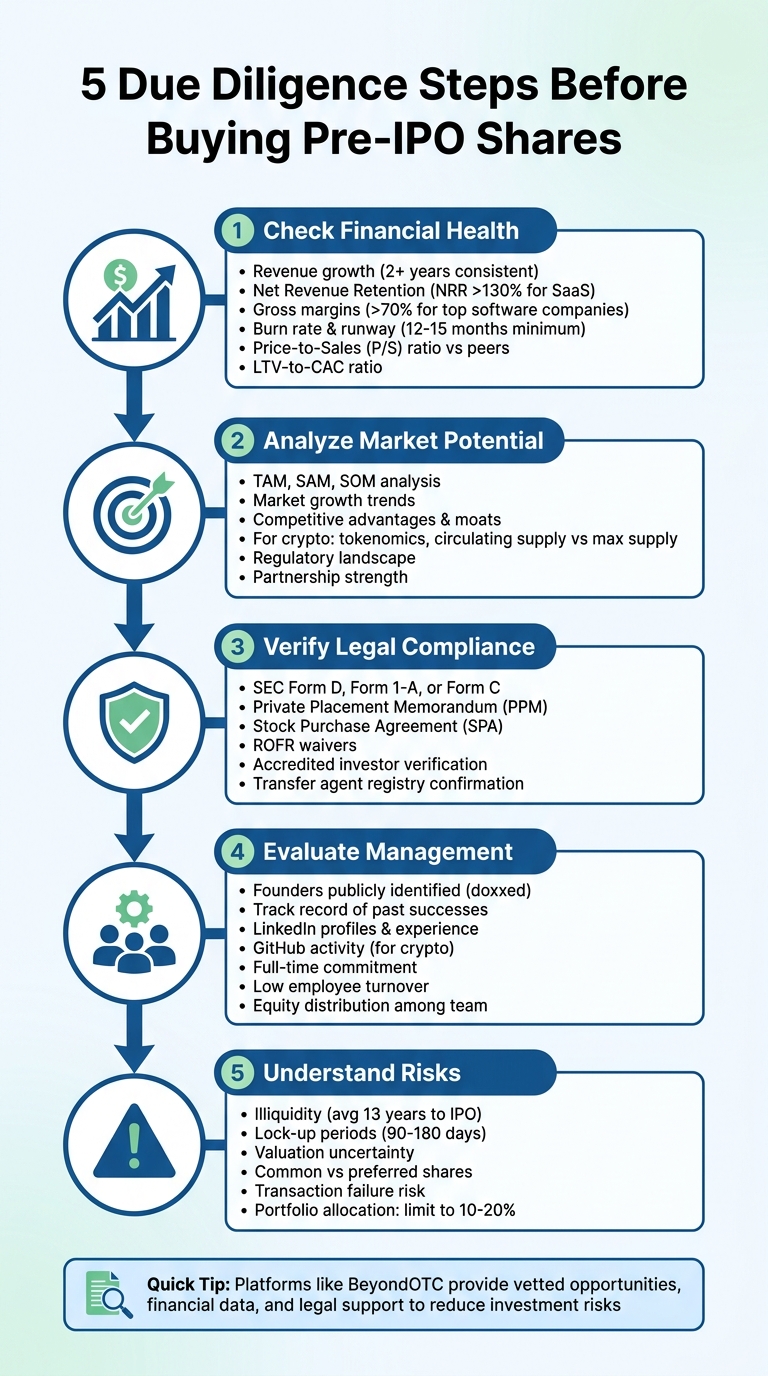
Buying pre-IPO shares can be a high-reward opportunity, but it comes with risks like illiquidity, limited financial transparency, and uncertain valuations. To make smarter decisions, follow these five steps:
- Check Financial Health: Review revenue growth, cash runway, and profitability trends. Metrics like burn rate and net revenue retention (NRR) are key indicators.
- Analyze Market Potential: Assess market size (TAM, SAM, SOM), adoption trends, and competition. For crypto, evaluate tokenomics and regulatory factors.
- Verify Legal Compliance: Ensure proper filings (e.g., SEC Form D), review transaction documents, and confirm investor status to avoid fraud.
- Evaluate Management: Research founders’ track records, leadership style, and commitment. Avoid teams with high turnover or anonymous leaders.
- Understand Risks: Consider illiquidity, valuation uncertainty, and share class differences (common vs. preferred). Limit exposure to 10–20% of your portfolio.
Quick Tip: Platforms like BeyondOTC can help by providing vetted opportunities, financial data, and legal support to reduce risks. Always prioritize thorough research before investing.
5 Essential Due Diligence Steps for Pre-IPO Share Investments
Unlocking the Secrets of Pre-IPO Investing | How the Wealthy Invest Before the IPO #financiallyfree
sbb-itb-7e716c2
Step 1: Review the Company’s Financial Health
Before diving into pre-IPO investments, it’s crucial to evaluate the company’s financial standing. Private companies often disclose limited information, so focus on identifying signs of steady growth and potential returns.
Financial Metrics to Examine
Start with revenue growth. Look for consistent increases over at least two years, whether quarterly or annually. For SaaS companies nearing IPO, strong performers typically report a net revenue retention (NRR) above 130%, signaling robust customer expansion. Pay attention to gross margins as well – top-tier software companies often achieve margins above 70%, which indicates the business can scale efficiently without costs spiraling out of control.
Next, assess the burn rate and runway. The burn rate reflects how much cash the company spends monthly beyond its income. Compare this to their cash reserves to calculate the runway – how many months they can operate without raising additional funds. As Supremus Angel explains:
If a company has less than 12–15 months of operational cash without confirmed funding, dilution risk increases significantly.
A short runway can force the company into emergency fundraising, often at terms that dilute existing investors’ stakes.
Dive deeper into profitability trends, focusing on operating margins and free cash flow. While pre-IPO companies often prioritize growth over immediate profits, positive free cash flow indicates the business can sustain itself without constant fundraising. Evaluate operational efficiency using metrics like Customer Acquisition Cost (CAC) and Lifetime Value (LTV). A favorable LTV-to-CAC ratio suggests the company isn’t overspending to acquire customers who won’t stick around.
Since many pre-IPO firms lack earnings, the Price-to-Sales (P/S) ratio becomes a key valuation tool. Compare this ratio against industry peers to determine if the company is overvalued. Also, watch out for customer concentration risk – relying heavily on a single client can expose the company to significant revenue loss.
How BeyondOTC Provides Financial Data
Private companies often limit what they disclose, but BeyondOTC helps fill those gaps through its extensive institutional network. The platform offers access to 409A valuations, which are IRS-compliant appraisals that establish the fair market value of common stock. These valuations provide a conservative baseline, though actual secondary market prices usually fall between the 409A floor and the preferred share price paid by venture capitalists.
BeyondOTC also compiles Tape D data, which includes quarterly pricing snapshots from institutional mutual funds holding private shares. This data offers real-time market insights, going beyond the information typically found in company pitch decks. Additionally, BeyondOTC provides revenue quality analysis, helping distinguish between recurring revenue (more predictable and valuable) and one-time sales (less reliable). The platform also evaluates unit economics, which measure the profitability of each customer or transaction, shedding light on whether the company’s growth is sustainable or merely fueled by investor funding.
Finally, always request the latest audited financial statements to confirm revenue trends over the past two years. BeyondOTC’s network and vetting process simplify access to these critical documents, reducing the information advantage insiders often have over individual investors. This thorough financial review sets the stage for understanding the company’s market potential in the next step.
Step 2: Evaluate Market Potential and Competition
Once financial stability is confirmed, the next step is to assess whether the market size can support long-term growth. This involves examining both the broader market and the competitive landscape to determine if sustained expansion is achievable.
Measuring Market Size and Growth
Begin by analyzing the Total Addressable Market (TAM) – this represents the maximum revenue potential if the company captured 100% of its target market. From there, narrow it down to the Serviceable Available Market (SAM), which reflects the portion the company can practically reach, and the Serviceable Obtainable Market (SOM), the share it can realistically capture considering current competition and resources. A growing TAM is a positive sign, while a stagnant or shrinking TAM could signal limited opportunities.
For crypto companies, evaluating tokenomics is critical. Look at the circulating supply versus the maximum supply to understand potential inflation. Additionally, compare the market capitalization with the Fully Diluted Valuation (FDV), which assumes all tokens are unlocked. A significant gap between these figures might suggest future sell pressure as tokens become available through vesting schedules.
Adoption trends provide further insights. Use tools like Nansen, Glassnode, or Dune to track metrics such as holder composition, transaction activity, and wallet growth. Developer activity on platforms like GitHub is another indicator; regular updates and a diverse contributor base show that a project is actively evolving. Community engagement on platforms like Discord and Reddit can also reflect momentum and interest. As Hillary Adler, Chief Commercial Officer and Co-founder of BitcoinOS, aptly notes:
Hype dies fast – fundamentals last. Surviving a bear market is that simple.
Pay attention to regulatory and macro trends as well. For example, in 2025, crypto spot OTC markets saw a 109% year-over-year growth – far exceeding the initial forecast of 10–60% – thanks to increased institutional adoption and the growing dominance of stablecoins. Stablecoins alone accounted for 78% of all institutional OTC trades in 2025, up from 26% in 2023. Regulatory developments like the EU’s MiCA implementation can open up new opportunities, while stricter rules elsewhere might hinder growth.
This thorough market analysis sets the stage for evaluating the company’s competitive strengths.
Identifying Competitive Advantages
A promising market alone doesn’t guarantee success – the company also needs a strong position within it. Look for competitive moats such as network effects, proprietary technology, or brand recognition. In crypto, network effects are particularly impactful. Take Ethereum as an example: its extensive developer ecosystem and growing user base create a cycle that’s tough for competitors to break. By early 2025, Ethereum’s market value had surpassed $200 billion, driven by these reinforcing dynamics.
Partnerships also play a key role. Collaborations with centralized exchanges (CEXs), decentralized exchanges (DEXs), or institutional liquidity providers can make scaling easier. BeyondOTC, for instance, offers insights into high-value partnerships and valuations, highlighting a $3 trillion pipeline of late-stage private companies approaching public markets in 2026.
For crypto projects, ensure smart contract audits have been conducted by reputable firms like OpenZeppelin, CertiK, or Trail of Bits. Unverified code is a significant security risk. Additionally, scrutinize the token unlock schedule – a heavy concentration of tokens in the hands of the team or venture capitalists early on could lead to sell pressure down the line. Finally, compare the company’s unit economics and valuation metrics with those of its peers in areas like DeFi, Layer 1 blockchains, or infrastructure to uncover any undervalued opportunities.
With market potential and competitive positioning assessed, the next step is to confirm compliance with legal and regulatory requirements.
Step 3: Check Legal and Regulatory Compliance
Once you’ve assessed market potential and competitive advantages, it’s time to ensure your investment complies with all legal and regulatory requirements. This step shields you from fraud, ensures smooth transactions, and reduces the chances of future legal headaches. Below, we break down the necessary documents and steps for thorough legal verification.
Compliance Areas to Verify
Start by reviewing the Private Placement Memorandum (PPM) or Offering Circular. These documents outline the company’s operations, management, and potential risks. Additionally, confirm the regulatory exemption through SEC EDGAR filings, such as Form D, Form 1-A, or Form C. Missing or improper filings could mean you’re buying shares from an unregistered offering, which carries serious legal risks.
Next, examine transaction documents like the Stock Purchase Agreement (SPA), Investor Rights Agreement (IRA), Stock Transfer Notice (STN), and any Right of First Refusal (ROFR) waivers. These documents are critical to confirming that the company or its existing investors have waived their rights to purchase the shares before a secondary transaction. Some companies place restrictions on secondary transfers to maintain ownership control, so researching the company’s ROFR history can help you avoid deals that may fall through.
You’ll also need to verify your accredited investor status. This typically requires submitting documents such as tax returns, bank statements, or professional licenses. Confirm shareholder records through the SEC transfer agent registry. As of 2026, around 18.5% of U.S. households qualify as accredited investors. Additionally, use FINRA BrokerCheck to ensure that any broker-dealers or placement agents involved have active registrations and no disciplinary issues.
The consequences of skipping these steps can be severe. For instance, in September 2024, the SEC charged Keyport Venture Advisors, LLC and several individuals in a $120 million pre-IPO fraud scheme that misled over 900 investors about share ownership and registration status. Similarly, in July 2024, another fraud case resulted in investors losing approximately $528 million due to markups as high as 150% on pre-IPO shares. SEC Chair Paul Atkins highlighted the importance of these safeguards:
"The Commission is exploring ways to facilitate the ability of individual investors to participate in the private markets, while at the same time protecting those investors from bad actors and fraud".
For investments in tokenized pre-IPO shares, ensure you review smart contract audit reports from trusted firms like Trail of Bits or OpenZeppelin. These audits confirm that the code is secure and meets established standards. Be mindful of blockchain-specific risks, such as platform dependency. If the issuance platform or custodian fails, there must be both legal and technical mechanisms in place to recover your assets.
BeyondOTC’s Legal Advisory Connections
BeyondOTC offers access to legal experts who specialize in OTC compliance. These professionals ensure share transferability, conduct thorough KYC/AML checks, and review all transaction documents before any funds are exchanged. Such measures help minimize regulatory and litigation risks.
BeyondOTC also provides escrow services, where funds are only released after the company’s transfer agent confirms the share transfer. With these legal protections in place, you’re ready to evaluate the company’s management team.
Step 4: Assess Management Team Credibility
Once the legal aspects are verified, the next step is to evaluate the people leading the company. A capable management team plays a critical role in determining a startup’s success. It’s worth noting that more than 90% of bull-market crypto projects eventually fail. This makes it essential to scrutinize the founders’ backgrounds and achievements.
Start by confirming that the founders are publicly identified (doxxed). Teams that operate anonymously pose a much higher risk. Check their LinkedIn profiles to ensure they have relevant and meaningful experience. For crypto projects, GitHub activity is another important factor – consistent contributions over time are far more reassuring than a sudden, short-lived burst of activity.
Researching Founders’ Past Performance
A founder’s past successes can often predict their ability to succeed in the future. Look into whether they have successfully scaled businesses, achieved profitable exits, or gained valuable lessons from prior ventures. This is particularly important in the crypto space, where fewer than 5% of tokens created during the 2017 ICO boom are still around today.
Also, cross-check their claims. Compare the founder’s narrative with feedback from previous colleagues to assess their leadership style and reliability. Be cautious of red flags such as high employee turnover, inconsistent stories about the company’s vision, or an unwillingness to accept constructive criticism.
Connecting with Founders and Investors
Using services like BeyondOTC can help you directly connect with founders, offering an opportunity to assess their problem-solving skills, resilience, and focus. Think of it as a private-market equivalent of a "Bloomberg Terminal", giving you deeper insights for negotiations. These interactions are also a chance to test how founders might handle challenging scenarios, such as a 30% funding shortfall or the emergence of a strong competitor.
Matt Wilson, Founder and Managing Director at Allied Venture Partners, highlights a key challenge:
"The most common reason I see startups shutting down is running out of cash while searching for product-market fit. Founders need unmatched focus and resilience to keep iterating, even when it seems like nothing is working."
Ensure all co-founders are fully committed to the project. Part-time involvement is often a warning sign. Additionally, review how equity is distributed among team members. Unequal splits can hint at potential internal disagreements down the line.
For companies approaching an IPO, you should also examine the S-1 registration document. This filing includes detailed profiles of key executives and board members, offering valuable insights into their past achievements and leadership credentials. Conducting a thorough assessment of the management team can significantly reduce your investment risks.
Step 5: Identify and Reduce Investment Risks
Navigating the world of pre-IPO investments means taking a hard look at potential risks. These investments often come with higher stakes than publicly traded stocks, making it crucial to protect your capital. High failure rates demand strong risk management strategies, as pre-IPO shares can sometimes lead to a complete loss of investment.
Investment Risks to Watch For
One of the biggest challenges with pre-IPO shares is illiquidity. Since these shares aren’t traded publicly, you may have to wait for a liquidity event like an IPO, acquisition, or merger to cash out. Even then, mandatory lock-up periods of 90–180 days can delay access to your funds. To put it into perspective, the average company now waits 13 years before going public, a jump from 10 years in 2018.
Another concern is valuation uncertainty. Unlike public stocks, private company valuations rely heavily on estimates, which can be subjective and vary widely. A good example is Elon Musk’s 2022 acquisition of X (formerly Twitter). After the deal, Fidelity and Baron Capital assigned vastly different valuations to their private holdings in the company, showing just how unpredictable private asset pricing can be. Add to that the risk of transaction failure, where deals can fall apart due to a company’s right of first refusal (ROFR) or board-level decisions, and it’s clear why careful research is essential before committing.
Capital structure risks are another key factor. Most individual investors end up buying common shares, which rank lowest in the "liquidation waterfall." This means preferred shareholders get paid first during an exit. For instance, even with a headline valuation of $4.00 per share, common shareholders in one scenario only received $1.84, thanks to liquidation preferences.
It’s also important to evaluate a company’s cash runway. If a business doesn’t have enough operational funds to last 12–15 months without confirmed additional funding, the risk of dilution increases. For example, a company burning through $10 million monthly with $200 million raised has just 20 months of runway.
To manage these risks, limit your pre-IPO exposure to 10–20% of your overall portfolio. This aligns with the "power law" of private investing, where only a small percentage of investments – around 7% – deliver returns of 10x or more. These few winners often drive most of the portfolio’s returns.
Understanding these risks also means recognizing the differences between share classes, which can significantly impact your returns.
Common vs. Preferred Shares Comparison
Grasping the differences between common and preferred shares is essential for understanding your risk exposure. Here’s a breakdown:
| Feature | Common Shares | Preferred Shares |
|---|---|---|
| Liquidation Priority | Paid only after preferred holders | Paid first, often guaranteeing at least 1x return |
| Voting Rights | Standard voting rights | May include board representation and protective provisions |
| Anti-Dilution Protection | Rarely included; value drops with lower-priced new shares | Often includes protections during "down rounds" |
| Typical Price | Lower; based on 409A valuation, often 50-80% less than preferred | Higher; includes a premium for preferences |
| Liquidity | Highly illiquid; subject to ROFR and board approval | Typically held by VCs; may have more structured exit options |
The 409A delta – the difference between the secondary market price and the IRS-compliant fair market value – can signal overvaluation. For example, SpaceX Series J preferred shares were priced at $110, while the 409A valuation for common stock was $45 (a 59% discount). Common shares on the secondary market traded at $85, reflecting a 23% discount to preferred shares.
By understanding these distinctions, you can better manage risks using both quantitative data and qualitative insights.
How BeyondOTC Helps Manage Risk
BeyondOTC provides tools and resources to help investors navigate the complexities of pre-IPO investments. The platform conducts rigorous due diligence, filtering out high-risk opportunities before they’re listed.
With institutional-grade analytics and real-time market data, BeyondOTC helps you make informed decisions about valuation and timing. Custom research reports dive deep into market trends and competitive positioning, while a smart matching algorithm connects you with opportunities that align with your risk tolerance and investment goals.
BeyondOTC also offers term sheet negotiation assistance, helping you secure better rights and protections in your deals. Secure deal rooms simplify data sharing, addressing one of the biggest challenges in private markets – information asymmetry. The platform’s track record includes facilitating over $5 billion in institutional TVL solutions and connecting with a network of more than 100,000 professionals.
Ongoing monitoring tools keep you updated on the performance and risk profiles of your investments, giving you insights that are rarely available in private markets. This combination of due diligence, monitoring, and expert support helps investors identify opportunities with balanced risk and potential returns. With these strategies, navigating pre-IPO investments becomes a more informed and manageable process.
Conclusion
Buying pre-IPO shares demands a thorough and methodical approach to due diligence. The five steps covered in this guide – reviewing financial health, evaluating market potential, checking legal compliance, assessing management credibility, and identifying investment risks – serve as a framework for making informed choices in private markets. This is especially important in the cryptocurrency sector, where fraud and scams are a persistent issue among the thousands of digital currencies vying for attention. As TradeDork emphasizes:
Due diligence is the linchpin in mitigating risks associated with cryptocurrency investments.
Pre-IPO investments come with significant risks. Unlike publicly traded companies that follow strict SEC reporting requirements, private firms often disclose limited information, making careful evaluation essential. For instance, understanding the 409A delta – the valuation gap between the preferred shares held by venture capitalists and the common shares available to secondary buyers – can be a key factor in achieving favorable returns or facing disappointing results.
To address these challenges, BeyondOTC offers tools to reduce information asymmetry. Their platform provides vetted investment opportunities, detailed analytics, and a secure transaction process. With a rigorous screening system, BeyondOTC filters out high-risk deals before they reach investors. Additionally, their custom research reports and real-time market data empower investors to make well-informed decisions. These resources are vital when navigating both traditional and cryptocurrency-focused pre-IPO markets.
As Supremus Angel wisely remarked:
Sustainability almost always wins over hype.
Companies aiming for successful public offerings often focus on strengthening their fundamentals and stabilizing margins 18–24 months before filing for an IPO. By following these five essential steps and utilizing BeyondOTC’s resources, investors can uncover opportunities that strike a balance between risk and sustainable growth in the increasingly complex private market landscape.
FAQs
What documents should I ask for before buying pre-IPO shares?
Before purchasing pre-IPO shares, it’s crucial to gather key documents that provide insight into the company’s overall condition and potential. Here’s what to look for:
- Financial statements: Review the income statement, balance sheet, and cash flow statement to understand the company’s financial stability and performance.
- Business details: Look into the business model, profit margins, revenue growth, and customer base to evaluate how sustainable the company’s operations are.
- Governance and compliance: Check information about the management team, corporate governance, and adherence to legal regulations to ensure the company operates with integrity.
These documents form the foundation of a proper due diligence process.
How can I tell if a pre-IPO valuation is inflated?
Spotting an inflated pre-IPO valuation requires a close look at a few key areas. Start by comparing the company’s pricing to that of established competitors in the same industry. This can give you a sense of whether the valuation aligns with market norms.
Next, dig into the company’s financials. Is the valuation grounded in strong fundamentals like solid revenue, consistent growth, or a strong market position? Or does it seem more like a product of market hype?
If the valuation looks disproportionately high without the backing of measurable performance or a competitive edge, it could be a red flag for inflation.
What’s the safest way to handle payment and share transfer in a secondary deal?
The safest approach to managing payments and share transfers in a secondary deal is to rely on secure platforms designed for verified and compliant transactions. Tools like virtual data rooms or escrow services can streamline the process by organizing and documenting every step, which helps minimize risks such as fraud or miscommunication. Partnering with well-established platforms that adhere to legal and regulatory standards adds an extra layer of security and ensures the transaction remains transparent.