
Cross-chain yield aggregation allows family offices to earn passive income by allocating capital across multiple blockchain networks, such as Ethereum, Solana, and Layer 2 solutions. This strategy identifies the best risk-adjusted returns while automating fund transfers and rebalancing. However, it introduces significant risks, including bridge failures, smart contract vulnerabilities, and liquidity issues.
Key takeaways:
- Family Office Adoption: 1–7% of portfolios allocated to crypto, with Asian offices leading at 5%.
- Main Risks: Technology failures, bridge exploits (over $2.5B lost in hacks), oracle manipulation, and liquidity crises.
- Risk Management: Use multi-signature wallets, real-time monitoring, and minimal bridge transfers. Evaluate protocols, bridge security, liquidity stability, and compliance.
- Investment Options: Direct on-chain operations, structured funds, or risk-managed vaults, each with varying levels of control and regulatory exposure.
- Yield Optimization: Platforms like Pendle, Morpho, and Gauntlet Vaults provide tailored solutions for predictable or high-yield strategies.
While cross-chain yield strategies offer attractive returns, they require rigorous risk controls to avoid losses. Family offices should implement structured frameworks, diversify allocations, and leverage trusted tools to mitigate vulnerabilities.
💎Cross-chain stablecoin yield aggregator with Mike Ting & Lawrence Wong | Ep. #40
sbb-itb-7e716c2
Main Risks in Cross-Chain Yield Aggregation
Cross-chain yield strategies can amplify risks significantly. Each additional bridge or protocol introduces new vulnerabilities, creating a complex web of potential failure points.
Technology Risks
Cross-chain yield aggregation involves interacting with over 150 smart contracts, each with its own audit history and upgrade mechanisms. This dramatically increases the potential attack surface compared to single-chain strategies, which typically rely on 10–20 contracts. Vulnerabilities can arise across bridges, destination protocols, and the aggregator’s own logic.
Oracle manipulation is another pressing concern. For example, Layer 2 price updates often lag behind Ethereum by about 12 seconds. This delay creates opportunities for MEV bots to exploit price discrepancies through front-running. A stark example of technical failure was the Nomad Bridge exploit in August 2022, which led to a $190 million loss. This incident froze assets across chains and disrupted downstream aggregation logic entirely.
Governance attacks also pose serious threats. Many protocols use upgradeable proxy patterns controlled by multisig wallets. If these wallets are compromised, as seen in the Multichain/Anyswap breach in July 2023, attackers can drain entire capital pools. This particular attack resulted in losses exceeding $125 million. Additionally, errors in vault token accounting – such as rounding issues or failure to account for external asset losses – can lead to undercollateralization. These risks extend to cross-chain bridges, where interoperability challenges further complicate the landscape.
Cross-Chain Bridge and Interoperability Risks
Cross-chain bridges bring their own set of operational challenges. Between 2021 and 2022, over $2.5 billion was stolen in bridge hacks, representing more than two-thirds of all DeFi hacks during that period. The stakes are high: while yields may average 5–10% APY, a single bridge failure can result in the complete loss of principal.
Take the Ronin Bridge exploit in March 2022, for instance. Attackers compromised 5 out of 9 validator keys, leading to a staggering $625 million loss. Similarly, the Wormhole Bridge exploit in February 2022 exposed flaws in signature verification, resulting in a $325 million breach.
Liquidity fragmentation is another pressing issue. If a bridge’s destination pools are depleted, transactions may fail or experience extreme slippage. Additionally, mismatches in finality between chains – such as Ethereum’s approximately 13-minute finality versus Solana’s near-instant finality – can expose funds to losses from chain reorganizations. These technical challenges, combined with market dynamics, create a volatile environment where risks can escalate quickly.
Market and Liquidity Risks
Liquidity rehypothecation is a hidden danger in cross-chain yield strategies. Assets are often redeployed across multiple platforms, creating a leverage effect. A $100 million vault, for instance, might represent over $1 billion in implied cross-chain exposure. If one component fails, it can trigger a cascade of losses across the system.
Wrapped asset depegging is another critical risk. Bridge-wrapped tokens act as liabilities of the bridge. If the underlying assets are compromised, these synthetic tokens can lose their value almost instantly, disrupting liquidity across chains. Additionally, MEV sandwich attacks targeting predictable yield harvests – often scheduled every 24–48 hours – can lead to slippage losses exceeding 30%. Such losses can wipe out weeks of accumulated yield.
All of these risks are interconnected through contagion. A failure in a major bridge or a liquidity crunch on one chain can trigger liquidations on another, leading to systemic shortfalls across the entire yield aggregation framework.
"A yield aggregator’s safety is the weakest link in this chain of custody" – Prasad Kumkar, Founder & CEO of ChainScore Labs
Given these layered vulnerabilities, it’s crucial for family offices and institutional investors to adopt stringent risk assessment frameworks before allocating capital to cross-chain strategies.
Risk Framework for Family Offices
This framework is designed to help family offices evaluate and address risks when navigating cross-chain yield opportunities. By following a structured approach, family offices can better manage potential vulnerabilities while maximizing returns.
4-Layer Risk Assessment Method
To thoroughly assess risks, it’s essential to examine these four key areas:
- Protocol and Smart Contract Security
Start by reviewing audit reports from trusted firms like Trail of Bits or OpenZeppelin. Look for active bug bounty programs and assess the development team’s track record. Protocols that undergo multiple audits and maintain bug bounties signal a strong focus on security. - Bridge and Interoperability Architecture
Evaluate the trust model of the bridge being used. For instance:- Native bridges like Arbitrum Bridge or Base Bridge inherit the security of Layer 1 but may have slower withdrawal periods (e.g., 7 days).
- Externally verified bridges, such as Wormhole, use validator nodes (e.g., 19 Guardian nodes with a 13-of-19 threshold) to enable faster transfers but depend on the reliability of those validators.
- Intent-based networks like Across use mechanisms like UMA’s Optimistic Oracle for trust-minimized transfers, with relayers providing liquidity for near-instant execution.
- Liquidity and TVL Stability
Monitor Total Value Locked (TVL) for sudden changes, reserve imbalances, or depegging of wrapped assets. For example, as of June 2025, LayerZero’s Omnichain Fungible Token standard manages $44 billion in cross-chain assets, with $7.4 billion (18.5%) allocated in Aave. Such concentrations require close attention. - Regulatory and Compliance Screening
Ensure protocols adhere to sanctions screening, assess whether the strategy could qualify as an "investment company" under U.S. securities laws, and confirm AML/KYC compliance. For instance, in December 2023, the SEC fined BarnBridge DAO $1.7 million after ruling its SMART Yield pools (holding $509 million in stablecoin deposits) as unregistered investment companies.
These assessments provide a solid foundation for implementing effective risk controls.
Risk Mitigation Techniques
To reduce exposure to risks, family offices can adopt several operational strategies:
- Minimal Hop Policy:
Transfer assets through a single canonical bridge instead of multiple intermediaries to limit trust dependencies. For transactions over $10,000, prioritize official native bridges. - Position Sizing and Diversification:
Spread allocations across various protocols, chains, and bridges to avoid concentration risks. Begin with small test transactions, and for significant transfers, divide them across multiple bridges or use centralized exchanges to minimize smart contract risks. - MEV Protection:
Use private RPCs like Flashbots Protect and apply time-weighted average price strategies during harvests to reduce exposure to miner extractable value (MEV). - On-Chain Monitoring and Reconciliation:
Set up alerts on platforms like Nansen or Dune to track large withdrawals, contract upgrades, oracle anomalies, and bridge reserve changes. Regular reconciliation of cross-chain balances can help catch discrepancies early. BeyondOTC’s advisory services can assist family offices in managing liquidity requirements while avoiding on-chain slippage.
Selecting the right investment structure also plays a crucial role in refining these risk controls and aligning them with the objectives of family offices.
Investment Structure Comparison
The investment vehicle chosen by a family office affects regulatory exposure, operational demands, and yield visibility. Here’s a breakdown of the options:
| Structure | Setup & Custody | Regulatory Profile | Yield Transparency | Best For |
|---|---|---|---|---|
| Direct On-Chain Operations | Self-custody via hardware wallets or multisig; requires technical expertise | Lower regulatory risk as a user rather than a service provider; avoids pooling concerns | Real-time on-chain visibility of positions and transactions | Tech-savvy offices managing gas fees and bridge security |
| Structured Cayman Funds | Professional custodian or fund-held; passive involvement for liquidity provision | Established legal framework via 3(c)(1) exemptions; requires Reg D/S private placement | Periodic reporting (quarterly or monthly) managed by the general partner | Offices seeking professional management and institutional distribution |
| Risk-Managed Vaults | Smart contract pooling with one-click entry | Higher risk of classification due to asset pooling and automated yield distribution | Automated reporting based on vault contract audits and transparency | Offices looking for convenience with smaller allocations |
Family offices, particularly those based in the U.S., must carefully consider regulatory precedents when choosing an investment structure.
"Whether it’s through staking-as-a-service, lending, or other means, crypto intermediaries, when offering investment contracts in exchange for investors’ tokens, need to provide the proper disclosures and safeguards required by our securities laws."
- Gary Gensler, Former SEC Chair
For many family offices, a hybrid strategy works best. This might involve direct on-chain operations for core positions, structured funds for larger allocations that benefit from institutional infrastructure, and limited exposure to risk-managed vaults for diversification. This approach balances compliance, operational efficiency, and risk management across the cross-chain yield ecosystem.
Yield Optimization Strategies and Protocols
Family offices require clear strategies and tools that ensure secure, risk-aware returns. With the right protocols, yield optimization can turn into a reliable source of revenue, aligning with established risk controls while maximizing returns.
Protocols for Risk-Managed Yields
Pendle Finance offers a way to secure predictable income by splitting yield-bearing assets into two components: Principal Tokens (PT) and Yield Tokens (YT). This setup allows investors to lock in fixed rates, functioning similarly to zero-coupon bonds, and eliminates the uncertainty of interest rate fluctuations. As of early 2026, Pendle is expanding into the $3.9 trillion Islamic finance market by creating Shariah-compliant yield products.
Morpho Blue takes a unique approach to risk management by outsourcing it to specialized curators. This isolates lending markets, ensuring family offices are only exposed to selected vault assets, which reduces the risk of contagion across the system.
Gauntlet Vaults stand out as an institutional-grade solution for active risk management. Using agent-based simulations and real-time liquidity data, these vaults manage stablecoin yields on Morpho. By early 2026, Gauntlet Vaults had over $2 billion in total vault TVL across multiple protocols. During a period of market stress in November 2025, the Gauntlet USDC Balanced vault saw a 35% increase in supply, while competitor vaults experienced outflows exceeding 60%. Suppliers earned an impressive annualized 13.3% APY during this time.
In October 2025, Gauntlet demonstrated its operational strength when it absorbed a $775 million deposit into two USDT vaults in a single transaction – an increase of 40 times the existing TVL. To restore yields, Gauntlet introduced new collateral markets (cbBTC/USDT and thBILL/USDT), generating $627 million in fresh borrowing demand through its partner network.
Yieldoor Loop Vaults employ leveraged interest rate arbitrage to enhance returns. This strategy involves purchasing Pendle PTs, using them as collateral on platforms like Morpho or Aave, borrowing stablecoins, and repeating the cycle. While this approach comes with a 6% performance fee, it can deliver higher returns for family offices that are comfortable with moderate leverage.
| Vault Type | Typical APY | Risk Profile | Ideal For |
|---|---|---|---|
| Gauntlet Prime | 4–6% USDC | Conservative/Treasury | Core holdings, capital preservation |
| Gauntlet Core | 5–8% USDC | Moderate | Balanced exposure with PT tokens, sUSDe |
| Gauntlet Frontier | 7–12% USDC | High/Liquidity-seeking | Smaller allocations, newer tokens |
How BeyondOTC Supports Yield Optimization

BeyondOTC plays a key role in helping family offices optimize their yields by connecting them directly to centralized and decentralized exchanges. These connections provide access to deep liquidity pools, reducing slippage during large-scale cross-chain transactions. Additionally, BeyondOTC offers advisory services focused on regulatory compliance, which is becoming increasingly important as yield aggregators and bridges tighten KYC/AML requirements in 2026. The firm ensures alignment with U.S. securities laws, making it easier for family offices to integrate DeFi yields into their broader investment strategies.
For those balancing yield maximization with liquidity needs, BeyondOTC’s OTC trading solutions offer an alternative to on-chain exits, which can sometimes lead to slippage or MEV extraction. This approach is especially beneficial during times of market stress, when vault liquidity may be constrained, or for rebalancing large positions across multiple protocols. These solutions work seamlessly with BeyondOTC’s cross-chain strategies, bridging the gap between effective risk management and revenue generation.
Implementation Checklist for Family Offices
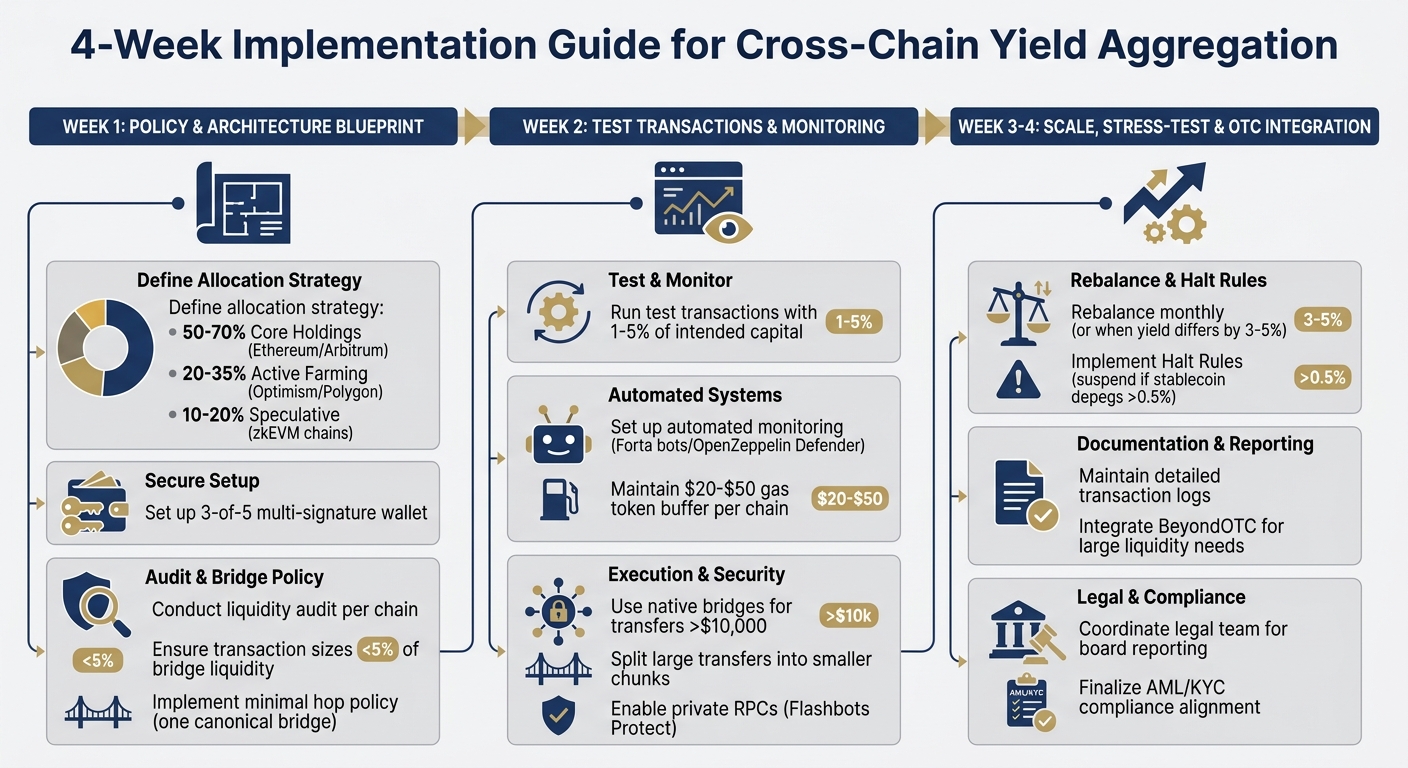
4-Week Cross-Chain Yield Implementation Guide for Family Offices
Step-by-Step Implementation Guide
Week 1: Policy & Architecture Blueprint
Start by defining your allocation strategy: allocate 50–70% to Core Holdings on highly secure chains like Ethereum or Arbitrum, 20–35% for Active Farming on reliable Layer 2 solutions such as Optimism or Polygon, and 10–20% for Speculative positions on newer zkEVM chains. Stick to a minimal hop policy – use only one canonical bridge during asset transfers to reduce risks.
Set up a 3-of-5 multi-signature wallet, involving core team members and trusted delegates, to enhance security. Conduct a liquidity audit for each chain, checking factors like transaction finality times, validator decentralization, and any past security breaches. Make sure your planned transaction sizes are less than 5% of a bridge’s total liquidity for the specific asset pair. This helps prevent slippage and minimizes the risk of failed transactions. Tie these steps back to your earlier risk assessment framework to ensure consistent controls.
Once you’ve finalized your allocation tiers and secured the infrastructure, move to Week 2 to validate these setups with test transactions.
Week 2: Test Transactions & Monitoring Setup
Run a test transaction using 1–5% of the intended capital to confirm wallet addresses, bridge routes, and fee estimates. Set up automated monitoring tools like Forta bots or OpenZeppelin Defender Sentinels to track large withdrawals, contract updates, or oracle anomalies. Keep a native gas token buffer of $20–$50 per chain to ensure you can quickly exit or rebalance during volatile periods.
For bridge transfers, prioritize native or official bridges such as the Arbitrum Bridge or Base Bridge for transactions over $10,000. For smaller, faster transfers, consider third-party options like Across or Stargate. To reduce risks, split large transfers into smaller chunks and use private RPCs like Flashbots Protect to avoid front-running or sandwich attacks during yield-entry trades.
If test transactions prove reliable, you’re ready to scale operations, conduct stress tests, and integrate OTC solutions in the following weeks.
Week 3–4: Scale, Stress-Test & OTC Integration
With your system tested, focus on scaling operations and stress-testing to ensure long-term reliability. Rebalance yield positions monthly, unless yield differences exceed 3–5%, to avoid unnecessary gas expenses. Implement Halt Rules, such as suspending operations if a stablecoin loses more than 0.5% of its peg. Maintain detailed logs – including timestamps, transaction hashes, and bridge details – for compliance and regulatory reporting.
For larger liquidity needs, rely on BeyondOTC’s OTC trading solutions to exit positions without causing on-chain slippage. Their advisory services can also help align your operations with AML/KYC standards and U.S. securities regulations. Coordinate with your legal team to prepare board-level reports on your crypto exposure. These measures will solidify your framework for efficient and secure cross-chain yield aggregation.
Conclusion
Cross-chain yield aggregation presents an opportunity for family offices to achieve attractive returns, but only when approached with a strong emphasis on risk management. As ChainScore Labs aptly notes: "Aggregating yield across chains doesn’t diversify risk – it multiplies it". The numbers speak for themselves – between 2021 and 2022, over $2.5 billion was lost to bridge hacks. When risking the entirety of principal for a modest 5–10% APY, the only way to justify such risks is by ensuring robust controls are in place.
This guide highlights the importance of balancing risk mitigation with yield pursuit. The 4-Layer Risk Assessment Method and implementation framework shift the focus from chasing the highest returns to achieving the best risk-adjusted outcomes. By diversifying across protocols, validators, and chains – and adhering to a Minimal Hop Policy alongside rigorous on-chain monitoring – family offices can reduce the likelihood of single points of failure that have historically plagued this space.
For those with larger liquidity needs or regulatory concerns, BeyondOTC’s OTC trading solutions offer a vital alternative. These services help avoid on-chain slippage and ensure compliance with AML/KYC requirements. Additionally, their advisory services provide guidance for navigating the intersection of traditional finance regulations and decentralized protocols, ensuring strategies remain both profitable and compliant.
As the cross-chain yield space evolves, new technologies like ZK-proof integration, intent-based architectures, and shared security models through platforms like EigenLayer are reshaping the landscape. However, these innovations demand the same level of rigorous risk management emphasized throughout this guide. Family offices that adopt these frameworks stand to gain from emerging opportunities while steering clear of costly missteps. Success in this space belongs to those who treat risk management as an equal priority to yield optimization.
FAQs
How do I choose the safest bridge?
When choosing a cross-chain bridge, it’s important to weigh its trust model. Native bridges are often considered safer but tend to operate more slowly. On the other hand, intent-based bridges provide quicker transfers while relying on fewer trust assumptions.
To ensure safety, look for bridges that have undergone independent security audits. Before committing large amounts, test the bridge with smaller transactions. It’s also wise to spread your transfers across multiple bridges to reduce risk.
For added protection, use hardware wallets when approving transactions and double-check contract addresses to steer clear of scams. Additionally, confirm that the destination chain has enough liquidity to support your transfer before proceeding.
What’s the best way to limit cross-chain blowups?
To minimize the risks of cross-chain failures, it’s essential to have strong risk management strategies in place. These should focus on addressing potential weaknesses like smart contract bugs, bridge vulnerabilities, and security gaps. Some effective approaches include:
- Diversifying across protocols and chains: Spreading assets and operations across multiple platforms reduces reliance on any single chain, limiting potential damage from isolated issues.
- Conducting thorough security audits: Regularly reviewing and testing systems can help identify and fix vulnerabilities before they become major problems.
- Monitoring liquidity risks: Keeping a close eye on liquidity levels ensures that funds remain accessible and operations stable.
In addition, using standardized protocols and implementing multi-layered security measures – such as insurance mechanisms – can provide extra protection, reducing the likelihood of widespread failures in multi-chain ecosystems. These practices collectively help safeguard assets and maintain system integrity.
How should a U.S. family office handle compliance?
A U.S. family office must prioritize compliance by following relevant regulations such as securities laws, fund management rules, and anti-money-laundering requirements. This becomes even more crucial when participating in activities like cross-chain yield aggregation and decentralized finance, whether or not offshore structuring is involved. A clear grasp of these regulations is essential for managing risks effectively while pursuing various investment opportunities.