
Stablecoins are now essential tools for institutional treasuries, offering liquidity, instant settlements, and yield opportunities. The two giants, USDC and USDT, dominate the market, but each serves different purposes:
- USDC: Known for strong regulatory compliance, transparency, and conservative reserves. Ideal for institutions needing secure, compliant options for settlements and long-term holdings.
- USDT: Offers unmatched global liquidity and trading volume, making it a preferred choice for high-volume trading and emerging markets. However, its offshore structure and limited transparency present higher risks.
- Alternatives like PYUSD (PayPal USD) and GUSD (Gemini Dollar) provide diversification but are less liquid and more niche.
Key Takeaway: Choose USDC for compliance and stability, USDT for liquidity and trading, and consider alternatives for specific use cases. Diversifying across stablecoins can help balance risk and optimize treasury operations.
Quick Comparison
| Feature | USDC (Circle) | USDT (Tether) | PYUSD (PayPal USD) | GUSD (Gemini Dollar) |
|---|---|---|---|---|
| Market Cap (2026) | $79 Billion | $184 Billion | ~$2.5 Billion | Smaller (~$1 Billion) |
| Reserve Composition | 100% cash & U.S. Treasuries | ~84% cash equivalents, Bitcoin, gold | 1:1 U.S. dollar backing | 1:1 U.S. dollar backing |
| Transparency | Monthly audits (Deloitte) | Quarterly attestations (BDO) | Monthly attestations (KPMG) | Monthly attestations (BPM LLP) |
| Regulatory Compliance | GENIUS Act, MiCA | Limited | NYDFS-regulated | NYDFS-regulated |
| Liquidity Depth | High for settlements | Highest for trading | Limited | Limited |
| Best Use Case | Regulated settlements, savings | Trading, global liquidity | PayPal ecosystem | Gemini ecosystem |
Decision:
- USDC: Best for compliance-focused institutions.
- USDT: Best for global trading and emerging markets.
- PYUSD/GUSD: Niche options for diversification.
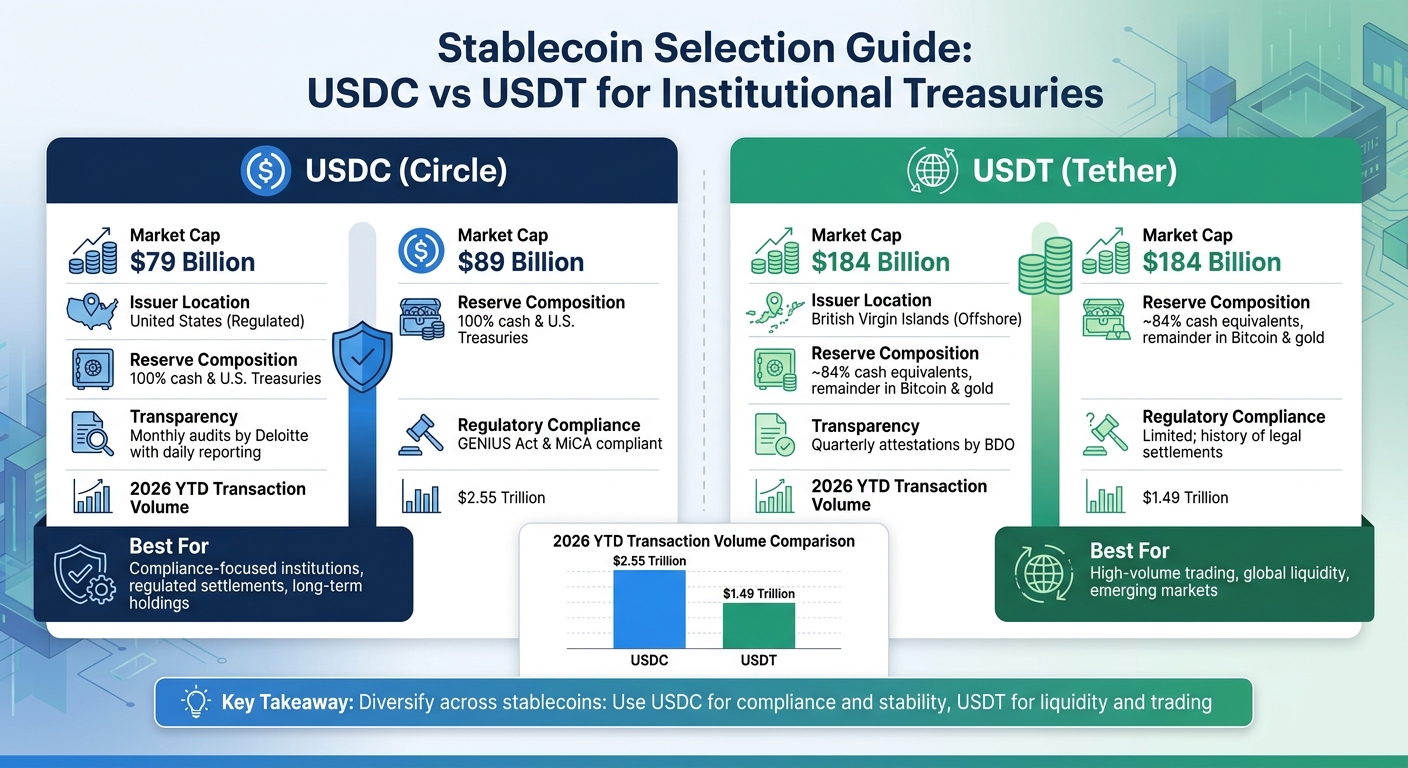
USDC vs USDT Stablecoin Comparison for Institutional Treasuries
USDC: Characteristics and Institutional Applications
Issuer and Reserve Structure
USDC is issued by Circle Internet Financial, a company that went public on NASDAQ under the ticker CRCL in June 2025, following a $1.05 billion IPO. Being publicly listed requires Circle to comply with strict SEC filings and regulatory oversight.
The reserve setup for USDC is straightforward. About 80% of its reserves are invested in short-duration U.S. Treasuries, while the remaining 20% is held as cash deposits at major global banks like JPMorgan Chase and Citigroup. A significant portion – around 80% – of these reserves is managed within the Circle Reserve Fund (USDXX), a 2a-7 government money market fund overseen by BlackRock and custodied at BNY Mellon. To ensure transparency, Circle provides daily CUSIP-level disclosures of its Treasury holdings, allowing institutions to confirm the backing behind USDC.
The reserves are stored in segregated "For Benefit Of" (FBO) accounts, which ensures they are separate from Circle’s corporate assets, even in bankruptcy scenarios. On top of this, Circle holds over $800 million in corporate cash as an additional safeguard.
Circle’s financial operations are subject to rigorous oversight. Deloitte performs monthly attestations in line with AICPA standards and conducts annual audits under PCAOB standards, which align with Circle’s SEC reporting requirements. These financial controls form the foundation of USDC’s regulatory compliance framework.
Regulatory Framework and Disclosure Standards
USDC’s regulatory approach is built on transparency and compliance. In July 2024, USDC became the first global stablecoin to secure MiCA authorization in the European Union. This authorization allows it to operate legally across all 27 EU member states. Once the EU’s grandfathering period ended, many exchanges restricted access to tokens that were not MiCA-compliant, but USDC remained available to European users.
In the United States, USDC complies with the GENIUS Act, signed into law in July 2025. This legislation requires stablecoins to be 100% backed by high-quality liquid assets and mandates monthly public attestations. Circle also holds a BitLicense from the New York Department of Financial Services and is licensed by Singapore’s Monetary Authority.
This strong focus on compliance has made USDC particularly appealing to institutions. As the Sphere Team observed:
"USDC has become the more transactionally active token, particularly in regulated corridors where compliance matters".
Treasury Applications
USDC’s robust reserve structure and regulatory foundation make it a reliable solution for treasury operations. It is commonly used in regulated settlement processes where audit trails and compliance documentation are crucial. The Cross-Chain Transfer Protocol (CCTP) enables seamless transfers of native USDC across over 30 blockchain networks, with median attestation times of just 13–18 seconds. This design reduces the security risks often associated with traditional blockchain bridges.
For institutional clients, Circle’s Mint API provides efficient liquidity solutions. Plus tier clients benefit from same-day settlement for large-scale redemptions, while Standard tier users receive next-day settlement. In 2025, USDC processed an impressive $18.3 trillion in transaction volume, surpassing USDT’s $13.3 trillion, even though USDC had a smaller market capitalization.
USDC’s resilience was tested during the March 2023 Silicon Valley Bank collapse. When $3.3 billion of its reserves were temporarily stuck at SVB, USDC briefly depegged to $0.87. Circle stepped in, using its corporate funds to cover the shortfall and restore the $1.00 peg within 48 hours.
sbb-itb-7e716c2
USDT: Characteristics and Institutional Applications
Issuer and Reserve Structure
USDT stands out for its focus on diversified reserves and global trading liquidity. It is issued by Tether Limited, headquartered in the British Virgin Islands. By the end of Q4 2025, USDT’s market capitalization had reached $187.3 billion, making it the largest stablecoin globally with a 60.8% market share. Tether’s reserves included $141.6 billion in U.S. Treasuries (79% of total reserves), 96,184 Bitcoins, 127.5 metric tons of gold, and secured loans. If Tether were a country, its holdings of U.S. government debt would rank it as the 18th largest holder globally. The company also reported $10 billion in profit in the first three quarters of 2025, showcasing strong financial performance.
Unlike USDC, which provides monthly audits, Tether offers quarterly attestations conducted by BDO. This less frequent disclosure has drawn criticism, with S&P Global assigning USDT a "4" rating on a scale of 1 to 5 (with 5 being the lowest). The rating reflects concerns about transparency and reserve concentration.
Market Liquidity and Trading Activity
USDT dominates global stablecoin liquidity. In Q4 2025, its spot market trading volume on centralized exchanges hit $3.2 trillion, accounting for 61.5% of total spot market volumes and 80% of all spot trades. While USDC recorded a higher annual volume of $18.3 trillion compared to USDT’s $13.3 trillion, USDT remains the go-to for fast, exchange-based trading.
"USDT’s superior liquidity makes it essential for global trading and settlement operations." – Patrick Shields, Author, AlphaPoint
USDT is widely used across major global exchanges, especially in regions like South Korea, Singapore, Hong Kong, and the Philippines. This extensive network allows users to convert between non-USD cryptocurrencies with minimal price disruption. By the end of 2025, the estimated number of USDT users reached 534.5 million.
USDT’s daily velocity was 18.2%, indicating its growing role as a store of wealth rather than just a transactional tool. In late 2025, 37.5% of USDT wallets were categorized as "savers", compared to 30% for other stablecoins. Philip Gradwell, Tether’s VP of Economics, highlighted this shift:
"The continued growth in USD₮ comes from diverse use cases beyond the crypto market, with the data clearly showing users’ preference for USD₮ as the stablecoin to both store wealth and transact in."
These liquidity attributes underline USDT’s utility for treasury management.
Treasury Applications
USDT offers unique advantages for institutional treasuries, particularly in managing large crypto positions and accessing global markets outside traditional banking hours. With near-instant, 24/7 settlements, USDT eliminates banking cut-off times and significantly reduces cross-border transaction fees – bringing costs down from 8.3% to under 0.1%.
Enterprises use USDT for intraday liquidity management, enabling rapid fund transfers across regions without the delays of multi-day settlements. In regions like Latin America and Sub-Saharan Africa, USDT also acts as a hedge against local currency instability.
However, there are operational nuances to consider. Direct redemption of USDT requires account verification and a minimum transaction of $100,000. Additionally, USDT’s smart contract includes provisions for freezing assets under legal orders. By January 2026, Tether had blacklisted over 7,800 addresses and frozen approximately $3.29 billion in USDT, including $225 million tied to criminal activities in June 2025.
Regulatory challenges also influence USDT’s institutional use. In the European Union, non-compliance with MiCA regulations led to its delisting from major exchanges for EU users in late 2024 and early 2025. Institutions with significant EU exposure may benefit from a multi-stablecoin approach – leveraging USDC for regulated settlements in the EU and U.S., while utilizing USDT for its unmatched global liquidity. This regulatory landscape underscores the importance of diversification in stablecoin strategies for treasury operations.
USDC vs USDT: Direct Comparison
Side-by-Side Metrics
Let’s break down the key metrics for USDC and USDT as of March 2026. USDT boasted a market cap of $184 billion, significantly higher than USDC’s $79 billion. However, USDC led in transaction volume for Q1 2026, recording $2.55 trillion compared to USDT’s $1.49 trillion. This suggests USDC is favored for payments and settlements, while USDT remains dominant in trading activity.
| Feature | USDC (Circle) | USDT (Tether) |
|---|---|---|
| Issuer Location | United States (Regulated) | British Virgin Islands (Offshore) |
| Market Cap (March 2026) | $79 Billion | $184 Billion |
| 2026 YTD Transaction Volume | $2.55 Trillion | $1.49 Trillion |
| Reserve Composition | 100% cash & U.S. Treasuries | ~84% cash equivalents; remainder in riskier assets (e.g., Bitcoin, gold) |
| Transparency | Monthly audits (Deloitte) with daily reporting | Quarterly attestations (BDO) |
| Regulatory Compliance | GENIUS Act & MiCA compliant | Limited; history of legal settlements |
Circle, the issuer of USDC, went public on the NYSE in early 2025, requiring quarterly SEC filings and greater institutional oversight. On the other hand, Tether operates offshore and has yet to complete a full independent audit. A 2021 CFTC investigation found that Tether had adequate fiat reserves to fully back USDT only 27.6% of the time during a sample period from 2016 to 2018.
These differences in transparency and regulatory oversight directly impact the risk profiles of each stablecoin, as explored below.
Price Stability and Risk Analysis
Both USDC and USDT have experienced temporary depegging during market turbulence. USDC, backed by its conservative reserve strategy, tends to recover quickly – highlighting its resilience during such events. In contrast, USDT dropped to approximately $0.95 during the LUNA crash in May 2022, reflecting vulnerabilities tied to its reserve composition.
The distinction lies in how reserves are managed. USDC holds 100% of its reserves in cash and short-term U.S. Treasuries, with around 90% managed by BlackRock’s Circle Reserve Fund. USDT, however, allocates roughly 84% to cash equivalents, with the rest in riskier assets like Bitcoin and gold. This approach led S&P Global to downgrade USDT’s stability rating to its lowest level, "5 – weak", in November 2025.
"USDC is structurally the safest for conservative holders, using only cash and short-term U.S. Treasuries with frequent, independent reserve attestations." – Stablecoin Insider
For treasury strategies, USDC’s conservative reserve model offers stronger assurance of 1:1 redemption during volatile periods. On the other hand, USDT’s mixed reserves introduce added counterparty risks.
Liquidity and Operational Performance
Liquidity is another critical factor, especially for institutional users. USDT leads in exchange-based liquidity, acting as the default quote currency on most centralized exchanges worldwide. This makes it indispensable for high-frequency trading and accessing deep order books.
USDC, while less liquid on some global exchanges, is increasingly favored by Western fintech and e-commerce platforms like Visa and Stripe for business-to-business settlements and payroll. Its Cross-Chain Transfer Protocol (CCTP) has also enabled secure cross-chain payments, as demonstrated by Visa‘s Solana blockchain pilot for cross-border transactions.
Meanwhile, Tether partnered with LINE NEXT Corp. in May 2025 to integrate USDT into the Kaia blockchain, granting nearly 200 million monthly users access to in-app payment capabilities.
These liquidity trends highlight how each stablecoin serves distinct purposes. USDC is more commonly used in the U.S. for regulated transactions, while USDT dominates in emerging markets across Asia, Latin America, and Africa for peer-to-peer transfers and as a store of value. For institutions, the choice between USDC and USDT often comes down to specific needs: USDC for compliance-focused operations and regulated settlements, and USDT for global trading and emerging market accessibility.
USDC vs USDT: Which Stablecoin is SAFER? (2025 Head-to-Head Comparison)
Alternative Stablecoins: PYUSD and GUSD
While USDC and USDT lead the stablecoin market, alternatives like PYUSD and GUSD provide options for diversification.
PYUSD: Structure and Applications
PayPal USD (PYUSD) is issued by Paxos Trust Company and regulated by the New York Department of Financial Services (NYDFS). It’s backed 1:1 by U.S. dollar deposits, short-term U.S. Treasuries, and cash equivalents. To ensure transparency, KPMG conducts monthly attestations of its reserves. Additionally, its reserves are legally separated from the issuer’s operational funds, offering protections in the event of bankruptcy.
By October 2025, PYUSD achieved a market cap of around $2.5 billion and supported nearly $2 billion in daily transactions. It expanded to Solana in 2024 and integrated with Arbitrum, enabling quicker and more cost-effective settlements. Its daily trading volume usually falls within the $100 million to $300 million range. PYUSD is particularly useful for institutional treasuries within PayPal and Venmo ecosystems, offering same-day redemption for institutional accounts via Paxos. However, liquidity constraints can lead to slippage for transactions exceeding $10 million.
On the other hand, Gemini Dollar takes a more exchange-focused approach.
GUSD: Structure and Applications
Gemini Dollar (GUSD), issued by Gemini Trust Company, is also regulated by NYDFS. Its reserves, held at regulated institutions, include FDIC-insured bank deposits. Like PYUSD, GUSD undergoes monthly third-party attestations, verified by BPM LLP, to confirm its 1:1 backing. It was among the first stablecoins to implement this monthly attestation framework under a state trust company model.
GUSD is designed primarily for use within the Gemini platform, where users can redeem it 1:1 without conversion fees. However, its smaller market presence limits its effectiveness for high-volume transactions requiring substantial liquidity.
Both PYUSD and GUSD benefit from NYDFS oversight, ensuring full reserve backing in low-risk, liquid assets and maintaining 1:1 redeemability. These stablecoins help reduce reliance on a single issuer and offer treasury diversification. Before utilizing either for large-scale operations, institutions should evaluate the liquidity of trading pairs on preferred exchanges and consider direct redemption to minimize slippage risks.
Selection Framework for Institutional Treasuries
Choosing the right stablecoins for institutional treasuries involves weighing regulatory compliance, liquidity needs, and operational risks. The first step? Clearly defining the primary use case. For example, USDC is often favored in compliance-driven environments and for long-term treasury holdings, while USDT tends to dominate in high-volume trading and global liquidity scenarios.
The GENIUS Act of 2025 sets strict rules for stablecoin issuers, requiring 1:1 backing with high-quality liquid assets such as U.S. currency, bank deposits, short-term U.S. Treasuries (under 93 days maturity), and government money market funds. Institutions must also confirm that their chosen issuer qualifies as a "Permitted Payment Stablecoin Issuer" under federal or state licensing frameworks.
Diversification is a key strategy for minimizing risk. Instead of relying on a single stablecoin, institutions should consider distributing their holdings. For instance, USDC can serve regulatory reporting and savings needs, while USDT can provide liquidity for immediate trading and access to emerging markets. As stablecoin researcher Mark Snowden explains:
"USDT is the working currency of emerging market crypto: reliable enough for transactions, not transparent enough for a savings account."
Decision Criteria Matrix
To refine the stablecoin selection process for treasury operations, institutional teams should evaluate options across five key dimensions: fiat redemption consistency, regulatory fit, reserve transparency, liquidity depth, and transaction controls. Here’s a closer look at these criteria:
- Fiat Redemption Consistency: This measures how reliably a stablecoin issuer can convert coins back to fiat at par value. USDC excels here, offering immediate liquidity, while USDT’s mixed reserves can complicate the process.
- Regulatory Fit: U.S.-based institutions must comply with the GENIUS Act, often making USDC the go-to choice due to its adherence to these stringent requirements.
- Reserve Transparency: USDC undergoes monthly independent audits by Deloitte, ensuring ongoing verification of its reserves. By contrast, USDT relies on quarterly attestations from BDO Italia, which only provide a snapshot of reserves at specific points in time.
- Liquidity Depth: For large-scale transactions, USDT’s market capitalization of approximately $145 billion and its dominant trading volume make it an effective option for trades exceeding $10 million. Smaller stablecoins like PYUSD may struggle with slippage in such scenarios.
- Transaction Controls: Features like sanctions screening, AML reporting, and address-freezing capabilities are critical. Major stablecoins, including USDC, USDT, and PYUSD, support these functions. Institutions should also verify redemption processes and cut-off times to avoid delays.
BeyondOTC‘s Role in Stablecoin Transactions

For institutions handling large-scale stablecoin transactions, a streamlined platform is crucial. BeyondOTC offers infrastructure tailored for high-volume trades, connecting institutional clients with OTC desks, liquidity providers, and counterparties. This is particularly useful for converting between stablecoins or executing multi-million-dollar transactions without disrupting the market.
BeyondOTC embeds KYC/AML oversight directly into its settlement process, ensuring trades comply with regulatory requirements from the outset. This reduces operational headaches and helps treasury teams navigate obligations under the GENIUS Act and other international regulations. The platform also provides direct redemption channels with major issuers, potentially lowering fees compared to exchange-based conversions.
On top of that, BeyondOTC links institutions with legal consultancy services specializing in blockchain and cryptocurrency law. This support is invaluable for crafting treasury policies around stablecoin holdings or interpreting new regulatory developments. By offering an end-to-end solution, BeyondOTC simplifies the entire lifecycle of stablecoin adoption, from strategy formulation to ongoing management and compliance. Institutions can use this framework to align their stablecoin choices with broader treasury goals.
Conclusion
Selecting the right stablecoin for institutional treasury management means matching the coin’s features with your specific needs. For balance sheet holdings, USDC stands out as the go-to choice. Its transparency, monthly Deloitte audits, and alignment with regulations like the GENIUS Act and EU MiCA frameworks make it a favorite for compliance-focused institutions. As RebelFi puts it:
"Circle is the gold standard for institutional trust among stablecoin issuers. If your compliance team or board needs to sign off on a stablecoin, USDC is the easiest conversation."
On the other hand, USDT excels in high-volume trading and payments in emerging markets. With a market cap of about $140 billion and daily trading volumes between $40 billion and $60 billion, it’s a powerhouse for operational flows. However, its offshore structure and quarterly attestations demand stricter due diligence, making it less ideal for long-term treasury holdings.
Stablecoins like PYUSD and GUSD offer strong NYDFS-regulated frameworks, but their lower liquidity means they work better as strategic supplements rather than primary treasury assets. This landscape highlights the importance of a diversified approach. As PayRam aptly notes:
"The era of a one-size-fits-all stablecoin is over. The market has fragmented into distinct categories, each tailored to a specific use case and regulatory philosophy."
FAQs
How much USDC vs USDT should an institutional treasury hold?
The best allocation between USDC and USDT really comes down to what matters most to you – whether that’s compliance, transparency, or liquidity.
USDC stands out for its regulatory clarity and monthly attestations, making it a reliable choice for core treasury holdings. On the other hand, USDT is known for its higher liquidity and trading volume, making it a go-to option for large-scale or international transactions.
Institutions often lean toward USDC when trust and compliance are top priorities. However, they turn to USDT when liquidity takes center stage, shaping their allocation based on their risk management strategies and broader goals.
What due diligence should we do on stablecoin reserves and attestations?
To ensure stability and reliability, it’s crucial to verify reserve transparency. This can be achieved by reviewing regular attestations and audits conducted by reputable firms. Make sure that reserve assets are legally segregated and managed by trusted custodians. Additionally, confirm that the issuer complies with all relevant regulations and has a clearly defined domicile status. These steps are key to conducting proper due diligence.
What’s the best way to move and redeem stablecoins without slippage?
To reduce slippage when transferring or redeeming stablecoins, it’s essential to grasp how the minting and burning process works and to use platforms that facilitate direct and efficient transactions. For example, redeeming stablecoins like USDC usually means sending the tokens back to the issuer. The issuer then destroys (or "burns") those tokens and transfers the equivalent fiat currency to your bank account.
When it comes to large transfers, institutional treasuries often rely on OTC desks or on-chain redemption methods. These approaches help maintain liquidity and ensure stable pricing during the transaction.