
Maximal Extractable Value (MEV) poses significant risks for institutions executing large trades in decentralized finance (DeFi). MEV occurs when validators or bots manipulate transaction ordering to extract profits, often through sandwich attacks. In 2024 alone, MEV-related losses totaled $1.38 billion, with sandwich attacks accounting for $924 million. For institutions, this translates to financial losses, operational inefficiencies, and reputational damage.
Key Takeaways:
- MEV Risks: Sandwich attacks on large trades can cause slippage losses of $1,000–$10,000 per $1M trade.
- Operational Costs: MEV-resistant infrastructure can cost $1.2M–$4.8M annually.
- Mitigation Strategies:
- Use private transaction tools like Flashbots Protect or MEV Blocker to avoid public mempool exposure.
- Implement MEV-resistant protocols like batch auctions or intent-based systems to obscure trade details.
- Apply advanced execution techniques, such as tight slippage tolerances, TWAP strategies, or predictive routing.
Platforms like BeyondOTC offer private OTC trading solutions and advisory services to protect institutional trades from MEV risks. By combining these strategies, institutions can reduce losses and improve trade execution efficiency.
Main MEV Threats for Institutional Transactions
Public Mempool Exposure
When institutions execute large trades via the public mempool, they unintentionally signal their intentions to automated bots scanning pending transactions. For instance, a $50M swap can trigger significant price impacts, which bots are quick to exploit.
The situation is worsened by the concentration of block builders. Roughly 90% of Ethereum blocks are created using MEV-Boost, with just three builders producing 80% of these blocks. This centralization makes transaction ordering more predictable, giving attackers an edge. Institutions often set higher slippage tolerances to ensure their large trades go through, but this opens the door for MEV bots to sandwich their trades, leading to worse execution prices.
These vulnerabilities translate into both operational inefficiencies and direct financial losses.
Operational and Financial Impacts
MEV introduces hidden costs into every transaction. For example, a $1M trade on a public DEX without adequate protection often loses $1,000 to $10,000 to sandwich attacks, equating to 0.1% to 1%. For high-frequency institutional traders executing around 100 trades each month, this adds up to annual losses between $100,000 and $1M.
"MEV is systematic leakage. It rewards better pipes, not better ideas." – Jennifer Silva, News Editor, Explica
Even a small misstep, like a 10-basis point error on a $50M monthly swap flow, can result in $50K in monthly losses. Beyond these direct costs, institutions face high infrastructure expenses. Building MEV-resistant systems requires significant investment, including:
- Dedicated RPC nodes: $100,000 to $600,000 annually
- Security monitoring: $150,000 to $400,000 annually
- Specialized custody solutions: $200,000 to $500,000 annually
Altogether, maintaining a robust institutional DeFi infrastructure can cost between $1.2M and $4.8M per year.
Operational inefficiencies add another layer of complexity. Data shows that 37% of institutional DeFi failures stem from poor gas management, while 23% result from weak integration between DeFi positions and risk systems. These challenges demand constant monitoring and advanced gas management strategies.
Reputational Risks
The financial losses caused by MEV are only part of the problem. Repeated sandwich attacks can severely damage an institution’s credibility. Clients expect their trades to be protected, and when they’re not, they’re likely to leave for more secure platforms.
"The longer you stick with public mempool routing, the more likely you are to see your users abandon ship. There’s solid empirical data showing that when users get hit by sandwich attacks, they tend to migrate or churn away." – 7Block Labs
This issue is gaining more visibility as crypto and mainstream media frequently report on monthly losses tied to sandwich attacks. For regulated institutions, the stakes are even higher. Regulators are beginning to scrutinize certain MEV behaviors, such as sandwich attacks, as potential cases of market manipulation. These predatory practices foster an environment where bots and insiders consistently gain an unfair advantage, eroding trust and undermining market integrity.
sbb-itb-7e716c2
MEV Protection: How to avoid front-running and sandwiching bots.
How to Reduce MEV in Large Trades
Institutions rely on three main strategies to protect large DeFi trades: private transaction tools, MEV-resistant protocols, and advanced execution techniques. Each method addresses specific vulnerabilities, and the best results come from combining all three.
Using Private Transaction Tools
One straightforward way to sidestep MEV is to avoid the public mempool altogether. Private RPCs like Flashbots Protect and MEV Blocker send transactions directly to block builders, preventing bots from detecting trades before they are confirmed. In fact, 80% of Ethereum transactions now use private RPCs instead of the public mempool.
These tools do more than just conceal transactions – they can also create financial benefits. Through Order Flow Auctions (OFAs), searchers bid for the chance to extract value from these trades, with users receiving up to 90% of the captured value as rebates. For instance, between December 2024 and January 2025, researchers Alex Vinyas and Paul Janicot from CoW DAO compared four major private RPCs. MEV Blocker stood out with the quickest inclusion time (1.34 blocks) and the highest average rebate (0.0035 ETH per transaction). Flashbots Protect followed with a 1.49-block delay and an average rebate of 0.0016 ETH. Meanwhile, Merkle had a lower success rate of 70% and a longer inclusion delay of 1.86 blocks.
Private RPCs also offer tailored features for specific needs. For example, the /fullprivacy mode hides all transaction details from searchers, making it ideal for sensitive operations like large redemptions. The /noreverts profile ensures that failed transactions don’t appear on the blockchain, saving on gas fees. These private routing options provide a strong foundation for protocols that further reduce MEV risks.
Implementing MEV-Resistant Protocols
Beyond hiding transactions, some protocols address MEV at a structural level. Batch auctions, like those used by CoW Protocol, and intent-based systems, such as UniswapX, disrupt transaction ordering, which is a common target for MEV attacks. Batch auctions gather multiple trades over a set timeframe and settle them at a single, uniform clearing price, making sandwich attacks impossible. Intent-based systems take a different approach. Instead of submitting a specific transaction path to the mempool, users sign an intent, such as "swap 1,000 ETH for USDC at the best price." Off-chain solvers then compete to execute the trade optimally, keeping the strategy hidden until it’s finalized. This method has shown price improvements of 3–6 basis points compared to standard execution.
Another effective technique is the commit-reveal scheme, which involves a two-step process. By concealing trade details until the final step, bots are unable to front-run these transactions.
Improving Trade Execution
Even with private tools and resistant protocols, strong execution techniques are critical. For instance, setting tight slippage tolerances – between 0.5% and 1% – can make sandwich attacks less profitable, discouraging bots from targeting the trade. Short deadlines, typically 60–120 seconds, also limit the time available for exploitation.
For larger trades, TWAP (Time-Weighted Average Price) strategies spread execution across multiple blocks, reducing the risk of single-block manipulation. Advanced routers, like Jupiter‘s Iris, use predictive execution to simulate quotes on-chain before executing a trade. This ensures the actual price aligns with the quoted price. Between October 7 and October 14, 2025, Jupiter Ultra delivered an average positive slippage of +0.63 basis points for users.
Additionally, Uniswap v4’s programmable hooks allow for dynamic fee adjustments during unusual price movements, such as tick jumps linked to sandwich attacks. These adjustments make such attacks financially unfeasible. By combining these execution strategies, institutions can enhance the security of their trades and build greater confidence in DeFi platforms.
How BeyondOTC Protects Institutions from MEV

BeyondOTC uses advanced private execution strategies to shield institutional trades from MEV (Miner Extractable Value) risks. By bypassing the public mempool and leveraging private liquidity channels, the platform eliminates exposure to MEV bots.
Private OTC Trading Solutions
The key to BeyondOTC’s protection lies in avoiding the public, on-chain mempool. Instead of routing trades through public venues where transactions are exposed to potential exploitation, BeyondOTC executes trades via private OTC desks and liquidity providers. These private channels function similarly to dark pools, where quoting, negotiating, and executing trades occur off-chain, keeping them invisible to MEV searchers.
The platform uses an intent-based execution model. Institutions specify their desired outcome – like acquiring "10,000 ETH at the best available price" – and BeyondOTC privately gathers quotes from liquidity providers. Since this process happens off-chain, there’s no public signal for bots to detect or front-run. Only after the trade is finalized is it broadcast on-chain.
In addition to private OTC execution, BeyondOTC offers tailored advisory services to further reduce MEV risks.
TVL Funding Advisory for DeFi Exposure
For institutions interested in gaining exposure to DeFi protocols, BeyondOTC provides TVL (Total Value Locked) funding advisory services. These solutions are designed to minimize MEV risks while offering comprehensive investment strategies. By structuring investments through private channels and using Smart Value Recapture (SVR) mechanisms, institutions can transform potential MEV risks into revenue for the protocols they engage with. Risk modeling is also employed to simulate various market scenarios, ensuring a robust investment approach.
This advisory service works alongside custom solutions to provide thorough protection and compliance for institutional clients.
Custom Solutions for Institutional Security
To address the specific needs of institutional clients, BeyondOTC offers customized solutions for institutional trading. These include rigorous KYC/AML oversight to maintain regulatory compliance and direct access to liquidity providers, ensuring large trades remain off-exchange and hidden from MEV attackers. This combination of compliance measures and operational security allows institutions to execute significant trades without falling victim to the value extraction risks common in public DeFi markets.
Comparing MEV Protection Methods for Institutions
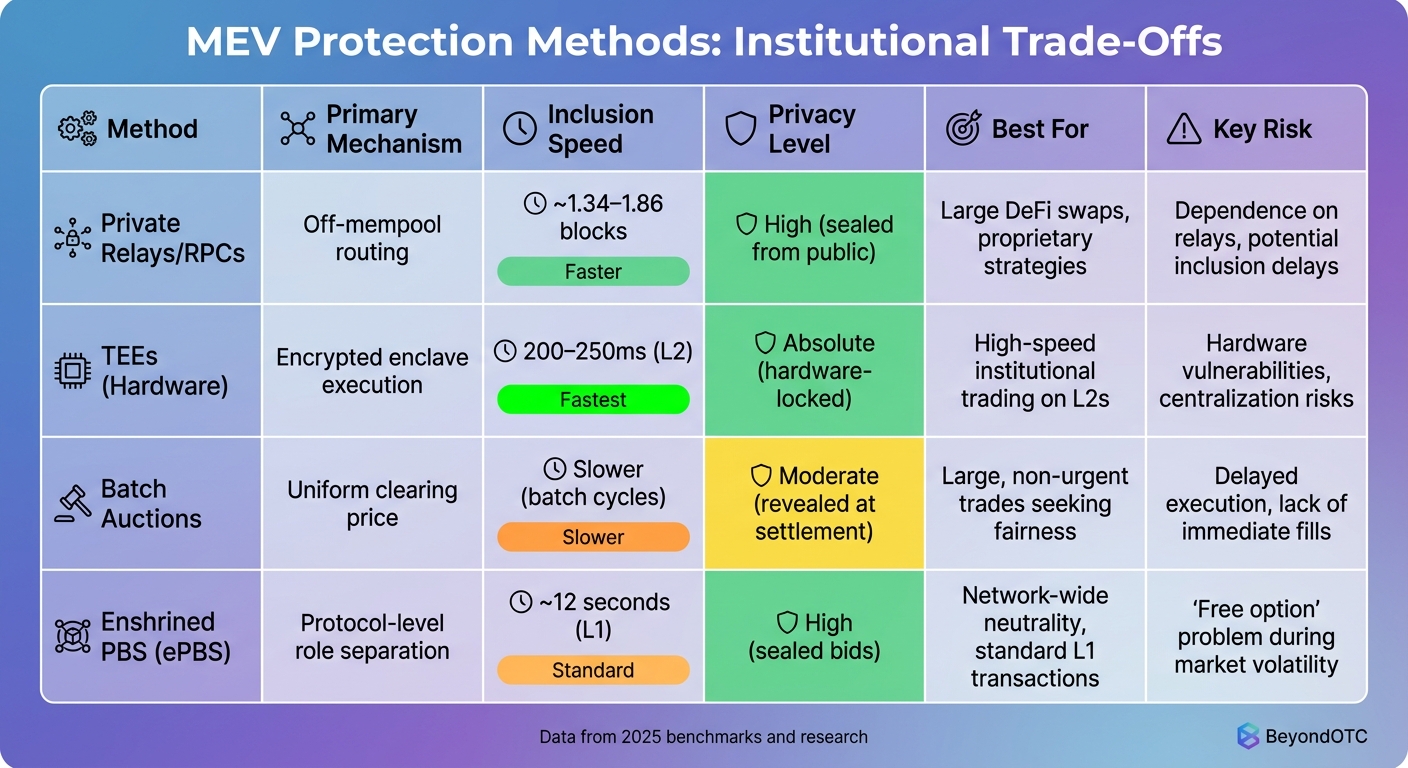
MEV Protection Methods Comparison for Institutional DeFi Trading
Building on the mitigation strategies discussed earlier, let’s dive into a side-by-side comparison of their trade-offs. This should help institutions make an informed choice based on their specific needs.
Trade-Offs Between MEV Protection Tools
Each method designed to mitigate MEV (Maximal Extractable Value) comes with its own strengths and weaknesses. Private relays are a strong option for privacy, as they bypass the public mempool entirely. However, they rely on external infrastructure. A 2025 benchmark reveals that Merkle achieves an average of 1.86 blocks compared to MEV Blocker’s 1.34 blocks for inclusion speed.
Trusted Execution Environments (TEEs), which use hardware-based privacy solutions like Intel TDX, provide quick confirmation times of 200–250 milliseconds on Layer 2 (L2) networks. But they require trust in the hardware provider, and if the secure enclave is compromised, vulnerabilities could arise.
Batch auctions focus on fairness by applying uniform clearing prices, but this comes at the cost of slower execution.
Enshrined Proposer-Builder Separation (ePBS) integrates MEV management directly into the Ethereum protocol. This eliminates reliance on third-party relays but introduces a "free option" issue. Builders may withhold block payloads during market volatility, which could lead to missed blocks. Research indicates that reducing the revelation window to two seconds can lower this risk by 77%.
Understanding these trade-offs is essential for institutions, especially those executing large trades, to align MEV protection tools with their priorities.
Comparison Table
Here’s a breakdown of the key aspects of each MEV protection method:
| Method | Primary Mechanism | Inclusion Speed | Privacy Level | Best For | Key Risk |
|---|---|---|---|---|---|
| Private Relays/RPCs | Off-mempool routing | ~1.34–1.86 blocks | High (sealed from public) | Large DeFi swaps, proprietary strategies | Dependence on relays, potential inclusion delays |
| TEEs (Hardware) | Encrypted enclave execution | 200–250ms (L2) | Absolute (hardware-locked) | High-speed institutional trading on L2s | Hardware vulnerabilities, centralization risks |
| Batch Auctions | Uniform clearing price | Slower (batch cycles) | Moderate (revealed at settlement) | Large, non-urgent trades seeking fairness | Delayed execution, lack of immediate fills |
| Enshrined PBS (ePBS) | Protocol-level role separation | ~12 seconds (L1) | High (sealed bids) | Network-wide neutrality, standard L1 transactions | "Free option" problem during market volatility |
This table highlights the nuances of each method, helping institutions weigh their options based on speed, privacy, and potential risks.
Conclusion
MEV presents both financial and reputational challenges, with losses reaching a staggering $1.38 billion. For instance, a $50 million monthly swap with 10 basis points of slippage could see $50,000 drained due to MEV-related activities.
However, there’s a clear path to protection. Combining private transaction routing, intent-based execution, and strict slippage controls can save institutions an estimated $890 million by 2025. These strategies form the foundation for the advanced solutions provided by BeyondOTC.
BeyondOTC tackles these issues directly. Its private OTC trading solutions bypass the public mempool, effectively neutralizing front-running and sandwich attacks. Additionally, its TVL funding advisory offers robust exposure protection, as evidenced by Aave Arc’s management of $8.7 billion for 31 institutions.
By mitigating MEV, institutions can maximize the value of every trade.
Looking ahead, deploying these tools across all trading scales – from a $10 million transaction to managing billions in exposure – will be essential for protecting capital and ensuring operational efficiency.
FAQs
How can we tell if a trade was sandwiched?
A trade might be sandwiched when two transactions are strategically placed around it: one before (front-running) and one after (back-running). This tactic takes advantage of price impact, allowing the exploiter to profit from the trade’s movement. Such patterns can often be spotted through transaction analysis or monitoring activity in the mempool. However, detecting these becomes trickier when private mempools are involved, as they obscure visibility.
What’s the best MEV protection for a $10M+ swap?
For swaps exceeding $10 million, the most effective way to guard against MEV (Maximal Extractable Value) involves a mix of private transaction tools and advanced execution strategies. These measures help prevent front-running and value extraction during the process.
Using private mempools or encrypted execution layers is key to keeping transaction details confidential. Additionally, protocols that offer intent-based execution or batch auctions provide an added layer of protection by structuring trades in a way that reduces exposure to MEV risks.
By employing these approaches, traders can significantly reduce slippage and ensure that high-value transactions are executed securely and efficiently.
Do private routes affect fill speed or cost?
Private routes are effective at minimizing slippage and reducing front-running risks. However, they don’t typically affect how quickly trades are executed or their overall cost. These aspects – execution speed and expenses – are still shaped by factors such as block competition and the state of liquidity in the market.