Real-world asset tokenization is transforming how institutions manage capital and generate returns. By converting physical and financial assets into blockchain-based tokens, institutions unlock faster settlement, improved liquidity, and access to high-yield opportunities. Key highlights include:
- Tokenized U.S. Treasuries: $8.7 billion market by March 2026, offering stable yields (~4.14%) and 24/7 liquidity.
- Private Credit: High-yield options (8–12%) with $14 billion in cumulative on-chain origination by early 2026.
- Real Estate & Commodities: Fractional ownership enables rental income, while tokenized gold offers trading flexibility.
Major players like BlackRock and Franklin Templeton are leading this shift, supported by regulatory clarity (e.g., GENIUS Act and MiCA). Platforms such as Securitize and Ondo Finance simplify access, while BeyondOTC streamlines large-scale transactions. Institutions now have tools to build yield-focused, diversified portfolios with faster, more efficient settlement systems.
Why Tokenize? Fidelity on Onchain Assets and the Next Phase of Adoption
sbb-itb-7e716c2
Yield Sources from Tokenized Assets
Tokenized assets offer returns supported by on-chain automation, making them a compelling choice for institutional investors. The primary categories for these assets are government securities, private credit, and physical assets like real estate and commodities.
By May 2025, income-generating assets such as private credit and U.S. Treasuries made up about 90% of the total value of RWAs (Real-World Assets) on-chain. The average yield to maturity for tokenized U.S. Treasuries stood at 4.14%, while tokenized private credit typically provided returns between 8% and 12%. Let’s take a closer look at the yield opportunities and operational benefits within each category.
Tokenized US Treasuries and Money Market Funds
Tokenized Treasuries and money market funds combine government-backed yields with modern advantages like 24/7 liquidity and near-instant settlement. These instruments, which include short-term U.S. Treasury bills and reverse repurchase agreements, distribute interest payments through on-chain mechanisms.
By March 2026, the market value of tokenized U.S. Treasuries reached $8.7 billion. A standout example is BlackRock’s BUIDL fund, which managed over $2.5 billion in on-chain assets, maintaining a stable $1.00 net asset value while distributing daily dividends via token credits. Similarly, Franklin Templeton’s OnChain U.S. Government Money Fund (BENJI) held more than $706 million in tokenized shares by April 2025.
"Yield-bearing products such as tokenized U.S. Treasuries, money market funds, and private credit have emerged as the most compelling and compliant entry points for institutional players." – Linh Tran, InvestaX
These instruments are more than just yield generators. Institutions like Standard Chartered and OKX use tokenized money market funds as collateral for off-exchange transactions, boosting capital efficiency without removing assets from regulated custody. MakerDAO also integrates tokenized Treasuries to back decentralized stablecoins, blending traditional yields with on-chain liquidity.
While government-backed products prioritize stability and liquidity, private credit offers higher yields through direct lending opportunities.
Tokenized Private Credit and Debt Instruments
Tokenized private credit provides access to high-yield loan portfolios, previously limited to select investors. These assets generate income through interest payments on loans extended to small and medium-sized enterprises (SMEs).
By May 2025, the average borrower rate for tokenized private credit was 10.16%, significantly outpacing Treasury yields. The cumulative origination of on-chain private credit surpassed $14 billion by early 2026. These tokenized instruments often feature shorter terms of 6–12 months and more flexible redemption options compared to traditional private credit products.
Examples include Mikro Kapital‘s ALTERNATIVE eNote™, which targets a 9.5% annual return through SME lending in emerging markets, with tenors ranging from 6 to 12 months. TradeFlow’s Tokenized Trade Finance Bond, which funds the movement of physical goods, delivers a target return of 8.25% per year. Meanwhile, Ondo Finance’s U.S. Dollar Yield ($USDY) tokenized note, secured by short-term U.S. Treasuries, managed around $630 million in assets by May 2025, catering to institutional and qualified investors.
Tokenized Real Estate and Commodities
Tokenized real estate allows fractional ownership, enabling investors to earn rental income and benefit from property appreciation through smart contracts. Instead of requiring large capital outlays, institutions can hold tokens tied to rental yields from diversified portfolios. Smart contracts streamline yield distribution, cutting out intermediaries, reducing administrative costs, and providing quick liquidity.
Tokenized commodities, on the other hand, primarily serve as price-tracking tools rather than direct yield generators. By March 2026, tokenized gold reached a market cap of $5.9 billion, with an annual trading volume of $178 billion. While gold tokens don’t produce interest, they offer round-the-clock trading and act as a safe haven during geopolitical instability. In 2025, such uncertainties drove institutional investors toward tokenized gold and U.S. Treasuries as safer alternatives to more volatile crypto assets.
Some commodity-backed instruments do generate yield. For instance, trade finance bonds deliver returns by funding the movement of goods like agricultural products or metals. These structured products combine commodity exposure with interest income from financing arrangements, offering institutions a way to enhance liquidity and diversify portfolios efficiently.
Benefits for Institutions: Liquidity and Portfolio Diversification
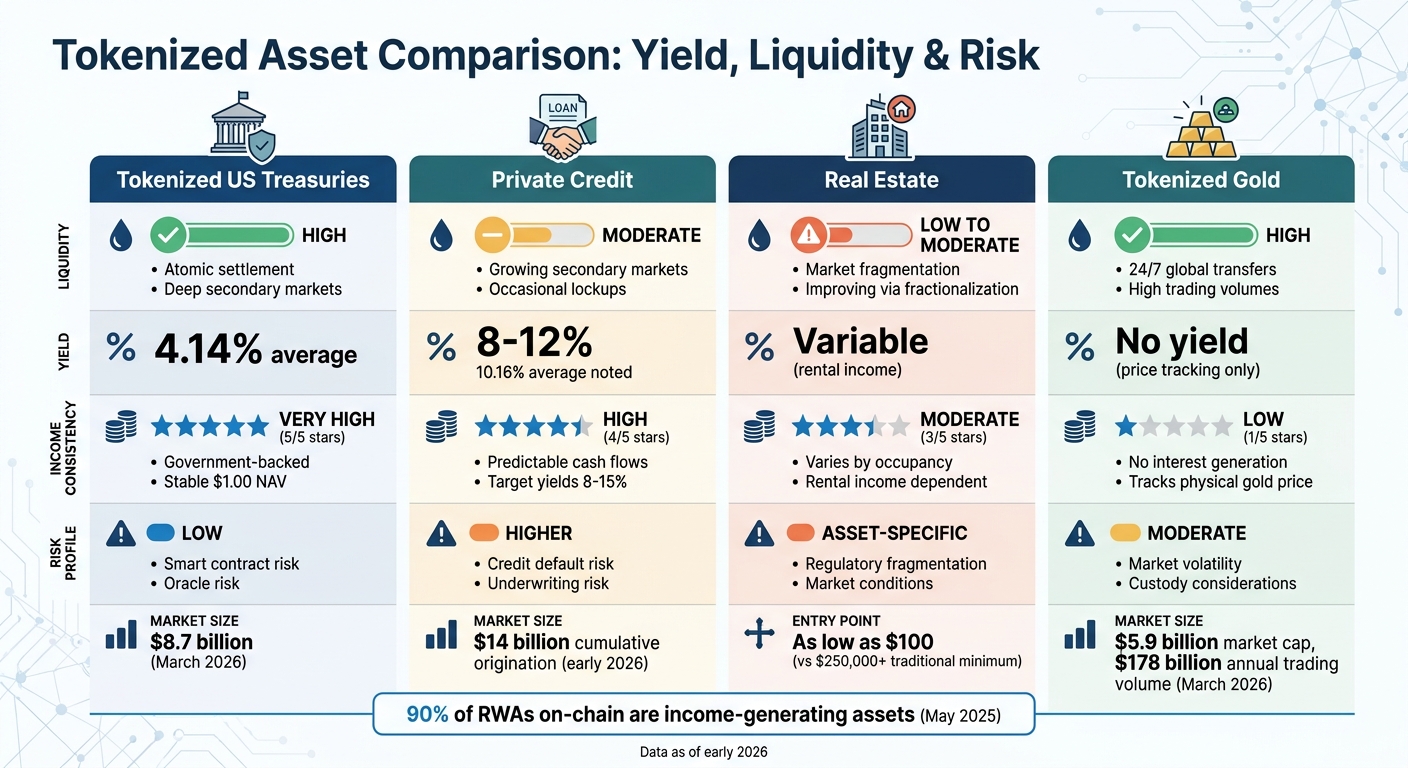
Tokenized Asset Comparison: Yield, Liquidity, and Risk Profiles for Institutional Investors
Tokenized assets don’t just deliver strong yields – they also tackle two major institutional hurdles: capital lockup and restricted access to high-yield opportunities. Traditional financial systems often tie up funds for 24 to 48 hours due to lengthy settlement cycles. This forces institutions to hold significant cash reserves as settlement buffers. Take, for example, a corporate treasury managing $500 million. They might need to keep $75 million to $125 million idle during these delays, missing out on $2.6 million to $4.4 million annually in potential returns at a 3.5% yield.
Tokenization changes the game by eliminating these liquidity bottlenecks. Instead of waiting days, tokenized assets settle in seconds or minutes, and markets run 24/7. This allows institutions to shift idle funds into tokenized Treasuries during downtime and access them instantly when needed. A practical example comes from Standard Chartered and OKX, which implemented a collateral mirroring program. This program lets institutions hold tokenized money market funds in regulated custody while simultaneously using them as trading margin on exchanges.
But liquidity is just one piece of the puzzle. Tokenization also opens up previously inaccessible asset classes. For example, private credit often requires minimum investments of $250,000 or more, but fractionalization now allows entry points as low as $100. This lower barrier enables institutions to diversify across a broader range of income-generating assets. These can include government-backed Treasuries yielding around 4% or private credit instruments offering returns between 8% and 15%. The combination of improved liquidity and expanded diversification options creates a solid foundation for constructing resilient, high-yield portfolios.
The results speak for themselves. By early 2026, the tokenized real-world asset market had grown to between $30 billion and $35.78 billion, with over 630,000 holders – a figure that grew by 10% in just one month.
Comparing Liquidity, Yield Stability, and Risk Profiles
| Asset Type | Liquidity | Income Consistency | Primary Risk Profile |
|---|---|---|---|
| Tokenized US Treasuries | High – Atomic settlement and deep secondary markets | Very High – Backed by the U.S. government with a stable $1.00 NAV | Low – Primarily smart contract or oracle risk |
| Private Credit | Moderate – Growing secondary markets with occasional lockups | High – 8%–15% target yields with predictable cash flows | Higher – Credit default and underwriting risk |
| Real Estate | Low to Moderate – Market fragmentation improving via fractionalization | Moderate – Rental income varies by occupancy | Asset-specific – Influenced by regulatory fragmentation |
| Tokenized Gold | High – 24/7 global transfers with high trading volumes | Low – No yield; price tracks physical gold | Moderate – Subject to market volatility and custody considerations |
This diverse mix allows institutions to build portfolios that leverage the strengths of each asset class. For instance, Treasuries can serve as liquid reserves, private credit can enhance yield, and real estate can provide diversification. All of this operates within a blockchain framework that ensures near-instant settlement and continuous market access, creating a portfolio that balances stability, returns, and flexibility.
Platforms and Tools for Accessing Tokenized RWA
Institutions looking to dive into tokenized real-world assets (RWA) need platforms that handle everything from legal structuring to token issuance, compliance, and distribution. By 2026, the leading platforms in this space have developed integrated systems that streamline these processes while adhering to regulatory requirements. This approach not only ensures compliance but also makes it easier for institutional investors to access higher yields.
As of April 2026, the tokenized RWA market reached a staggering $30 billion, with over 70% concentrated in U.S. Treasuries and money market products. Securitize has emerged as a leader in the institutional market, providing the infrastructure for BlackRock’s BUIDL fund, which boasts $2.4 billion in assets. Securitize holds all four major SEC registrations – Broker-Dealer, Transfer Agent, ATS, and RIA – enabling it to oversee the entire lifecycle of tokenized assets, from issuance to secondary trading, across nine blockchains. Ondo Finance is another key player, with its USDY product amassing $2.6 billion in total value locked. Ondo specializes in Treasury-backed yields and integrates with DeFi protocols.
Tokenized private credit and trade finance follow a different operational model. Centrifuge has tokenized over 1,768 assets, achieving a total value locked (TVL) of more than $1.8 billion. It uses SPV structures and relies on pool delegate due diligence instead of traditional broker-dealer methods. Similarly, Maple Finance focuses on institutional credit, managing over $500 million across Ethereum and Solana.
"Collaboration with Centrifuge and Anemoy represents a significant step forward in bridging traditional and decentralized finance by bringing robust institutional collateral pools into the decentralized autonomous organization and stablecoin ecosystems." – Nick Cherney, Head of Innovation, Janus Henderson
When choosing a platform, institutions typically evaluate three main factors: regulatory status, asset specialization, and settlement mechanics. For those dealing with Treasuries, platforms with SEC-registered transfer agent status are essential for automated corporate actions. Private credit investors, on the other hand, benefit from SPV-based structures with clear, detailed pool-level data. Platforms offering T+0 atomic settlement – where trade execution, payment, and ownership transfer occur simultaneously – are ideal for reducing counterparty risk, unlike the traditional T+2 settlement cycle. These features are critical for transforming tokenized assets into reliable sources of yield.
Below is a summary of the top platforms by asset type, showcasing their compliance frameworks, blockchain integrations, and estimated assets under management (AUM) or TVL in 2026:
Platforms by Asset Type
| Platform | Primary Asset Class | Compliance Framework | Blockchain(s) | AUM/TVL (Est. 2026) |
|---|---|---|---|---|
| Securitize | Treasuries, Private Funds | SEC-registered BD/TA | Multi-chain (9+) | $3B+ |
| Ondo Finance | Treasuries, Money Markets | Regulated Fund Wrapper | Multi-chain (5+) | $2.6B |
| Centrifuge | Private Credit, Trade Finance | SPV-based | Ethereum, Centrifuge Chain | $1.8B+ |
| Maple Finance | Institutional Credit | Pool Delegate Due Diligence | Ethereum, Solana | $500M+ |
| Franklin Templeton | Government Money Funds | SEC-registered Mutual Fund | Stellar, Polygon | $410M+ |
| OWNR | Mortgage-Backed Securities | SEC-compliant SPV | EVM-compatible | Upcoming |
These platforms are shaping the future of tokenized assets, offering the tools and efficiencies needed to meet the demands of institutional trading strategies. Each platform’s unique strengths align with specific asset classes, setting the foundation for advanced over-the-counter (OTC) opportunities. Explore more insights on the BeyondOTC blog.
OTC Trading Strategies for Institutions via BeyondOTC
BeyondOTC leverages its streamlined platform to optimize OTC trading strategies, offering tailored solutions for institutions handling large-scale transactions.
BeyondOTC OTC Solutions for RWA Deals
When institutions execute sizable tokenized asset transactions, they often encounter a key obstacle: public exchanges lack the liquidity to handle block trades without triggering significant price movements. BeyondOTC solves this by directly linking institutional clients with liquidity providers and counterparties, enabling smoother high-volume transactions for tokenized Real World Assets (RWAs). This approach is particularly essential since tokenized assets typically have thinner liquidity compared to traditional cryptocurrencies.
The platform has already demonstrated its ability to handle substantial volumes, facilitating over $250 million in Bitcoin transactions and $30 million in OTC Altcoin trades. For tokenized RWAs, BeyondOTC employs custom algorithms and provides 24/7 support to manage complex deals efficiently. Its atomic settlement feature eliminates counterparty risk, freeing up capital for institutions to reinvest in yield-generating instruments within the same day. This approach maximizes returns and optimizes treasury management.
TVL Funding Advisory for Tokenized Yield Exposure
BeyondOTC also offers advisory services to help institutions allocate capital into yield-generating tokenized RWAs. The platform has directed over $40 million into TVL DeFi opportunities and raised more than $5 billion for institutional TVL clients. These services include thorough protocol evaluations, risk assessments, and strategies for optimizing annual percentage yields (APY) on tokenized Treasuries, private credit, and money market funds.
To mitigate risks, the advisory team emphasizes smart monitoring to address vulnerabilities in smart contracts and oracle systems. They also use accumulation token models instead of rebasing structures, simplifying accounting and tax reporting for traditional fund operators. With the tokenized US Treasury market growing by 127% between January 2025 and early 2026 to reach $8.9 billion, BeyondOTC provides the expertise needed for institutions to tap into these expanding opportunities while maintaining strict risk controls.
Networking and Legal Consultancy for Secure RWA Participation
In addition to trading and advisory services, BeyondOTC offers extensive legal and networking support to ensure secure participation in RWA markets.
Regulatory compliance is a critical aspect of RWA transactions. BeyondOTC connects institutions with legal experts who specialize in creating compliant structures like Special Purpose Vehicles (SPVs) and navigating regulations such as the US GENIUS Act (effective July 2025) and the EU’s MiCA framework. Its global network spans over 50 countries, facilitating cross-border transactions and international settlements.
Through its "Deal Room", institutions gain access to secure data sharing and receive real-time updates on exclusive RWA investment opportunities. BeyondOTC also connects clients with venture capital firms, high-net-worth individuals, market makers, and institutional buyer/seller mandates. This comprehensive ecosystem ensures institutions can operate within a secure and compliant framework while exploring jurisdictions with favorable regulatory environments, such as Dubai under VARA or Singapore’s forward-thinking digital asset policies.
| BeyondOTC Service | Institutional Benefit | Key Features |
|---|---|---|
| OTC Solutions | Execute large trades with minimal market impact | Deep liquidity, block trade support, custom algorithms |
| TVL Advisory | Maximize returns on idle capital | Thorough protocol vetting, risk management, APY optimization |
| Fundraising Advisory | Secure and efficient capital allocation | Due diligence, term sheet preparation, investor connections |
| Global Network | Simplify cross-border RWA transactions | Multi-currency support, 50+ countries, international settlement |
Conclusion
Tokenized real-world assets (RWAs) are reshaping the way institutions generate yield. By addressing inefficiencies like T+1 liquidity taxes and enabling 24/7 capital deployment, these digital assets provide a streamlined and dynamic approach to managing institutional capital. The integration of programmable collateral that operates at the speed of digital technology further enhances this transformation.
"RWAs are winning because they solve a boring problem: cash management and predictable yield. That is why institutions show up. They are not here for culture. They are here for rails." – Moses Otieno, InfluxJuice
The move from traditional T+1 settlement processes to atomic (T+0) transactions eliminates the need for idle settlement buffers, freeing up millions of dollars that were once tied up in inefficiencies. This shift turns what used to be unavoidable capital constraints into flexible, optional choices.
Platforms like BeyondOTC play a crucial role in this evolution by providing infrastructure tailored to institutional needs. They facilitate secure, large-scale OTC transactions, while also connecting clients with legal and regulatory experts to ensure compliance and proper SPV structuring. This comprehensive approach aligns with the market’s transition toward faster, more efficient settlement cycles.
As regulatory clarity improves – with frameworks like the GENIUS Act and MiCA offering guidance – and as major players such as BlackRock and Franklin Templeton expand their tokenized portfolios, institutions now have a clear roadmap for adopting digital financial solutions. Tokenized RWAs are emerging as the foundation for modern institutional treasury management, delivering predictable yields through programmable, liquid, and regulation-compliant digital systems.
FAQs
How do tokenized RWAs actually pay yield?
Tokenized real-world assets (RWAs) create income by tapping into the earnings of the assets they represent, such as private credit, government bonds, or real estate. This income – whether it’s interest, dividends, or rent – is distributed to token holders through blockchain-based smart contracts. These contracts simplify and automate the payment process. Additionally, some tokenized assets may generate returns through decentralized finance (DeFi) methods like lending or liquidity pools, depending on how they’re structured and utilized.
What are the biggest risks with tokenized Treasuries and private credit?
Tokenized assets come with their own set of challenges. One major concern is liquidity issues, as these assets often face restricted secondary trading and limited transfer options – this is particularly true for private credit. On top of that, tokenization doesn’t eliminate core risks like underlying credit problems or operational hurdles. These points underscore why thorough due diligence is essential when dealing with tokenized Treasuries and private credit.
How can institutions use OTC trading to avoid slippage in RWA block trades?
Institutions looking to minimize slippage in RWA block trades can turn to OTC (over-the-counter) trading. By handling large transactions off-exchange, this method avoids the pitfalls of public order books, where large orders can significantly impact market prices. OTC trading allows for direct price negotiation, giving institutions more control over pricing and ensuring transactions are handled efficiently. This approach not only reduces market impact but also helps maintain precision in pricing for large-scale trades.