OTC trading plays a key role in solving liquidity challenges in tokenized asset markets. Tokenized assets, which represent traditional assets like real estate or gold on blockchain, make investing more accessible through fractional ownership. However, liquidity remains a hurdle due to low trading volumes, fragmented markets, and regulatory constraints.
Here’s how OTC trading addresses these issues:
- Direct Negotiations: OTC trading bypasses public exchanges, enabling large trades without disrupting market prices.
- 24/7 Trading: Unlike traditional markets, OTC desks operate around the clock, offering flexibility for institutions.
- Instant Settlement: Trades settle in seconds via blockchain, reducing counterparty risk compared to the two-day settlement in traditional markets.
- Access to Liquidity: OTC desks connect buyers and sellers to private liquidity networks, overcoming fragmented market challenges.
For example, Flow Traders launched a 24/7 OTC liquidity service in 2026, supporting tokenized assets like Tether Gold and Franklin Templeton’s BENJI. This service caters to institutional clients seeking deeper liquidity and efficient, large-scale transactions.
OTC trading is transforming tokenized asset markets by enabling smoother, faster, and more secure transactions, bridging the gap between emerging blockchain-based assets and conventional financial systems.
What Are Tokenized Assets and Why Is Liquidity Difficult?
Understanding Tokenized Assets
Tokenized assets are digital versions of ownership rights tied to real-world assets, recorded on a blockchain or distributed ledger. The tokenization process involves four main steps: selecting the asset, choosing a blockchain, setting up a smart contract, and minting the asset onto the blockchain.
These assets fall into several categories, including financial instruments (like stocks and bonds), real assets (such as real estate or commodities), unique assets (art and collectibles), and intangible assets (intellectual property or carbon credits). Tokens can be structured as "on-chain", where legal information is managed directly on the blockchain, or "off-chain", where tokens act as digital representations while the actual rights remain in traditional registries.
Smart contracts play a key role in automating processes like distributing dividends, ensuring compliance, and handling interest payments. This automation reduces reliance on intermediaries like brokers or clearinghouses, which are often necessary for traditional assets. A notable example is the St. Regis Aspen Resort, which used "Aspen Coin" to fractionalize ownership of high-value real estate.
Another example comes from Hamilton Lane, which used tokenization to lower its minimum investment threshold from $5 million to just $500. This drastic reduction – by a factor of 10,000 – allowed a much larger group of investors to access institutional-grade opportunities.
While tokenization simplifies access and automates many functions, it also introduces challenges, especially when it comes to liquidity.
Common Liquidity Problems in Tokenized Markets
Even with $25 billion in on-chain value projected by mid-2025, liquidity in tokenized markets faces significant hurdles. Regulatory barriers are one of the biggest issues. Many tokenized assets are classified as securities, meaning they can only be traded among whitelisted, KYC-verified, or accredited investors. This heavily restricts the pool of potential buyers and sellers.
Another challenge is market fragmentation. Liquidity is scattered across decentralized platforms, specialized custodial systems, and informal over-the-counter (OTC) channels, instead of being concentrated in centralized marketplaces. Technical limitations, such as high gas fees, scalability issues, and poor cross-chain interoperability, further complicate trading.
Valuation challenges also create barriers. Determining fair market values for unique or complex assets, like real estate or private loans, is difficult. This often results in wide bid-ask spreads and "liquidity discounts". For example, tokenized residential properties are traded, on average, only once a year.
Investor behavior compounds these issues. Many tokenized assets designed for institutional investors are treated as "buy-and-hold" instruments to generate yield, rather than being actively traded. Take BlackRock’s BUIDL fund as an example: despite handling over $1.8 billion in monthly transfers as of mid-2025, it had just 85 holders and 30 monthly active addresses. Most of the activity involved minting and redemption rather than active trading. By contrast, commodity-backed tokens like PAXG demonstrate much higher liquidity, with over 52,000 monthly transfers and 69,000 holders during the same period.
As Rischan Mafrur from Macquarie University’s Department of Applied Finance explains:
"Realizing the liquidity potential of RWAs requires coordinated progress across legal, technical, and institutional domains".
sbb-itb-7e716c2
How OTC Trading Solves Liquidity Problems for Tokenized Assets
How OTC Trades Work for Tokenized Assets
OTC trading offers a direct and efficient solution to the liquidity challenges often faced by tokenized assets. Unlike public exchanges, OTC trades occur through direct negotiations between two parties, completely bypassing public order books. The process usually begins with a Request for Quote (RFQ), where a buyer or seller inquires about pricing for a specific volume. Once both sides agree on the terms, blockchain technology and smart contracts handle the asset and payment transfers almost instantly.
This method removes the need for traditional intermediaries. In fact, tokenized OTC trades can settle within seconds on a blockchain – far faster than the conventional T+2 (two-day) settlement cycle in traditional financial markets. This near-instant settlement significantly lowers counterparty risk, ensuring that traders don’t have to worry about whether the other party will deliver on their end of the deal.
A good example of this approach is the service offered by Flow Traders. It enables institutional clients to trade and hedge tokenized equity and commodity positions against fiat currencies or stablecoins, using direct FIX connectivity or high-touch execution methods.
Benefits of Using OTC Trading
One of the key advantages of OTC trading is its ability to minimize market impact. Large trades on public exchanges often cause "slippage", where the price shifts dramatically as the order is processed. OTC trading avoids this by keeping transactions private, safeguarding both the price and the strategies of institutional players from being exploited by other market participants.
Another major benefit is around-the-clock market access. Unlike traditional exchanges, which operate during fixed hours (e.g., 9:30 AM to 4:00 PM), OTC desks for tokenized assets provide 24/7 liquidity. This enables institutions to manage risk and adjust their positions during weekends or overnight sessions when conventional markets are closed. Marc Jansen, Co-Chief Trading Officer at Flow Traders, highlighted this flexibility:
"The demand mainly comes from institutions that want the ability to manage exposure outside traditional market hours".
Additionally, OTC desks serve as liquidity aggregators, connecting to extensive networks of providers to source assets from fragmented markets. With over 450 exchanges and more than 17,000 tokens in circulation, liquidity is often scattered. OTC desks consolidate these fragmented pools, making it easier to execute large trades. Instead of charging flat fees, OTC desks typically earn through the bid-ask spread or by taking a small percentage of the total trade value.
In some cases, trading activity in tokenized and synthetic markets for large-cap U.S. stocks has already reached 2–3% of the notional trading volume of their primary U.S. listings. These advantages demonstrate the growing importance of specialized OTC solutions, such as those provided by BeyondOTC, in addressing liquidity issues within the tokenized asset market.
Tokenized Assets, Explained in Under 4 Minutes
Main Benefits of OTC Trading for Tokenized Assets
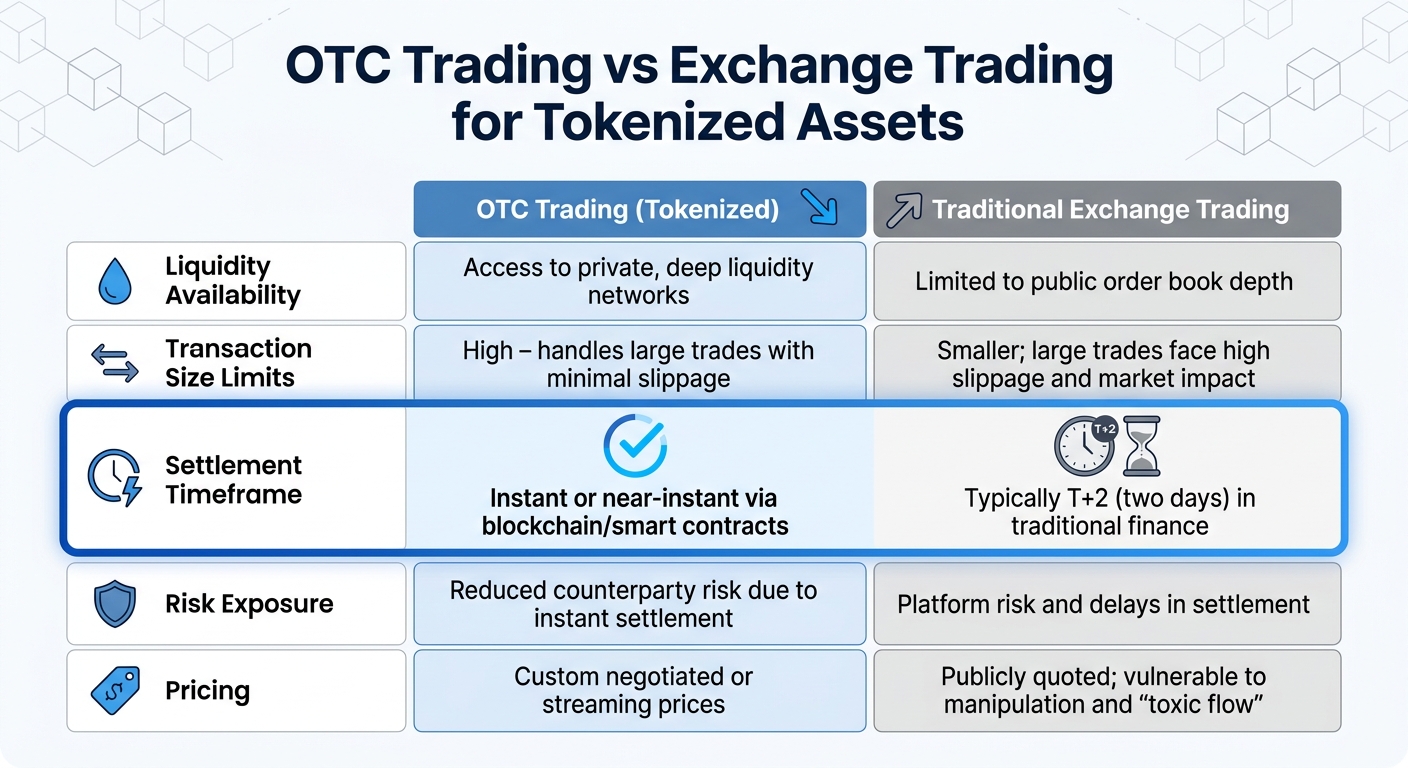
OTC Trading vs Exchange Trading for Tokenized Assets Comparison
OTC trading offers a way to navigate market fragmentation and settlement delays, but its benefits go even further. It provides better access to liquidity and more precise price-setting mechanisms, making it a standout option for tokenized asset trading.
Liquidity Access and Price Setting
One of the standout features of OTC trading is its ability to tap into private liquidity networks. These networks, comprised of liquidity providers and market makers, open up access to capital that you won’t find on public order books.
Pricing is another area where OTC trading shines. By relying on direct negotiations between parties, it often achieves tighter bid-ask spreads than public exchanges. Matthew Newton, Director of Trading at Galaxy, explains:
"OTC allows for trading large volumes and limiting market impact as a specialist can use algos and execute across multiple venues at once".
This approach minimizes toxic flows and shields prices from large-order disruptions. Some providers, like FinchTrade, even offer quotes for over 100 different tokens, extending beyond major cryptocurrencies like Bitcoin and Ethereum. These advantages in liquidity and pricing are key for fostering trust among institutional players.
Meeting Regulations and Building Institutional Trust
Regulatory compliance plays a crucial role in OTC trading. Leading OTC desks adhere to strict KYC/AML protocols and operate under the watchful eye of regulatory bodies such as the SEC (United States), FINMA (Switzerland), or MiCAR guidelines (European Union). While these requirements may seem complex initially, they are essential for gaining the trust of institutional investors.
Nazia Siddiqi, Head of Credit Risk at Galaxy, highlights the importance of due diligence in this context:
"Effective due diligence is the cornerstone of prudent credit risk management. By thoroughly evaluating counterparties, institutions can make informed decisions, mitigate potential losses, and build sustainable relationships".
In addition to regulatory safeguards, post-trade settlement options further enhance security. These mechanisms allow firms to confirm prices before transferring assets, reducing the risks tied to platform insolvency. Together, regulatory oversight and advanced settlement processes make OTC trading an appealing choice for institutions managing significant tokenized assets.
OTC Trading vs Exchange Trading Comparison
A quick comparison highlights the key differences between OTC trading and traditional exchange trading for tokenized assets:
| Feature | OTC Trading (Tokenized) | Traditional Exchange Trading |
|---|---|---|
| Liquidity Availability | Access to private, deep liquidity networks | Limited to public order book depth |
| Transaction Size Limits | High – handles large trades with minimal slippage | Smaller; large trades face high slippage and market impact |
| Settlement Timeframe | Instant or near-instant via blockchain/smart contracts | Typically T+2 (two days) in traditional finance |
| Risk Exposure | Reduced counterparty risk due to instant settlement | Platform risk and delays in settlement |
| Pricing | Custom negotiated or streaming prices | Publicly quoted; vulnerable to manipulation and "toxic flow" |
One of the most striking advantages is the speed of settlement. While traditional markets rely on a T+2 settlement cycle, tokenized OTC trades can settle in seconds, thanks to blockchain technology. For example, JPMorgan’s Onyx blockchain platform already processes billions of dollars in tokenized transactions, showcasing how institutions are embracing this efficiency. Instant settlement not only frees up capital quickly but also eliminates the counterparty risks tied to longer settlement periods.
How BeyondOTC Supports OTC Trading for Tokenized Assets
Navigating the tokenized asset markets requires strong networks and reliable infrastructure, and BeyondOTC delivers both. Acting as a digital bridge, the agency connects founders, institutional clients, and investors to deep liquidity pools and OTC deals, enabling large-scale transactions in tokenized assets.
With a presence in over 50 countries and connections to more than 100,000 industry professionals, BeyondOTC taps into a vast global network. This reach has facilitated major transactions, including over $250 million in Bitcoin trades, $30 million in OTC altcoin transactions, and more than $5 billion in institutional Total Value Locked (TVL) solutions. This extensive network forms the backbone of its services, supporting high-volume, efficient transactions.
BeyondOTC’s OTC Trading Services
BeyondOTC specializes in handling large-scale transactions while minimizing their impact on the market. The platform provides block trade execution and custom algorithms tailored for institutional trades. Using a smart matching algorithm and secure deal rooms, BeyondOTC ensures confidentiality by managing buyer and seller mandates during negotiations.
Key features include:
- 24/7 support for global trading needs
- International settlement and multi-currency capabilities
- Integrated due diligence to reduce counterparty and smart contract risks
These tools ensure that both buyers and sellers can execute trades securely and efficiently, even at high volumes.
BeyondOTC’s Approach to Liquidity Solutions
BeyondOTC enhances liquidity access by offering tailored solutions. Using its extensive industry connections, the platform links clients to established OTC desks, institutional investors, and market makers, providing liquidity that isn’t visible on public order books.
For institutions interested in decentralized finance (DeFi), BeyondOTC delivers specialized TVL investment solutions. These include smart monitoring and APY optimization, ensuring clients can maximize returns. The agency has raised over $2 billion for clients through its advisory services and allocated more than $40 million to DeFi TVL. Additionally, BeyondOTC has facilitated over 1,000 active deals, giving clients access to vetted DeFi protocols and exclusive OTC opportunities.
What’s Next for OTC Trading in Tokenized Asset Markets
The world of tokenized assets is evolving rapidly, and OTC trading is adapting to keep pace. As of March 17, 2026, the tokenized asset market (excluding stablecoins) had grown to an impressive $27.1 billion, marking a fourfold increase over the previous year. Tokenized US Treasuries alone make up $11.59 billion of that total, with tokenized gold surpassing $6 billion in value. These numbers highlight the momentum behind this market and the technologies reshaping OTC trading.
Expanding Asset Classes and Hybrid Trading Models
OTC trading is no longer limited to cryptocurrencies. It now includes tokenized real estate, private equity, carbon credits, fine art, and equities. Tokenized equities, for instance, have already surpassed $1 billion in market value. At the same time, hybrid liquidity models are bridging the gap between traditional finance and decentralized protocols. These models allow investors to mint stablecoins against tokenized assets without having to sell their underlying holdings.
A notable example is the launch of Aave Labs’ "Horizon" platform in August 2025. This institutional platform enables users to mint stablecoins like GHO, USDC, and RLUSD against tokenized assets such as Superstate US Treasury funds and Centrifuge-tokenized Janus Henderson products. This approach provides liquidity while preserving ownership – an investor could pledge a tokenized building, mint stablecoins against it, and use that capital elsewhere.
Fractionalization is another key driver, opening up access to alternative assets through OTC channels. This shift is breaking down barriers between institutional and retail markets, creating new pools of liquidity that traditional finance never offered.
Technological Advancements in OTC Trading
The diversification of asset classes and trading models is matched by technological improvements that are revolutionizing OTC trading. Automated OTC trading, powered by smart contracts, enables instant settlement (T+0), replacing the traditional two-day settlement period. Blockchain technology supports this speed – Ethereum achieves probabilistic finality in 12–15 minutes, while Solana can finalize transactions in just 400 milliseconds.
In March 2026, Flow Traders introduced a 24/7 digital asset OTC service. This offering includes tokenized assets like Franklin Templeton’s BENJI and Tether Gold (XAU₮), leveraging direct FIX connectivity and Electronic Communication Networks (ECNs). CEO Thomas Spitz emphasized:
"Tokenization has the potential to be one of the next major steps in that evolution… creating new infrastructure to manage equity risk overnight and across global trading sessions."
Tokenized markets are already making an impact. For some large-cap U.S. stocks, activity in their tokenized versions has reached 2–3% of the notional trading volume of their primary U.S. listings. The move from manual, broker-driven systems to electronic platforms with smart order routing and algorithmic execution – dubbed "OTC 2.0" – is accelerating this transformation. Institutional participation in crypto trading climbed from 26% in 2023 to about 42% by late 2025, with crypto OTC market volumes growing 106% year-over-year in 2024.
Conclusion
OTC trading has become a key player in providing liquidity for tokenized assets, tackling challenges that traditional exchanges often can’t handle. By enabling large trades to happen privately and reducing market impact, OTC desks allow institutions to move significant amounts in tokenized real estate, treasuries, equities, and commodities without causing broader market disruptions. Over time, OTC trading has shifted from its traditional roots to modern platforms, revolutionizing access to liquidity. Thanks to smart contract integration, trades now settle almost instantly on the blockchain, significantly cutting down counterparty risks. As of late 2025, institutional investors account for over 60% of crypto trading volume, highlighting how crucial OTC trading has become in bridging traditional finance and digital markets.
Innovations like 24/7 digital asset OTC services illustrate how OTC trading is evolving into a programmable, global financial system. These advancements show that OTC trading is no longer just a tool for institutions – it’s becoming a vital part of global financial infrastructure.
In the words of Larry Fink, CEO of BlackRock:
"Every asset will eventually be tokenized".
OTC trading lays the groundwork to make that vision a reality. By connecting fragmented liquidity pools and minimizing settlement risks, it creates opportunities for both institutional investors and everyday participants. With technology advancing and more assets moving on-chain, OTC trading continues to serve as the critical link between decentralized tokenized markets and the traditional financial world.
FAQs
When should I use OTC instead of an exchange for tokenized assets?
Over-the-counter (OTC) trading is a smart option for handling large transactions involving tokenized assets, especially when privacy, direct negotiation, or trading outside regular market hours is essential. This approach minimizes price slippage and reduces market impact, which is why it’s often favored by institutional investors and high-net-worth individuals.
OTC trading also provides continuous liquidity and greater flexibility, making it perfect for sizable or complex trades that demand speed and discretion – capabilities that standard exchanges may not always offer.
What risks still exist with “instant” blockchain settlement?
While "instant" blockchain settlement sounds appealing, it comes with its own set of challenges. One major concern is the risk of hacking and cyberattacks. Since blockchain transactions are irreversible, any breach could lead to significant losses with no way to recover funds.
Another issue is the potential for technical failures. Bugs in smart contracts or flaws in the system can disrupt transactions, leaving them incomplete or delayed. Network congestion is another factor that can slow down the process, undermining the promise of speed and reliability.
These vulnerabilities highlight the importance of addressing both security and technical stability to maintain trust in blockchain-based settlements.
How do KYC limits impact OTC trading for tokenized assets?
KYC (Know Your Customer) rules are essential in OTC trading for tokenized assets. They ensure compliance with regulations while prioritizing investor protection. These rules often involve identity verification or trade size limitations, which can restrict access for participants who fail to meet the necessary requirements. By implementing these measures, the marketplace works to prevent illegal activities, adhere to regulatory standards, and create a secure, transparent environment – primarily catering to verified institutional investors and accredited individuals.