
Blockchain’s environmental impact is a double-edged sword. While it improves supply chain transparency and material tracking, its energy use and hardware waste raise concerns. Lifecycle Assessment (LCA) offers a structured way to evaluate blockchain’s full environmental footprint, from hardware production to disposal.
Key takeaways:
- Blockchain can enhance real-time data accuracy for supply chains, reducing inefficiencies.
- Energy-intensive systems like Proof of Work (PoW) contribute to high electricity use, but alternatives like Proof of Stake (PoS) are more efficient.
- Blockchain supports circular economy goals through material tracking and Digital Product Passports (DPPs), aiding resource reuse and waste reduction.
- Challenges include high setup costs, scalability issues, and data privacy concerns.
The verdict? Blockchain has potential to support circular systems but must address its own resource demands to achieve long-term balance.
MILLE – Blockchain Technology & Circular Economy
sbb-itb-7e716c2
Lifecycle Stages of Blockchain Networks
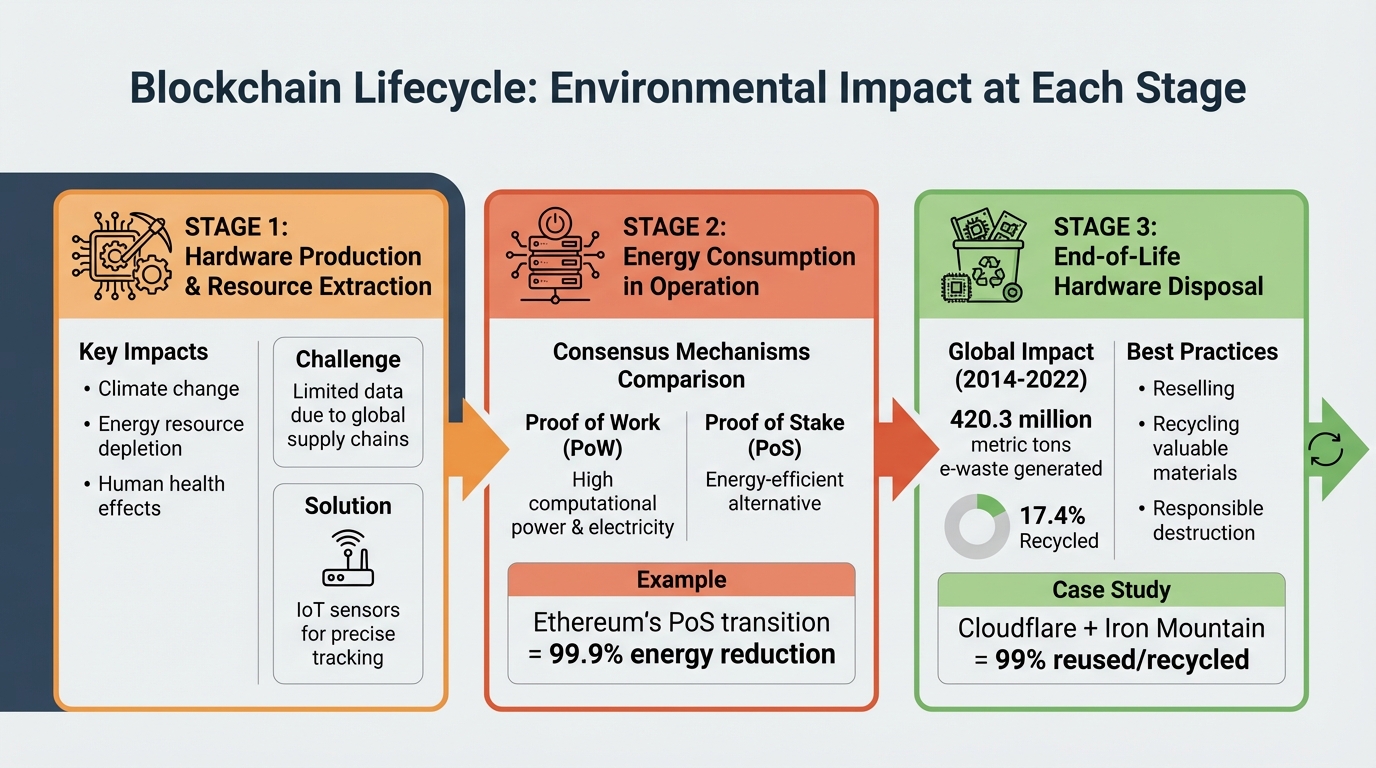
Blockchain Lifecycle Assessment: Three Environmental Impact Stages
To fully understand blockchain’s impact on the environment, it’s crucial to look at its entire lifecycle – from sourcing raw materials to disposing of outdated hardware. Let’s start with the environmental effects tied to hardware production.
Hardware Production and Resource Extraction
Even before a blockchain network goes live, its environmental footprint begins with the production of mining rigs and servers. Manufacturing these components often involves mining and processing raw materials, which can negatively affect areas like climate change, energy resources, and human health.
Tracking these impacts isn’t easy due to limited data, confidentiality concerns, and the global nature of supply chains. However, technologies like IoT sensors and actuators could help by providing more precise data on the environmental costs of production.
Energy Consumption in Consensus Mechanisms
Once operational, blockchain networks use energy-intensive consensus mechanisms to validate transactions. The environmental impact of these protocols varies significantly. For example, Proof of Work (PoW) demands high computational power and electricity, while Proof of Stake (PoS) is much more energy-efficient. A prime example is Ethereum’s transition to PoS, which cut its energy consumption by over 99.9%.
End-of-Life Disposal of Blockchain Hardware
The lifecycle ends with the disposal of outdated blockchain hardware, contributing to the global e-waste problem. Between 2014 and 2022, 420.3 million metric tons of e-waste were generated globally, yet only 17.4% of it was recycled.
Proper disposal methods can include reselling, recycling valuable materials, or, as a last resort, destruction. In December 2022, Cloudflare showcased a sustainable approach by collaborating with Iron Mountain to ensure 99% of its decommissioned hardware was either reused or recycled. Their detailed sustainability reporting highlights how responsible end-of-life management can minimize waste while recovering valuable resources.
Blockchain’s Role in the Circular Economy
Blockchain’s role in supporting a circular economy is becoming increasingly evident, even as its own environmental impact is scrutinized. The technology offers powerful tools to help implement circular economy principles by enabling immutable records of material flows. This capability allows businesses to track resources with greater precision and reduce waste.
Transitioning from the traditional "take-make-dispose" model to a circular approach requires detailed, accurate data about products throughout their lifecycle. Blockchain steps in by replacing general market data with real-time, supplier-specific information. When paired with IoT devices like sensors and RFID tags, blockchain automates data collection, cutting down on the costs and inefficiencies of manual tracking.
This tracking capability aligns with the "4R" framework – Reduce, Reuse, Recycle, Recover – helping stakeholders extend the life of materials and streamline end-of-life management. Additionally, blockchain’s ability to provide a single, unchangeable record reduces reliance on third-party audits.
Supply Chain Transparency and Material Tracking
Blockchain technology strengthens supply chain transparency by maintaining an unalterable ledger of material movements. This system ensures that sustainable practices can be verified from the start of the supply chain to the final product. Such transparency is critical, especially considering that approximately 99% of consumer goods are discarded within six months of purchase.
Real-world examples highlight blockchain’s potential. Since 2014, Walmart has partnered with IBM’s Hyperledger Fabric to trace pork and mangoes within its supply chain, improving traceability and cutting down on food waste for these products. Another success story is the Plastic Bank initiative, which has motivated 1 million participants across countries like Haiti, Indonesia, and the Philippines to collect 3 million kilograms of plastic waste. Participants are rewarded with blockchain-secured digital tokens that can be exchanged for goods.
Digital Product Passports
Digital Product Passports (DPPs) complement blockchain’s tracking capabilities by storing detailed lifecycle data. These passports create permanent records on blockchain networks, empowering both businesses and consumers to make informed choices about production and consumption. DPPs automatically capture environmental data under various conditions, offering valuable insights into sustainability.
By standardizing environmental data across global supply chains, DPPs help stakeholders verify compliance with sustainability standards and improve lifecycle assessments. Industries like construction, textiles, and electronics are already exploring DPPs for precise material tracking, which is crucial for reducing waste and managing resources responsibly.
"A circular economy is one that is restorative and regenerative by design and aims to keep products, components, and materials at their highest utility and value at all times, distinguishing between technical and biological cycles." – Ellen MacArthur Foundation
Despite its promise, blockchain adoption in this area remains limited. A systematic review found only 31 peer-reviewed studies on blockchain and lifecycle assessment (LCA) integration as of June 2024, with 74% of research originating from high-income economies. Barriers like high maintenance costs and concerns over data privacy continue to hold many organizations back.
Case Studies and Real-World Applications
DIBIChain‘s Supply Chain Innovations
DIBIChain is shaking up supply chain management by integrating blockchain with Life Cycle Assessment (BC-LCA). This combination enables the secure and real-time transmission of inventory data from suppliers to manufacturers. Instead of relying on outdated and generic background data, DIBIChain provides specific, up-to-the-minute information, which helps reduce uncertainty in environmental assessments.
One of the standout benefits of this system is its ability to automate data collection for Life Cycle Inventory (LCI), significantly cutting both time and costs. This aligns perfectly with the "Reduce" principle of the 4R framework by promoting efficient resource use and reducing waste through clear and traceable material flows. Beyond supply chains, DIBIChain’s blockchain technology is also making waves in the steel construction industry.
Blockchain in Steel Construction
In the steel construction sector, blockchain frameworks are tackling circular economy challenges by improving traceability and ensuring material reuse. By tracking the origin and quality of steel components, these applications guarantee both traceability and the verification of material quality for reuse.
A systematic review conducted as of June 2024 highlights how blockchain is driving progress in the materials industry. Notably, it has spurred the creation of new standards for LCA data and the development of transparent databases to support circular practices. This technology also makes it easier to evaluate material regeneration and restoration, giving stakeholders the tools to verify the circularity of building materials.
"Blockchain can bring a lot of potential benefits, such as reducing the time of LCA data collection, providing accurate and real-time inventory data, providing data transparency and traceability, and improving the credibility of LCA results" – Asif & Gill
Challenges and Future Directions
Barriers to Blockchain Adoption in Circular Economy
Understanding the hurdles blockchain faces in supporting circular economy goals is crucial. Key challenges include scalability issues, the high energy demands of Proof-of-Work (PoW) systems, and the risk of inaccurate input data. While blockchain ensures data cannot be tampered with once recorded, it can’t prevent incorrect or manipulated information from entering the system in the first place. The energy-intensive nature of PoW adds another layer of complexity, as previously discussed.
Regulatory uncertainty also plays a significant role. The lack of standardized legal frameworks for blockchain transactions leaves businesses uncertain about compliance, while concerns over data privacy – particularly the fear of exposing sensitive information that could impact competitive standing – further complicate adoption. For small and medium-sized enterprises (SMEs), high setup costs and limited technical expertise make participation in circular networks even more challenging.
| Barrier Category | Specific Obstacles | Impact on Circular Economy |
|---|---|---|
| Technological | Scalability, storage limits, and data transmission rates | Hinders global tracking of millions of product components |
| Organizational | High setup costs, lack of technical expertise, and resistance to change | Limits SME involvement in circular networks |
| Inter-organizational | Coordination challenges and lack of trust among stakeholders | Creates data silos, disrupting "closed-loop" supply chains |
| System-related | Security challenges and negative public perception of blockchain | Reduces engagement from consumers and partners |
These barriers highlight the need for innovative approaches to redesign blockchain systems to better align with circular economy objectives.
Strategies for Improved Blockchain Design
Addressing these challenges requires advancements in both technology and organizational practices. A key step is transitioning from PoW to energy-efficient consensus mechanisms like Proof-of-Stake (PoS), Delegated Proof-of-Stake (DPoS), or Practical Byzantine Fault Tolerance (PBFT). Additionally, adopting permissioned blockchain networks can help secure privacy and protect sensitive data.
Another promising solution lies in integrating blockchain with IoT devices. Tools like RFID tags, sensors, and GPS trackers can automate data collection, minimizing human error and reducing costs associated with Life Cycle Inventory analysis. A great example of this is the collaboration between Telefonica Tech and Exxita Be Circular in early 2022, which introduced Europe’s first Green Passport for electronic devices. This initiative used blockchain and AI to verify product durability and repairability.
"Effective use of blockchain in the circular economy requires an entire network of players to be taking part, making some fundamental changes to many aspects of their operations, and that’s not simple to achieve." – Phil Brown, Vice President of Business Development and Strategy, Circularise
Sector-specific applications continue to demonstrate the potential of blockchain in circular systems. For instance, the EU’s Circular Foam program in 2022 showcased a collaboration between Electrolux and Covestro to improve recycling processes for rigid polyurethane foam used in refrigerators. Through the Circularise blockchain platform, dismantling recommendations were stored to simplify end-of-life recovery.
Government incentives could further accelerate adoption. Policies like Extended Producer Responsibility schemes and carbon fee programs can help offset initial setup costs, encouraging broader participation in blockchain-enabled circular networks.
Conclusion
The connection between blockchain technology and lifecycle assessment is still in its early stages. By mid-2024, only 31 peer-reviewed studies had delved into this specific topic, with most meaningful research appearing only after 2018. While the theoretical advantages – like better data transparency, automated environmental accounting, and improved supply chain traceability – are well-recognized, the lack of practical, real-world applications remains a significant challenge.
Blockchain holds the promise of supporting circular economy principles through the 4R framework: Reduce, Reuse, Recycle, and Recover. Its ability to create an unchangeable ledger can revolutionize material tracking, sustainability certifications, and compliance reporting. For instance, Plastic Bank has shown what’s possible by collecting around 3 million kilograms of plastic waste since 2014, demonstrating blockchain’s potential in real-world scenarios.
However, achieving this vision isn’t without obstacles. Issues like scalability, the high energy demands of some consensus mechanisms, and inconsistent data quality need to be addressed before blockchain can see widespread adoption. Additionally, the fact that 74% of the research comes from high-income countries underscores an accessibility gap that could hinder global implementation.
To turn blockchain’s promise into practice, future research must focus on real-world case studies that validate its environmental impact in circular systems. Solutions like standardized lifecycle assessment data protocols, integration with IoT sensors for automated data collection, and government-led incentives will play a crucial role in bridging the gap between academic theory and industrial application.
FAQs
What should an LCA of a blockchain project include?
A Life Cycle Assessment (LCA) for a blockchain project involves examining critical factors to ensure it aligns with goals around sustainability and the circular economy. This means evaluating the environmental impacts, such as energy consumption and carbon emissions, while also focusing on the traceability, transparency, and accuracy of the data it handles.
Beyond just energy use, an LCA should take into account the entire lifecycle of the blockchain. This includes the hardware it relies on, data storage requirements, and ongoing network maintenance. It’s also essential to address challenges like scalability and legal compliance to uncover areas where resources can be used more efficiently.
What blockchain design choices reduce energy use the most?
Designs that aim to reduce the workload on each node – such as energy-efficient consensus mechanisms like Proof-of-Stake (PoS) or alternatives like Proof-of-History and Hashgraph – are highly effective in cutting down energy use. These methods demand far less computational power than traditional approaches, making them a more sustainable choice.
How can blockchain improve circularity without creating more e-waste?
Blockchain plays a key role in advancing circular economy practices by boosting transparency, traceability, and accountability within supply chains. Its decentralized structure allows for precise tracking of products and materials, making it easier to manage reuse, recycling, and recovery efforts effectively.
When combined with technologies like RFID and 3D printing, blockchain helps streamline resource management, cut down on waste, and avoid overproduction. This alignment with circular economy principles not only encourages smarter use of resources but also helps reduce e-waste, contributing to a more efficient and eco-conscious system.