
Liquid staking tokens (LSTs) have transformed decentralized finance by allowing staked assets to remain tradable while earning staking rewards. As of early 2026, LSTs account for $58.33 billion in total value locked (TVL), with nearly 40% of DeFi TVL tied to these assets. Popular tokens like stETH and rETH offer liquidity and flexibility, making them attractive to institutional investors. However, managing LSTs involves unique challenges:
- Custody Risks: Reliance on smart contracts introduces vulnerabilities like protocol exploits and private key mismanagement.
- Slashing Penalties: Validator misbehavior can lead to shared losses across holders.
- Depegging: Market stress can cause LSTs to trade below their underlying asset value.
- Regulatory Compliance: Institutions must navigate AML/KYC rules and ensure their custody models meet SEC standards.
Institutions can mitigate risks by diversifying validators, securing slashing insurance, using advanced custody solutions like MPC wallets, and maintaining liquidity buffers. Regulatory clarity, such as the SEC’s 2025 guidance, has eased concerns, but emerging risks like quantum vulnerabilities and restaking complexities require proactive management. For those investing in LSTs, balancing yield opportunities with security and compliance is paramount.
Is Institutional Staking the KEY to Unlocking Ethereum’s Future?
sbb-itb-7e716c2
Custody Challenges with Liquid Staking Tokens
Liquid staking tokens (LSTs) introduce unique custody challenges due to their reliance on smart contracts. Unlike traditional staking, where assets like ETH or SOL are locked directly at the protocol level and managed through validator and withdrawal keys, LSTs are represented by derivative tokens – such as ERC-20 tokens like stETH or rETH – that signify ownership of the staked assets. This shift creates a reliance on smart contracts to mint, redeem, and track ownership, exposing institutions to risks like protocol vulnerabilities and counterparty issues not present in native staking. Below, we’ll explore the key areas of private key management, system integration, and regulatory compliance that institutions must address.
Managing Private Keys Securely
Proper private key management is critical for securing LSTs, just as it is for any digital asset. Institutions typically rely on solutions like hardware security modules (HSMs), qualified custodians (e.g., Coinbase Prime, BitGo), or multi-party computation (MPC) platforms like Fireblocks to protect their private keys.
To mitigate the risk of irreversible loss due to human error, institutions implement multi-party approval processes for all LST-related transactions, including delegation, undelegation, and reward claims. The Institutional Staking Guide 2026 emphasizes that:
"An institutional staking programme is a governed financial process – not a technical configuration. Every decision requires documentation, approval, and audit trail."
Institutional custody isn’t cheap. Costs typically include annual fees of 10–50 basis points on assets, along with an additional 0.5–2% for slashing insurance, which must be factored into yield calculations.
Integration with Institutional Custody Systems
Liquid staking tokens present operational challenges for traditional custody systems. For example, rebasing tokens like stETH adjust balances daily as rewards accrue, requiring real-time updates to ensure accurate valuations. Many legacy systems lack the functionality to handle workflows like minting, redeeming, and trading LSTs on secondary markets.
In July 2025, Robinhood introduced ETH and SOL staking for U.S. customers, allowing users to stake with as little as $1 through its self-custodial wallet infrastructure. While this simplifies staking for retail users, institutional systems require more advanced features. These include multi-party authorization and automated reward tracking, supported by platforms such as Lukka or Allnodes.
Regulatory concerns further complicate integration. Smart contract–based custody solutions may not meet "qualified custodian" standards in all jurisdictions, prompting institutions to adopt hybrid models that combine on-chain custody with oversight from regulated third parties. Beyond technical integration, ensuring compliance with regulatory frameworks is a top priority for institutional-grade custody solutions.
Regulatory Compliance in Custody
In the U.S., liquid staking custody must adhere to strict AML/KYC and record-keeping requirements, aligning with fiduciary responsibilities. In August 2025, the SEC Division of Corporation Finance clarified that liquid staking activities are largely "administrative or ministerial" and do not necessarily qualify as securities offerings if providers avoid discretionary staking decisions:
"The Division views these liquid staking arrangements as primarily administrative, not involving entrepreneurial or managerial efforts that could trigger securities registration under the Howey test." – SEC Division of Corporation Finance
Institutions are required to maintain detailed audit logs of all transactions, including timestamps, and provide daily records of staking rewards with USD valuations for tax and compliance reporting. Additionally, robust sanctions screening – such as compliance with OFAC regulations – is essential. By late 2025, over 30% of Ethereum’s total supply was staked, representing more than $169 billion in secured value.
Looking ahead, institutions must prepare for emerging risks, including quantum vulnerabilities. In January 2026, the Ethereum Foundation launched a Post-Quantum security team to address these concerns. Institutions are encouraged to assess their exposure and work with HSM vendors that have clear plans for transitioning to quantum-resistant cryptography to safeguard against future threats.
Risks in Managing Liquid Staking Tokens
Institutional investors handling liquid staking tokens (LSTs) face a unique set of risks that go beyond the typical concerns of asset custody. These risks stem from the reliance on smart contracts and market dynamics, making them more complex than native staking, where assets are directly locked at the protocol level. With over $58.33 billion flowing through liquid staking protocols and an additional $19.63 billion in restaking as of early 2026, managing these risks has become critical for institutional portfolios.
Slashing Risk
Slashing is a protocol-imposed penalty that reduces the staked asset when validators breach network rules, such as double signing or submitting conflicting attestations.
"Slashing is a special type of penalty in Ethereum incurred only if a validator violates one of three protocol rules: signing two different blocks for the same slot, signing an attestation that surrounds another, or signing two different attestations with the same target."
The penalty starts at 1 ETH but can grow depending on how many validators are penalized simultaneously. For institutional LST holders, this risk is shared across the pool, meaning a single validator’s failure can impact the overall redemption rate or yield. Restaking amplifies this exposure. Platforms like EigenCloud allow validators to secure multiple Actively Validated Services (AVS) with the same stake, increasing the risk of "layered" slashing.
"Poor behaviour in one attached service can result in a loss on the original stake."
Some platforms have introduced measures to mitigate slashing risks. For instance, Rocket Pool‘s rETH protocol requires node operators to post collateral, which acts as a first-loss buffer, while Bifrost‘s BNC Insurance Fund compensates users for losses in principal or earnings due to slashing. Institutions should ensure their LST providers offer slashing coverage or maintain surplus funds. Additionally, diversifying across independent node operators can help reduce the impact of a single point of failure.
Smart Contract Vulnerabilities
LSTs depend on smart contracts for minting, redeeming, and tracking ownership. A flaw or exploit in these contracts can lead to frozen withdrawals, total loss, or depegging. In Q1 2026, the cryptocurrency industry suffered $450 million in losses from 145 exploits. While losses from pure code bugs dropped by 89% year-over-year, social engineering attacks caused approximately $306 million in damages.
A notable incident involved the Drift Protocol, which lost $285 million due to a coordinated attack by state-sponsored operatives who spent six months infiltrating private repositories. Restaking adds another layer of risk, as failures in secondary AVS can cascade back to the primary asset, potentially triggering liquidations in lending markets.
"Restaking magnifies this risk significantly… an algorithmic slashing event triggered by a minor, secondary protocol could theoretically cause cascading liquidations."
Institutions increasingly prefer native staking to avoid these compounded risks. For those using LSTs, thorough due diligence on the provider’s audit history, governance, and redemption processes is essential. Maintaining liquidity reserves in native tokens can also prevent forced unwinding during contract freezes.
Liquidity and Depegging Risks
LSTs are designed to reflect the value of their underlying asset plus accrued rewards, but market friction and withdrawal delays can cause them to trade below expected value. During times of stress, large sell-offs can drain liquidity pools on decentralized exchanges like Curve, leading to significant slippage and depegging. For example, after the Terra/Luna collapse in June 2022, mass sales of stETH caused a 6% deviation, triggering widespread liquidations of leveraged positions.
"Liquidity frictions can cause sharp de-pegs during market stress… This 6% deviation triggered liquidations and deepened the spiral."
Many investors use LSTs as collateral to borrow and further stake, creating leverage loops. When depegging occurs, margin calls can force additional selling, worsening the situation. Furthermore, blockchain exit queues, such as Ethereum’s multi-step withdrawal process, can delay access to the underlying asset, leaving investors reliant on secondary market liquidity during crises.
To mitigate these risks, institutions should maintain native token reserves and limit exposure to avoid liquidity shocks. Monitoring liquidity pool health with on-chain tools can help identify imbalances before they lead to depegging events. For example, BlackRock‘s iShares Staked Ethereum Trust (ETHB), launched on March 12, 2026, keeps 5% to 30% of its ETH liquid to meet daily redemption needs without disrupting the market.
| Risk Factor | Impact on LST Security | Institutional Mitigation Strategy |
|---|---|---|
| Slashing | Protocol penalties result in burned assets; losses are pooled | Diversify node operators; ensure providers offer slashing coverage |
| Smart Contract Bug | Potential for frozen withdrawals or total loss of principal | Favor native staking; require regular audits and robust governance |
| Depegging | LST trades below its underlying asset value; can force liquidations | Maintain liquidity buffers; monitor DEX pool health; limit leverage |
| Restaking Contagion | Failures in secondary AVS can impact the primary stake | Cap restaking exposure at 0–10%; diversify exposures |
Secure Custody Solutions for Institutions
Institutional investors managing digital assets require custody systems that eliminate single points of failure while adhering to strict regulatory frameworks. Traditional single-signature wallets simply can’t handle the scale and complexity of institutional needs.
MPC Wallet Infrastructure
Multi-Party Computation (MPC) wallets offer a sophisticated solution by dividing cryptographic key shares across multiple secure environments. This ensures that no single party ever controls the entire private key, significantly reducing risks from compromised devices or insider threats.
At the heart of MPC wallets are threshold signatures, which require coordinated action from multiple key share holders – such as three out of five participants – to authorize transactions. Unlike multisig wallets, this method keeps signer arrangements private and avoids the higher gas fees associated with adding more signers.
MPC wallets also support advanced features like multi-level approvals, transaction limits, and role-based permissions, all without the need to transfer funds or update wallet addresses. This adaptability is critical for institutions managing liquid staking tokens (LSTs) across various protocols and validator networks, ensuring compliance with operational and fiduciary standards.
| Feature | MPC Wallets | Multisig Wallets |
|---|---|---|
| On-chain Footprint | Appears as single-signature; private | Publicly reveals signer setup |
| Gas Efficiency | High; standard transaction costs | Lower; costs increase with signers |
| Flexibility | Policies update without address changes | Often requires new addresses |
| Compatibility | Works across all blockchains | Limited to chains with multisig support |
This combination of privacy, efficiency, and flexibility makes MPC wallets particularly well-suited for institutional use.
Institutional-Grade Custodians
To address the challenges of custody, regulated custodians now combine MPC technology with rigorous compliance measures. These providers ensure that client assets are stored in segregated wallets, verifiable on-chain, and never commingled, reused, or rehypothecated. This approach is crucial for meeting the requirements of registered investment advisors and fund managers.
For example, in May 2025, Komainu, a custodian regulated across Jersey, Dubai, and the UK, introduced custody support for Lido‘s stETH. This allowed institutions to securely hold stETH in segregated wallets that meet bank-grade safekeeping standards while complying with regulations across multiple jurisdictions. Sebastian Widmann, General Manager of Komainu MEA, highlighted:
"With institutions increasing their exposure to crypto-native primitives it becomes ever more important to enable them to access the digital asset market without compromising on compliance, operational security and transparency."
Institutional custodians also mitigate protocol-specific risks like slashing. They rely on vetted node operators, Distributed Validator Technology (DVT) to prevent single-operator failures, and insurance or coverage pools funded by protocol fees. These systems maintain immutable, timestamped audit logs of all actions – such as validator key rotations and delegation changes – to support audits and regulatory compliance.
In early 2026, Solstice Staking partnered with Lido V3 to launch stVaults for institutions. These segregated staking pools allowed asset managers to stake from multiple custody solutions while ensuring assets remained traceable and separate, catering specifically to ETH ETF issuers. Kean Gilbert, Head of Institutional Relations at Lido Ecosystem Foundation, commented:
"Komainu’s custody integration helps institutions incorporate stETH into their portfolios more easily. It directly addresses operational considerations we’ve consistently heard institutions raise around custody and staking tokens."
Looking ahead, some institutional models are beginning to adopt post-quantum cryptography (PQC) to safeguard long-term digital asset holdings against future quantum computing threats. For institutions viewing LSTs as strategic, multi-year investments, this forward-thinking approach is becoming an important factor in evaluating custody solutions.
Risk Mitigation Strategies for Liquid Staking Tokens
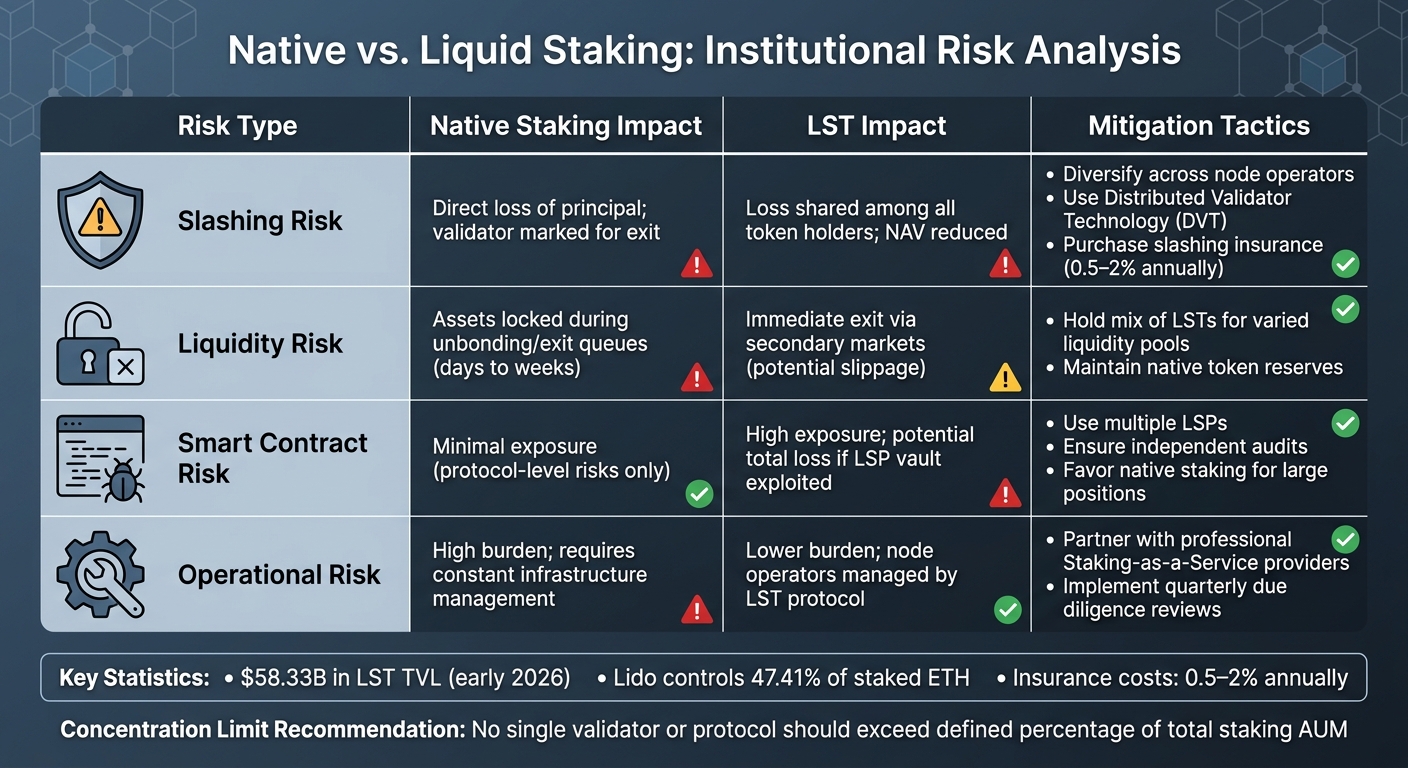
LST Risk Comparison: Native Staking vs Liquid Staking for Institutional Investors
Institutional investors need a strong approach to managing risks tied to liquid staking tokens (LSTs). This involves strategies like validator diversification, insurance, and ongoing monitoring to navigate the specific risks associated with these protocols.
Native vs. Liquid Staking: Risk Comparison
To allocate capital wisely, institutions must understand how risks differ between native staking and liquid staking. Each method presents unique challenges around liquidity, operational demands, and vulnerabilities tied to smart contracts.
| Risk Type | Native Staking Impact | LST Impact | Mitigation Tactics |
|---|---|---|---|
| Slashing | Direct loss of principal; validator marked for exit | Loss is shared among all token holders; NAV is reduced | Diversify across node operators; use Distributed Validator Technology (DVT); purchase slashing insurance (0.5–2% annually) |
| Liquidity | Assets locked during unbonding/exit queues (can take days or weeks) | Immediate exit possible via secondary markets, though slippage may occur | Hold a mix of LSTs to tap into varied liquidity pools |
| Smart Contract | Minimal exposure (limited to protocol-level risks) | High exposure; potential for total loss if the Liquid Staking Protocol (LSP) vault is exploited | Use multiple LSPs; ensure independent audits have been conducted |
| Operational | High operational burden; requires constant infrastructure management | Lower burden; node operator set is managed by the LST protocol | Partner with professional Staking-as-a-Service providers |
Institutions should enforce concentration limits in their risk policies to avoid over-reliance on any single validator or protocol. This helps guard against infrastructure failures or governance-related risks. As highlighted in the Institutional Staking Guide:
"No single validator or protocol should represent more than a defined percentage of total staking AUM. Define limits in your risk policy before deploying."
This comparison underscores the importance of spreading risk across various platforms and validators.
Diversification Across Validators and Platforms
Given the current dynamics of liquid staking, diversification plays a critical role. By early 2026, liquid staking protocols handle over $58.33 billion, with Lido alone accounting for 47.41% of staked ETH. Such concentration highlights the need for institutions to diversify and reduce the risk of correlated losses.
Fireblocks emphasizes the importance of this strategy:
"Diversification helps mitigate counterparty and operational risk… exposure to as broad a set as possible of the overall validator network is a robust way of ensuring stable and high-quality performance over time."
To achieve this, institutions should maintain a due diligence register updated quarterly. This register should evaluate each validator’s legal status, service-level agreements (SLAs), and slashing history over at least 24 months. Additionally, institutions should verify that selected LST protocols, like Rocket Pool, use diverse node operator sets – Rocket Pool, for example, leverages over 3,000 independent node operators to bolster network strength.
Another key aspect is maintaining liquidity reserves. By holding part of their assets in liquid LSTs or spot ETH, institutions can meet redemption needs without getting caught up in protocol unbonding delays or secondary market discounts during volatile periods. Monitoring LST prices for deviations from NAV is equally important. Early detection of depegging risks allows institutions to rebalance or exit positions before losses escalate.
Regulatory Considerations for Liquid Staking Tokens
Institutional investors dealing with liquid staking tokens must carefully navigate a regulatory landscape shaped by the SEC Division of Corporation Finance’s August 2025 guidance. This guidance clarified that Liquid Staking Activities and Staking Receipt Tokens (LSTs) generally do not fall under the category of securities offerings or sales. A critical element is ensuring that providers limit their role to administrative tasks.
The SEC uses the Howey test to determine whether an arrangement qualifies as an investment contract. To avoid being classified as securities, providers must restrict their activities to functions like node maintenance and distributing rewards – without making decisions about “whether, when, or how much” of a client’s assets to stake. Institutional custodians who act solely as agents, allowing depositors to retain full ownership and control, remain outside the scope of securities registration requirements.
"Liquid staking is a variant on the longstanding practice of depositing goods with an agent who performs a ministerial function in exchange for a receipt that evidences ownership of the goods."
– Hester M. Peirce, Commissioner, SEC
The SEC’s August 2025 guidance cleared up much of the previous uncertainty. For example, Kraken faced $30 million in penalties for its staking-as-a-service program, which advertised returns as high as 21%. Former SEC Chair Gary Gensler emphasized the importance of proper disclosures and safeguards under securities laws.
The sections below explore specific AML/KYC requirements and SEC guidelines that influence institutional practices.
AML/KYC Compliance Requirements
Institutions managing liquid staking tokens must implement robust anti-money laundering (AML) and know your customer (KYC) protocols. These measures go beyond initial client onboarding, requiring continuous monitoring and detailed record-keeping for regulatory purposes. Third-party custodians managing LSTs are also expected to protect sensitive client data.
Strong governance practices are essential. These include role-based access controls, clear separation of duties, and comprehensive activity logs to ensure both internal accountability and compliance with external regulatory demands. For example, audit trails tracking wallet access, staking reward patterns, and network performance data can serve as evidence of compliance during regulatory reviews. Institutions should also carefully evaluate third-party providers, reviewing their regulatory history and ensuring they have adequate insurance to cover potential losses or theft.
The risks of non-compliance are significant. The August 2025 conviction of Roman Storm, a Tornado Cash developer, for running an unlicensed money-transmitting business highlights the importance of AML/KYC compliance – even for non-custodial software providers. Institutions must ensure their LST providers have strong compliance programs to mitigate such risks.
SEC Guidelines on Staking Services
In addition to compliance, the SEC has outlined specific operational boundaries for staking services. The Division of Corporation Finance clarified that LSTs issued on a one-for-one basis against deposited assets are not considered "receipts for a security" because the underlying crypto assets are not securities. Even when reward adjustments or slashing events change the ratio, as long as these changes occur automatically via smart contracts, the classification remains unaffected.
Institutions can leverage additional services – such as slashing protection, early unbonding options, alternative reward schedules, and asset aggregation – without triggering a securities classification. However, providers must steer clear of offering “guaranteed returns” or “guaranteed yield,” as these could be interpreted as managerial efforts, potentially subjecting the arrangement to SEC registration.
"The value of Staking Receipt Tokens is derived from the value of the deposited Covered Crypto Assets and not from the entrepreneurial or managerial efforts of the Liquid Staking Provider."
– Division of Corporation Finance, SEC
One area the guidance does not currently address is "restaking", where staked assets are used to secure additional networks. This remains a gray area requiring further regulatory analysis. Institutions should also be aware that while the SEC’s guidance offers a safe harbor from Commission enforcement, it does not protect against private securities-law claims or future policy changes under a different SEC leadership. Notably, the SEC’s dismissal of action against Binance-related entities on May 29, 2025, coincided with the release of new staking protocol guidance, suggesting a more accommodating regulatory stance toward institutional involvement.
These regulatory guidelines play a vital role in shaping custody protocols and risk management strategies for LSTs, underscoring the necessity for secure and compliant institutional operations.
How BeyondOTC Supports Institutional LST Investors

BeyondOTC leverages its expertise to simplify institutional entry into the liquid staking ecosystem. Acting as a key connector, the platform links institutional investors with trusted providers, including MPC wallet infrastructure, top-tier institutional-grade node operators, and regulated custodians operating under frameworks like MiCAR.
Fundraising and OTC Solutions
For institutions looking to manage large liquid staking token (LST) positions without disrupting the market, BeyondOTC facilitates high-volume OTC transactions. This service is particularly useful during times of market volatility or when secondary markets for LSTs face depegging issues. By engaging with liquidity-focused counterparties, BeyondOTC enables the execution of block trades in tokens like stETH, rETH, or frxETH. Throughout these transactions, the platform ensures the preservation of key audit logs and USD valuations.
Access to LST Investment Opportunities
BeyondOTC offers institutional clients exclusive access to segregated staking pools and early-stage LST ventures. For instance, it connects investors to Lido V3 "stVaults", which ensure institutional funds remain traceable and separate from retail deposits. This approach supports efforts to diversify risk and manage liquidity effectively. With yields typically ranging from 2–5% APY on ETH, and potentially increasing to 4–8% when LSTs are used as collateral in DeFi strategies, this access aligns with fiduciary responsibilities while unlocking staking returns. As of January 2026, the liquid staking market had grown to over $58.33 billion in total value locked, highlighting the scale of the opportunity.
Regulatory and Legal Support
Navigating the regulatory complexities of LSTs demands specialized legal guidance. BeyondOTC connects institutions with blockchain and cryptocurrency law experts, offering support for SEC compliance, AML/KYC protocols, and staking structures designed to avoid securities classification. This includes ensuring third-party providers limit their roles to "administrative or ministerial" tasks, as outlined in the SEC’s August 2025 guidance. For emerging areas like restaking – still a regulatory "grey area" – BeyondOTC’s network helps institutions evaluate risks tied to new protocols like EigenCloud. This comprehensive legal support helps institutions balance risk management with the pursuit of staking yields.
Conclusion
Liquid staking tokens present a massive $58.33 billion opportunity, but they also come with increased risks for institutions. A single validator misconfiguration or a smart contract exploit could lead to fiduciary breaches, regulatory complications, and substantial financial losses.
To navigate these challenges, institutions should adopt a three-step strategy:
- Implement custody solutions: Use qualified custodians or MPC wallets to secure assets.
- Actively manage risks: Diversify validator exposure, secure slashing insurance (typically 0.5–2% annually), and closely monitor validator performance.
- Ensure regulatory compliance: Follow the SEC’s March 2026 Interpretive Release to align operations with clear guidelines.
These steps create a foundation for institutional support that balances security, compliance, and operational efficiency.
"Institutions don’t just need yield; they need auditability, security, and workflow fit." – Andrew Gibb, CEO, Twinstake
This highlights the critical need for combining robust technical infrastructure with governance frameworks that meet fiduciary and operational standards.
Managing these complexities often requires specialized support. For example, BeyondOTC addresses liquidity challenges during network congestion. In late 2025, Ethereum’s unstaking queue reached approximately 750,000 ETH, resulting in wait times of up to 13 days. BeyondOTC also assists with regulatory and legal hurdles, including evolving AML/KYC protocols and staking frameworks.
As restaking protocols add $19.63 billion in TVL, they also amplify security risks – misconduct in one service could lead to slashing across multiple networks. Institutions that prioritize secure custody, enforce strong governance, and form strategic partnerships will be better positioned to capture competitive staking yields while maintaining their fiduciary responsibilities.
FAQs
How do institutions choose between native staking and LSTs?
Institutions weigh their options between native staking and liquid staking tokens (LSTs) by considering factors such as risk tolerance, operational needs, and regulatory requirements.
Native staking gives institutions direct control over their staked assets. However, it comes with challenges like lock-up periods, the risk of slashing (penalties for validator misconduct), and potential delays when withdrawing funds.
On the other hand, LSTs offer added liquidity and open the door to DeFi opportunities, allowing staked assets to be used elsewhere in the ecosystem. That said, they carry their own risks, including those tied to smart contracts and custody.
Regulatory clarity also plays a critical role. For example, institutions must navigate evolving rules from bodies like the SEC, which could impact how they approach staking strategies.
What’s the best way to custody LSTs with audit-ready controls?
The best approach to securely manage liquid staking tokens (LSTs) while maintaining audit-ready controls is by utilizing institutional-grade solutions like MPC (Multi-Party Computation) wallets and custody platforms designed with risk management in mind. These solutions offer robust security, ensure compliance, and protect against slashing risks by using advanced protocols such as MPC security and structured frameworks specifically built for institutional requirements.
How can a portfolio avoid LST depegs and forced liquidations?
To steer clear of liquid staking token (LST) depegs and forced liquidations, it’s crucial to pick platforms that prioritize security. Look for those implementing advanced safeguards, such as multi-party computation (MPC) protocols. Spreading your investments across multiple providers can also help lower concentration risk.
Keep an eye on potential risks like smart contract vulnerabilities and market volatility. Tools such as stop-loss orders can be invaluable for protecting your positions, while effective collateral management and maintaining liquidity buffers are essential strategies to navigate market downturns or protocol-related issues.