Liquidity providers (LPs) face different tax rules and reporting challenges depending on whether they earn yield through onchain (DeFi) or offchain (CeFi) platforms. Here’s a quick breakdown:
- Onchain yield involves decentralized finance protocols like Uniswap or Curve. Taxable events include depositing into liquidity pools, earning rewards, and withdrawing assets. You must manually track all transactions, as DeFi platforms don’t issue tax forms.
- Offchain yield is managed by centralized exchanges like Coinbase or Binance. Income is taxed as ordinary income when credited, and platforms provide Form 1099-DA for easier reporting.
Key Differences:
- Tax Complexity: Onchain yield requires tracking multiple taxable events; offchain yield is simpler but taxed immediately.
- Reporting: DeFi lacks automated tax forms, while CeFi platforms handle reporting for you.
- Privacy: Onchain offers pseudonymity; offchain requires full KYC.
Quick Tip: Onchain yield may allow for tax deferral, while offchain yield simplifies compliance. Choose your strategy based on your tax goals and ability to maintain records.
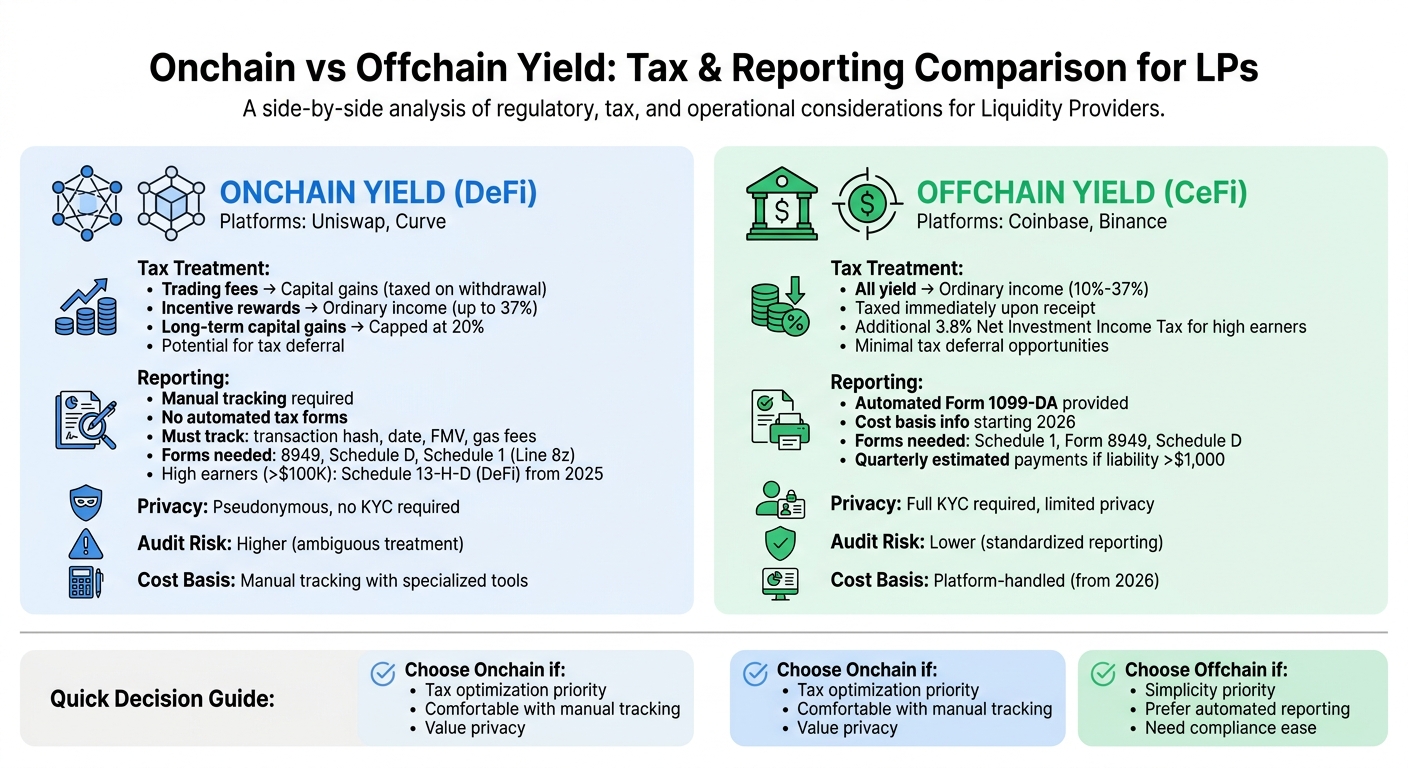
Onchain vs Offchain Yield: Tax and Reporting Comparison for Liquidity Providers
1. Onchain Yield
Tax Treatment
When it comes to onchain yield, the tax rules can get quite intricate, especially for LPs engaging in DeFi activities. Depositing assets into a DeFi liquidity pool, for example, is considered a taxable event. Why? Because you’re essentially swapping your tokens (like ETH or USDC) for LP tokens. This triggers a capital gain or loss based on the fair market value (FMV) of the assets at the time of the deposit. The cost basis for your LP tokens is then set by the combined FMV of the assets you provided.
Taxation on onchain yield falls into two main categories:
- Trading Fees: These increase the value of your LP tokens and are taxed as capital gains when you withdraw from the pool.
- Incentive Rewards: Governance tokens or other rewards you claim are treated as ordinary income. These are taxed at the time you take control of them, with rates potentially reaching up to 37%. On the other hand, long-term capital gains (for assets held over a year) are generally taxed at lower rates, capped at 20%.
When you exit a liquidity pool, another taxable event occurs. You’ll need to calculate the gain or loss by comparing the FMV of the assets you receive to the cost basis of your LP tokens. It’s important to note that impermanent loss – a common risk in DeFi – is only accounted for when you exit the pool and calculate your overall gain or loss.
Because of these complex scenarios, precise record-keeping is critical, as detailed in the next section.
Reporting Requirements
The recent repeal of Form 1099-DA issuance for decentralized protocols has shifted the burden of documentation entirely onto users. This means you’ll need to track every swap, deposit, withdrawal, and reward claim meticulously. For each transaction, record details such as:
- Transaction hash
- Date
- FMV in U.S. dollars
- Associated gas fees
When it’s time to file your taxes, here’s how to report:
- Asset disposals: Use Form 8949 to list transactions and summarize gains or losses on Schedule D.
- Staking or farming rewards: Report these as ordinary income on Schedule 1 (Line 8z).
- Digital asset question: Check "Yes" on Form 1040 to ensure compliance.
- High earners: If your annual rewards exceed $100,000, starting in the 2025 tax year, you’ll also need to file Schedule 13-H-D (DeFi).
Compliance Challenges
The layered tax treatment of onchain yield makes compliance especially challenging. Without centralized reporting, you’ll need to piece together every step of your multi-chain strategies. For instance, a single yield position might involve:
- Swapping tokens on Ethereum
- Bridging assets to another network (e.g., Arbitrum)
- Depositing into a liquidity pool
- Staking LP tokens
- Claiming rewards
Each of these actions has its own tax implications. Platforms like Uniswap v3 add another layer of complexity by using concentrated liquidity positions structured as NFTs. This means you’ll need to track the cost basis for each individual position, rather than handling it as a single, fungible token.
"The gap between what gets reported to the IRS and what you are required to report is wider than ever. This makes proactive record-keeping essential." – Beancount.io
Don’t forget to include gas fees as part of your cost basis when purchasing tokens. Subtract these fees from sale proceeds, and if a transaction fails, you can treat the associated fees as deductible losses.
Given the sheer volume and complexity of these transactions, many professionals recommend using crypto tax software to streamline the process. Tools like dTax, Koinly, and CoinTracker can help you parse transactions across multiple blockchains, making record-keeping and compliance much more manageable.
sbb-itb-7e716c2
Navigating Complex Crypto and DeFi Taxes
2. Offchain Yield
Offchain yield simplifies tax and reporting processes compared to onchain yield. While onchain yield often requires meticulous manual tracking, offchain yield benefits from automated systems provided by centralized platforms.
Tax Treatment
Offchain yield, earned through centralized exchanges or CeFi platforms, is subject to straightforward taxation. The IRS treats income from interest, staking rewards, or lending as ordinary income, based on the fair market value (FMV) of the asset on the date it is credited to your account. This means that as soon as the yield appears in your account, it becomes taxable – even if you don’t withdraw or sell it.
Ordinary income tax rates range from 10% to 37% for 2025, with an additional 3.8% Net Investment Income Tax for high earners. If you later sell or trade the assets, the IRS calculates any capital gains based on the difference between the FMV at the time of receipt (your cost basis) and the sale price.
In cases where market volatility leads to the liquidation of collateral, the IRS considers it a taxable event, potentially triggering capital gains taxes – even if you didn’t initiate the trade yourself. This straightforward tax framework simplifies the reporting process.
Reporting Requirements
One of the advantages of offchain yield is that centralized platforms handle much of the tax reporting for you. These platforms issue Form 1099-DA, which reports gross proceeds. Starting in 2026, these forms will also include cost basis information.
For tax filing, offchain yield income is reported as "Other Income" on Schedule 1 of Form 1040. Any capital gains or losses are reported on Form 8949 and summarized on Schedule D. Additionally, if you’ve engaged in offchain yield activities, you’ll need to answer "Yes" to the digital asset question on your tax return.
Compliance Challenges
Despite automated reporting, maintaining detailed records is still crucial. A common challenge arises when reconciling the platform-issued Form 1099-DA with your own transaction history. For instance, if you’ve transferred assets between onchain wallets and offchain accounts, the centralized platform may not have complete cost basis information for tokens moved from external wallets. This can lead to discrepancies.
For the 2025 tax year, centralized platforms will report only gross proceeds, with cost basis details becoming available in 2026. To avoid overpaying taxes, it’s essential to keep thorough records, including transaction timestamps, FMV at receipt, and any associated fees.
If your projected tax liability exceeds $1,000, you’ll need to make quarterly estimated tax payments by April 15, June 17, September 15, and January 15 to avoid penalties. High earners with annual rewards exceeding $100,000 may also face additional filing requirements starting in 2025.
"In the United States (IRS), there is no minimum tax-exempt threshold for income earned through DeFi, staking, lending, yield farming, or any other crypto-related activities." – Andrew Bennett, Junior Research Analyst, FORECK.INFO
Pros and Cons
The table below highlights the key advantages and disadvantages of onchain (DeFi) and offchain (CeFi) yield approaches, focusing on tax treatment, privacy, reporting, and other critical factors:
| Feature | Onchain Yield (DeFi) | Offchain Yield (CeFi) |
|---|---|---|
| Tax Efficiency | Mixed tax treatment: trading fees count as capital gains (realized upon withdrawal), while liquidity mining rewards are taxed as ordinary income at the time of receipt | Typically taxed as ordinary income (within the 10%–37% range) immediately upon receipt, with minimal opportunities to defer taxes |
| Privacy | Pseudonymous transactions without mandatory KYC; post-April 2025 repeal removes 1099 reporting requirements | Limited privacy due to mandatory KYC; platforms issue Form 1099-DA directly to the IRS |
| Reporting Ease | Complex, requiring manual tracking of multi-chain transactions and smart contract interactions | Simplified reporting with automated 1099-DA forms and cost basis information provided starting in 2026 |
| Audit Risk | Higher risk due to ambiguous treatment of LP deposits, token wrapping, and bridging, which can result in "double tax exposure" | Lower risk due to standardized reporting and direct oversight by institutions |
| Cost Basis Tracking | Requires specialized tools or diligent manual record-keeping; methods like HIFO or specific identification can help optimize taxes | Platforms handle cost basis tracking (starting in 2026), though this limits flexibility for tax-loss harvesting |
This breakdown shows the trade-offs liquidity providers (LPs) face when deciding between these strategies.
"DeFi accounting is perhaps the most complicated type of accounting out there." – Andrew Gordon, Tax Attorney and CPA at Gordon Law
One notable benefit of onchain yield is the potential for tax deferral. When yield is integrated into the value of your LP token instead of being distributed as separate rewards, taxation can often be postponed until withdrawal. These distinctions are essential for LPs aiming to strike the right balance between tax efficiency and ease of reporting.
Conclusion
Deciding between onchain and offchain yield strategies comes down to weighing tax efficiency against the ease of reporting. Onchain yield allows for potential tax deferral as trading fees accumulate within the value of your LP tokens. However, tracking every multi-chain transaction manually can be a challenge without specialized tools.
Offchain yield, on the other hand, simplifies reporting since centralized exchanges now offer automated IRS reporting for gross proceeds. The trade-off? You’ll face ordinary income tax rates (10%–37%) on rewards as soon as they’re received, leaving less room for tax optimization. While decentralized protocols require LPs to self-report, centralized exchanges handle reporting but often restrict flexibility in cost-basis methods, limiting opportunities for tax-loss harvesting.
To navigate these complexities, having a clear tax strategy is essential. For instance:
- Hold LP tokens for over 12 months to qualify for long-term capital gains.
- Sell volatile rewards promptly to cover tax liabilities.
- Keep a detailed sub-ledger that tracks transaction hashes, fair market values (FMVs), and gas fees, which can either be added to your cost basis or deducted as expenses.
For those leveraging both onchain and offchain strategies, a combined approach can strike a balance between tax efficiency and simpler reporting. Platforms like BeyondOTC can connect you with crypto accountants and compliance experts to help safeguard against audits. Whether you’re managing concentrated liquidity positions, cross-chain transactions, or auto-compounding vaults, using the right tools and seeking expert advice can help you stay compliant while maximizing your after-tax returns.
FAQs
Is adding liquidity in DeFi always a taxable event?
In the United States, participating in DeFi liquidity pools often comes with tax implications. When you deposit or withdraw funds from a liquidity pool, it’s usually viewed as a disposal of cryptocurrency. This action could result in a taxable event, depending on the circumstances. To ensure you’re following IRS rules and avoiding potential issues, it’s essential to consult a tax professional.
How do I track cost basis across bridges, wraps, and LP NFTs?
Tracking your cost basis requires treating every event – like deposits, withdrawals, wrapping, bridging, or receiving LP tokens – as a taxable event. For each, record the fair market value at the time it occurred. Adjust for any gains or losses, and keep detailed records that include timestamps, token amounts, USD values, and event types. Maintaining thorough documentation ensures your calculations are accurate and aligns with IRS regulations.
How should I handle 1099-DA mismatches with my own records?
To handle 1099-DA mismatches, it’s important to reconcile your records with the form ahead of time. DeFi protocols often skip issuing 1099-DAs for activities like staking or providing liquidity, so it’s up to you to track and report all taxable events. Keep detailed records of any discrepancies – note the dates, amounts, and transaction types – and adjust your tax filings as needed. For added peace of mind, consider working with a tax professional experienced in cryptocurrency to ensure your reporting is accurate and compliant.