
Pre-IPO forward contracts come with high counterparty risk, particularly in crypto markets where deals lack the safety net of clearinghouses. These private agreements, often used to trade equity or tokens before public listing, are vulnerable to defaults, delays, and legal complications. Key risks include:
- Counterparty Defaults: Buyers or sellers failing to fulfill obligations.
- Information Gaps: Limited transparency in private company data.
- Legal and Regulatory Issues: Non-compliance with securities laws.
- Settlement Delays: Extended timelines increase exposure to risk.
Mitigation Strategies:
- Verify ownership and vesting schedules.
- Audit cap tables for accuracy.
- Use escrow services to secure funds.
- Verify intermediaries’ credentials (SEC/FINRA registration).
- Track risk metrics like Exposure at Default (EAD) and Altman Z-Scores.
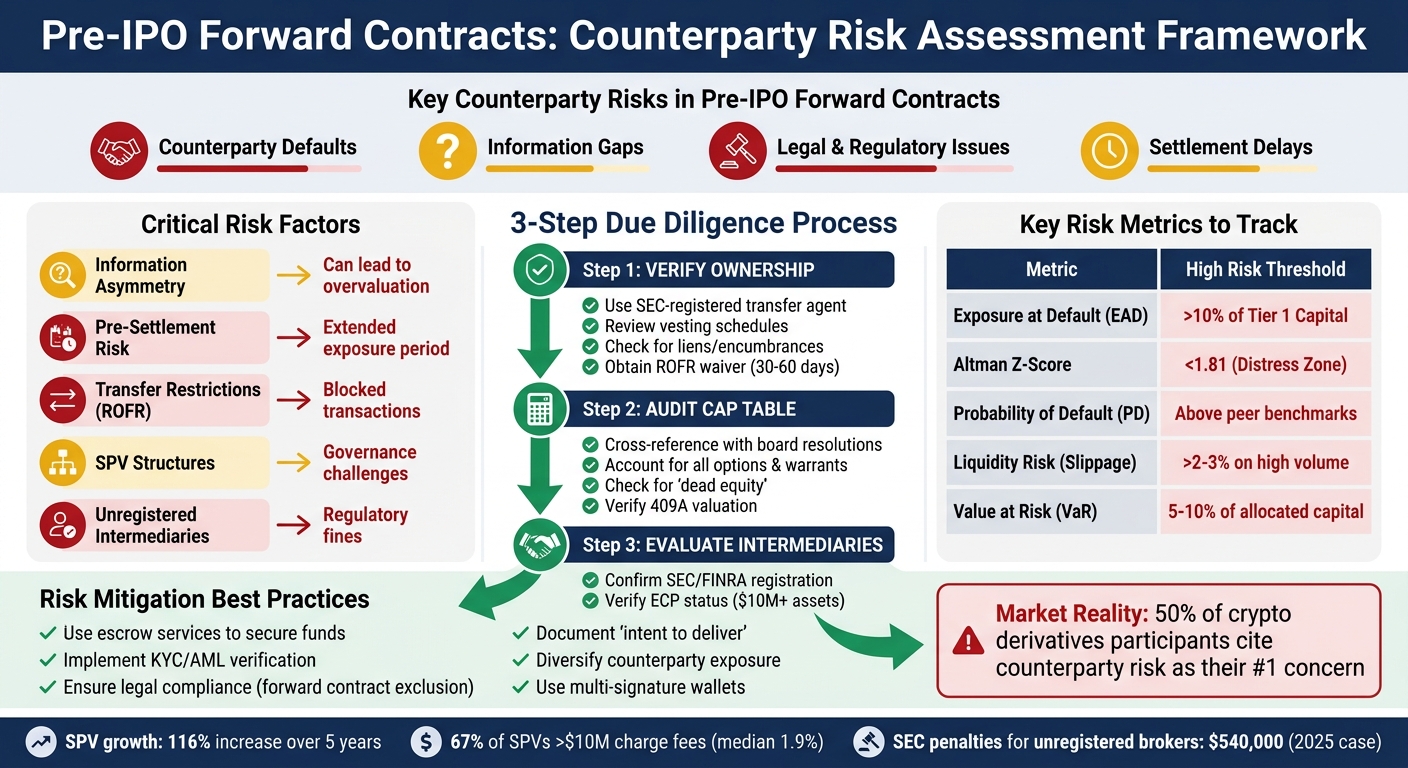
Pre-IPO Forward Contract Counterparty Risk Assessment Framework
Pre-IPO Investing: Risks, Rewards, and Strategy
sbb-itb-7e716c2
What Is Counterparty Risk in Pre-IPO Forward Contracts
Counterparty risk refers to the chance that one party in a financial deal won’t fulfill their end of the agreement. In the case of pre-IPO forward contracts, this could mean the seller failing to deliver the tokens or equity, or the buyer not making the agreed payment. Either way, it can lead to financial losses.
"Counterparty risk is the probability that the other party in a financial transaction will default or fail to fulfill their contractual obligations." – Chainlink
This risk is particularly concerning in over-the-counter (OTC) transactions because there’s no clearinghouse to guarantee the deal. On regulated exchanges, clearinghouses help reduce default risks, but with forward contracts, you’re relying entirely on the other party’s ability and willingness to stick to the agreement. If they don’t, there’s often little recourse.
In the crypto world, counterparty risk becomes even more pronounced with synthetic pre-IPO tokens. These tokens represent economic interests rather than actual ownership, meaning you’re essentially buying a promise tied to the performance of an underlying asset. This issue gained attention after the collapse of FTX, which exposed vulnerabilities in crypto derivatives markets and highlighted the fragility of such agreements.
While traditional forward contracts often settle within a day or two (T+1 or T+2), pre-IPO agreements might not settle until the IPO or token listing occurs. This could take months or even years, increasing the likelihood of a default during this extended period.
Now, let’s dig into the key factors that make counterparty risk even more challenging in these contracts.
Main Risk Factors in Counterparty Transactions
Several elements intensify counterparty risk in pre-IPO forward contracts:
Information Asymmetry
Private companies are not required to release regular audited financial statements. This lack of transparency makes it harder to evaluate pricing and risk. Sellers might have insider knowledge – like delays in an IPO or financial struggles – that they don’t share with buyers, putting buyers at a disadvantage.
Pre-Settlement Risk
This occurs when a counterparty defaults before the settlement date. Unlike standard equity trades, which close quickly, pre-IPO forward contracts can remain open for an extended time. If a default happens during this period, you may need to renegotiate a new contract under worse terms, leading to what’s known as replacement cost risk.
Transfer Restrictions
Many private companies, like SpaceX and OpenAI, enforce strict Rights of First Refusal (ROFR) or require company approval for share transfers. Even if the seller intends to deliver, these restrictions can block the transaction. Some sellers use synthetic agreements to bypass these rules, but this approach introduces additional risks tied to documentation and corporate actions.
"Where forward purchase agreements or other synthetic constructs are used to navigate restrictions, investors assume additional counterparty, documentation, and corporate‑action risks prior to settlement." – Chad J. Gottlieb and Douglas B. Otto, Partners, DarrowEverett LLP
SPV Structures
Special Purpose Vehicles (SPVs) are sometimes used to pool investors or bypass transfer limits. While they can be useful, SPVs also bring added governance challenges, extra fees, and another counterparty layer. If the SPV manager acts improperly or the issuer doesn’t recognize SPV holders, your economic interest could be at risk.
Unregistered Intermediaries
Using brokers or finders who aren’t registered with the SEC or FINRA can lead to legal and financial complications. These intermediaries might not verify suitability or keep accurate records, which could result in regulatory fines or even claims for rescission.
| Risk Factor | Impact on Counterparty Risk | Mitigation Strategy |
|---|---|---|
| Information Asymmetry | Can lead to overvaluation and mispricing | Use independent valuations and clear representations |
| Unregistered Brokers | May result in regulatory fines or invalid deals | Confirm SEC/FINRA registration |
| Transfer Restrictions | Issuer could block transactions via ROFR rules | Obtain formal company consent |
| Settlement Delays | Longer settlement increases default exposure | Use escrow services and standardized documentation |
These operational risks are further complicated by legal and regulatory factors.
Legal and Regulatory Considerations
Pre-IPO forward contracts exist in a complex and evolving legal landscape. Unlike public securities, which are subject to strict SEC disclosure requirements, private transactions often rely on exemptions like Section 4(a)(1½), Rule 144A, or Regulation S. If these rules aren’t followed, the deal could be voided or subject to rescission.
Material Non-Public Information (MNPI)
If a seller has insider information, trading could unintentionally involve MNPI. This not only breaches securities laws but could also lead to the agreement being invalidated. To avoid this, contracts should explicitly state that no MNPI is being used or shared.
Lock-In Periods
In some jurisdictions, pre-IPO shareholders are required to hold their shares for a set period – often six months – after the company goes public. This restriction means even after an IPO, you might not be able to sell your position right away, increasing your exposure to counterparty risk.
Regulatory Tightening
Global regulators are introducing stricter rules, such as the EU’s Markets in Crypto-Assets (MiCA) regulation and enhanced FATF standards. These efforts aim to boost transparency through measures like proof-of-reserves requirements. However, non-compliant counterparties could face shutdowns, increasing default risks.
"Transactions through unregistered intermediaries may violate securities regulations, exposing investors to legal and financial losses." – Global Banking & Markets
Without a clearinghouse, there’s no daily mark-to-market process or margin call system to manage potential losses. As a result, the risk in a forward contract is typically confined to its profit or loss, with pre-settlement risks often factored into pricing and fees.
Due Diligence Framework for Counterparty Assessment
Before entering a pre-IPO forward contract, it’s essential to systematically evaluate whether the counterparty can fulfill their obligations. A solid due diligence process – covering ownership records, corporate documents, and the credentials of intermediaries – can help you avoid costly mistakes or potential defaults. This framework focuses on three key areas where counterparty issues are most likely to arise: confirming ownership, ensuring cap table accuracy, and evaluating intermediary credibility.
Verifying Ownership and Vesting Status
Start by confirming the seller’s official share ownership. Use an SEC-registered transfer agent to verify whether the seller’s name is listed in the official shareholder registry. If no transfer agent is involved, request copies of the stock ledger and cross-check them with board resolutions that authorized the issuance of shares.
Next, review the vesting schedule. Ask for the original grant agreement and employment contract to confirm how many shares have vested. Pay close attention to clauses that could lead to forfeiture, such as termination for cause or failure to exercise options within a specific timeframe. For example, a seller might claim to own 10,000 shares, but if only 6,000 have vested – especially if they’ve recently left the company – they may not legally control the full amount.
Check for liens or encumbrances on the shares by conducting a third-party legal review or using an escrow service to confirm no other party holds a claim on the assets.
Additionally, obtain written confirmation that the company has waived its Right of First Refusal (ROFR) or has formally approved the transfer. Keep in mind that this process often takes 30 to 60 days.
"Missing IP assignments kill more deals than any other single issue, particularly for technology companies." – Laura Ryan, Barrister
If the seller is a founder or an early employee, ensure they’ve signed an IP assignment agreement. Without this, the company could challenge the transaction or even question the validity of the seller’s equity.
Reviewing Cap Tables for Accuracy
Once ownership details are verified, move on to the company’s cap table. A cap table is supposed to be the definitive record of equity ownership, but errors, outdated entries, or missing information are surprisingly common. These inaccuracies can lead to miscalculations in ownership percentages, dilution, and payout scenarios.
Begin by auditing the cap table from the company’s incorporation. Cross-reference it with board resolutions, articles of incorporation, shareholder agreements, and stock option plans to identify any discrepancies in share counts, vesting dates, or the size of the option pool.
Ensure the cap table accounts for all granted options (both vested and unvested), warrants, and any SAFEs or convertible notes that have been converted into equity. This ensures an accurate picture of fully diluted ownership. Be on the lookout for “dead equity” – shares held by former employees that should have been repurchased by the company.
It’s also important to review offer letters and email correspondence for informal or verbal equity promises. These unrecorded commitments can result in unexpected dilution.
Make sure the cap table reflects a current 409A valuation. This valuation is typically updated annually or after a significant event. Outdated pricing data can lead to unreliable figures and may even expose employees to IRS penalties.
"A poorly managed capitalization table isn’t just an administrative oversight – it’s a liability that can derail negotiations, inflate legal costs, and in worst-case scenarios, kill deals entirely." – Ishwar Gogineni, Product Lead, Commenda
If the company is managing its cap table via spreadsheets, consider it a warning sign. Companies with more than 10 option holders or those that have raised outside funding should use dedicated cap table management software like Carta or Pulley to minimize manual errors and maintain a reliable record.
Evaluating Intermediaries and Broker-Dealers
The credibility of intermediaries is just as important as verifying share details. Unregistered intermediaries can expose you to regulatory fines, invalid contracts, or rescission claims.
To start, confirm that the intermediary is registered with both the SEC and FINRA. Use FINRA BrokerCheck to verify their registration status and disciplinary history. Also, check whether the company has filed the required Form D under Regulation D (Rules 506(b) or 506(c)) through the SEC’s EDGAR database.
If the transaction involves derivatives or could be classified as a “swap,” ensure the intermediary has verified Eligible Contract Participant (ECP) status for all parties. Under the Commodity Exchange Act, companies typically need at least $10 million in assets to qualify as an ECP. Make sure this is documented in the transaction paperwork.
Assess the intermediary’s track record by looking into team backgrounds on LinkedIn, funding sources on Crunchbase, and news reports for any controversies or legal issues. Confirm they use a qualified custodian – such as a registered broker-dealer or bank – and that client assets are kept separate from the custodian’s funds. Third-party attestations and clear redemption procedures are additional signs of strong operational controls.
Be cautious of red flags like anonymous teams, single admin key controls (without multi-signature security), or vague answers about proof of reserves.
"The primary purpose of a forward contract is to transfer ownership of the commodity and not to transfer solely its price risk." – Mike Frisch, Attorney
Lastly, review all legal documentation thoroughly before committing. Demand and examine the Private Placement Memorandum (PPM), Subscription Agreement, and any Token Terms and Conditions. If the intermediary hesitates to provide these documents or pressures you to act quickly, it’s a major warning sign.
Risk Evaluation Tools and Metrics
Once you’ve wrapped up your due diligence, it’s time to quantify counterparty risk using measurable metrics. These indicators provide a clear picture of default likelihood and potential losses, allowing you to compare counterparties objectively. They also help establish thresholds that can trigger early warnings, giving you a chance to act before a deal turns sour.
Risk Metrics to Track
One of the first metrics to consider is Exposure at Default (EAD). This measures the dollar amount you’re owed if the counterparty fails to meet their obligations. For example, if you have a $500,000 commitment, your EAD is $500,000. Regulatory guidelines like Basel III often cap large exposures at 10% of Tier 1 capital to prevent systemic risks. If your exposure exceeds this threshold, it’s a sign of heightened risk.
Another key metric is Potential Future Exposure (PFE), which estimates the maximum expected loss over a specific time frame at a confidence level of 95% or 99%. This is particularly useful for forward contracts with delayed settlements, where market shifts or financial instability could increase risk.
The Altman Z-Score is a well-known tool for predicting bankruptcy. It combines five financial ratios, including working capital to assets and market value of equity to liabilities. A score below 1.81 places a company in the "distress zone", suggesting a high probability of bankruptcy within two years. If a counterparty’s Z-Score falls into this range, it’s a major red flag.
Probability of Default (PD) estimates the likelihood of a counterparty defaulting within a set timeframe. Compare this number to industry benchmarks – if it’s significantly higher, you’re looking at a risky situation.
"Counterparty risk is the possibility that the other party in a financial transaction will default before fulfilling its obligations." – Sarah Lee, Number Analytics
Value at Risk (VaR) calculates the potential loss within a specific confidence level and time frame. For instance, a 95% VaR of $50,000 means there’s a 5% chance your loss could exceed $50,000. If this metric breaches 5% to 10% of your allocated capital, it signals a concerning level of exposure.
For pre-IPO forward contracts, liquidity risk is another critical factor. This can be measured by price slippage – the gap between the quoted price and the final execution price. If slippage exceeds 2% to 3% on a high-volume trade, it may indicate the counterparty lacks adequate inventory or struggles to source shares.
Lastly, monitor Key Risk Indicators (KRIs) like widening credit spreads, covenant breaches, or legal issues. These early warning signs can help you detect potential defaults before they happen. For example, a sudden lawsuit or missed debt payment should prompt immediate reevaluation of your exposure.
Risk Comparison Tables
A comparison table is a practical way to assess multiple counterparties at once, highlighting which ones pose the most significant risks. Here’s an example framework:
| Metric Name | Description | Calculation Method | High Risk Threshold |
|---|---|---|---|
| Exposure at Default (EAD) | Estimated loss at default | Current Mark-to-Market + PFE | >10% of Tier 1 Capital |
| Altman Z-Score | Bankruptcy prediction score | Weighted sum of 5 financial ratios | Score < 1.81 (Distress Zone) |
| Potential Future Exposure (PFE) | Max expected future loss | Quantile of exposure distribution | 95% confidence level breach |
| Probability of Default (PD) | Likelihood of default | Statistical credit scoring models | Significant deviation from peer benchmarks |
| Liquidity Risk (Slippage) | Price difference on execution | (Executed Price – Quoted Price) / Quoted Price | >2-3% on high-volume trades |
When creating your own table, add columns for each counterparty’s name, current metric values, and a color-coded risk rating (low, medium, high). This visual approach makes it easier to spot riskier counterparties and decide where additional safeguards are needed.
In addition, consider a red-flag checklist for qualitative risks. Warning signs include a lack of reputation proof, no third-party escrow, vague settlement terms, or outdated Proof-of-Reserves (PoR) verification. If a counterparty checks several of these boxes, it’s best to walk away, no matter how tempting the deal might seem.
"In OTC, you don’t lose access, you lose everything." – CustomersChain
How to Reduce Counterparty Risk with BeyondOTC
Once you’ve assessed counterparty risks, the next step is implementing measures to protect your capital. BeyondOTC offers services designed to address vulnerabilities in pre-IPO forward contracts, such as settlement failures, fraud, and regulatory challenges. A cornerstone of this approach is their escrow service, which provides a secure foundation for transactions.
Escrow Services for Transaction Security
Escrow services are an effective way to mitigate settlement risk. By routing funds through a neutral third party, neither the buyer nor the seller can access the funds until all contract conditions – like share delivery or token transfer – are fully satisfied. This process directly tackles pre-settlement risks.
BeyondOTC’s escrow service operates under strict, written guidelines to secure funds. For instance, if a seller is bound by a six-month post-IPO lock-in period, the escrow agent holds the buyer’s payment until the shares are legally transferable and delivered. This eliminates the risk of paying upfront for shares that might never be received.
"The underlying postulate of the forward exclusion is that the CEA’s regulatory scheme for futures trading simply should not apply to private commercial merchandising transactions which create enforceable obligations to deliver but in which delivery is deferred for reasons of commercial convenience or necessity." – Mike Frisch, Attorney
For synthetic structures like forward purchase agreements, escrow also protects against complications from corporate actions, such as stock splits or hard forks, that might occur before the final settlement.
KYC and AML Verification
Securing funds is just one part of the equation; verifying the identity of counterparties is equally critical. BeyondOTC employs rigorous KYC (Know Your Customer) and AML (Anti-Money Laundering) procedures to confirm each counterparty’s identity, solvency, and legitimacy. These measures help to reduce fraud and avoid regulatory breaches, which have led to significant losses in recent years.
The process includes:
- Identity and solvency checks to ensure counterparties are credible and financially stable.
- Source of funds validation to confirm assets are not linked to illicit activities.
- Sanction screening to avoid dealing with blacklisted or ineligible entities.
For high-value transactions, BeyondOTC takes it further with Enhanced Due Diligence (EDD). This involves continuous monitoring of transaction patterns and higher-risk customers to detect suspicious activity early. This is especially important, as nearly 50% of participants in the crypto derivatives market cite counterparty risk as their top concern – far outpacing operational (31%) or liquidity (13%) risks.
When choosing an OTC provider, always ensure they are registered with relevant regulatory bodies, such as a Money Services Business (MSB) in the U.S. or a Virtual Asset Service Provider (VASP) in the EU. Be cautious of "brokers" who operate solely through encrypted apps like Telegram without verifiable institutional affiliations or formal KYC processes.
Legal and Contract Support
Legal compliance is another critical layer of protection, and robust contract support helps to mitigate risks further. Missteps in pre-IPO forward contracts can lead to voided deals or penalties. BeyondOTC’s legal consultancy ensures contracts are structured to meet the "forward contract exclusion" under the Commodity Exchange Act, preventing them from being classified as unregulated "swaps".
This involves documenting the commercial intent and "intent to deliver" within transaction agreements – key factors for regulatory exemptions. Contracts must clearly demonstrate that the primary purpose is transferring ownership of the asset, not merely its price risk.
BeyondOTC’s legal team also ensures compliance with transfer restrictions and federal resale exemptions, such as Section 4(a) for accredited investors, Rule 144A for institutional buyers, or Regulation S for offshore transactions. They draft comprehensive representations regarding the absence of Material Non-Public Information (MNPI) and define roles, compensation, and payment flows to address the challenges of fragmented private markets.
"The complexities and nuances of these transactions means that engaging counsel competent in the full range of issues presented – both legal understanding of securities and commodity derivatives, and the technical issues underlying these markets and assets – is key." – Mike Frisch, Attorney
Common Mistakes and Case Studies
Examining real-world errors in pre-IPO forward contracts can provide invaluable lessons for avoiding similar missteps. Even experienced traders sometimes falter, and these examples highlight the importance of vigilance when managing counterparty risk.
Case Study: Risks of Unregistered Brokers
In January 2025, the SEC resolved charges against three investment adviser representatives who acted as unregistered brokers. They sold share interests in LLCs that claimed to hold pre-IPO company shares. These representatives marketed investments and provided advice to individuals who were not their existing advisory clients. Instead of earning traditional management fees, they received transaction-based compensation, a practice that often raises red flags with regulators. The SEC’s order resulted in $540,000 in penalties and disgorgement.
"The settled charges against investment adviser representatives highlight the SEC’s continued drive to hold unregistered brokers accountable – especially those who facilitate the sale of pre-IPO investments to retail investors." – Richard F. Kerr, Pablo J. Man, and Jessica D. Cohn, K&L Gates LLP
To protect yourself, always check the registration status of intermediaries using SEC or FINRA databases. Unregistered brokers who earn commissions can lead to significant risks, including rescission claims, invalidated exemptions, and regulatory actions. SPV structures, in particular, add another layer of complexity, potentially amplifying these risks.
Case Study: SPV Structure Problems
Special Purpose Vehicles (SPVs) can also introduce unique challenges. For example, in April 2026, Bitget Exchange launched "IPO Prime", which offered "preSPAX" tokens in collaboration with Republic. These tokens provided synthetic exposure to SpaceX’s economic performance rather than actual equity. The structure involved a $500 subscription fee and created a convoluted counterparty chain connecting Bitget, Republic, and a reference index. Because the tokens tracked a post-IPO index, investors faced risks such as time decay and platform counterparty issues, particularly if SpaceX delayed its IPO or if intermediaries failed to honor the contract.
"Multi-layer SPVs are something to especially watch out for… they could lead to serious issues, like compounding fees and markups, broken chains of ownership, and even fraud." – Sim Desai, Founder, Hiive
The use of SPVs has surged, with the annual number of new SPVs growing by 116% over the past five years. In 2023, 67% of SPVs managing over $10 million in assets charged fees, a sharp rise from 41% in 2021. Before investing in an SPV, request share certificates or subscription agreements to confirm ownership of the underlying shares. Additionally, carefully review the SPV’s governing documents to examine control rights, management fees (which had a median of 1.9% in 2023), and carried interest to ensure they align with your financial objectives.
Conclusion
Pre-IPO forward contracts in the cryptocurrency space require careful management of counterparty risks, with nearly half of market participants identifying this as their top concern. This guide has explored essential frameworks – like verifying ownership, assessing vesting schedules, evaluating intermediaries, and understanding legal classifications – to safeguard your investments in this evolving sector.
The industry’s shift from a "don’t be evil" mindset to a "can’t be evil" approach highlights a major transformation in transaction security. Cryptographic guarantees and atomic settlement mechanisms are replacing traditional T+1 or T+2 settlement windows, which expose parties to default risks. Modern Delivery versus Payment (DvP) systems address these vulnerabilities, ensuring real-time, risk-free settlements.
BeyondOTC has created a streamlined solution to tackle these challenges. By integrating escrow services, KYC/AML checks, and legal contract support into one workflow, they provide a comprehensive process. Their approach emphasizes documenting "intent to deliver" and the "commercial necessity" for deferred settlement, ensuring compliance with the Commodity Exchange Act while avoiding classification as unregulated swaps. These measures form the foundation for effective risk management in pre-IPO forward contracts.
Real-world examples show that vigilance is non-negotiable. Use the risk management tools and due diligence practices discussed here for every transaction. Diversify your counterparty exposure, secure your assets with multi-signature wallets, and adopt atomic settlement whenever feasible. These strategies can help you navigate and seize opportunities in the pre-IPO forward market with confidence.
FAQs
What should I demand before sending any money?
Before transferring funds for a pre-IPO forward contract, it’s critical to prioritize due diligence and establish safeguards against risks. Start by verifying the counterparty’s credibility and financial stability – this includes reviewing their track record and ensuring their processes are transparent. Additionally, insist on clear documentation outlining all contractual terms, including escrow arrangements and any collateral or guarantees. Taking these steps can significantly lower the chances of fraud or default in such high-stakes transactions.
How can I tell if a pre-IPO “token” is real equity or just synthetic exposure?
Pre-IPO “tokens” can represent genuine equity if they grant actual ownership in a company, such as shares or direct claims on assets. However, synthetic exposure tokens work differently. These are typically cash-settled or tied to an index and don’t provide any ownership. Instead, they often reflect performance metrics, like a company’s valuation after its IPO, without offering equity stakes.
What red flags mean I should walk away from the deal?
When dealing with pre-IPO forward contracts, there are a few warning signs that should grab your attention. Be cautious of promises of guaranteed or unusually high returns – these often sound too good to be true. Similarly, offers involving excessive margin or loans can signal potential trouble. Another red flag is when transactions are restricted to digital assets that can’t be reversed or disputed, as this can leave you vulnerable to significant counterparty risks. Always approach these situations with care and diligence.