Right of First Refusal (ROFR) clauses can complicate pre-IPO investments, especially in fast-moving markets like blockchain and crypto. These clauses allow companies or existing investors to match third-party offers for shares, often leading to delays, deal cancellations, or price volatility. For buyers, this means potential financial risks and wasted time.
Key takeaways:
- ROFR Basics: Companies or investors can match your offer within 10–30 days, or sometimes longer.
- Buyer Risks: Delays, deal cancellations, or being forced to find replacement shares at higher prices.
- Navigation Tips: Negotiate waivers, shorter timeframes, or unique terms to minimize ROFR impact.
- Due Diligence: Review shareholder agreements to identify ROFR priorities and carve-outs.
Platforms like BeyondOTC can help by offering deals with fewer ROFR restrictions and providing advisory services to mitigate risks.
Rights of First Refusal & Rights of First Offer in Contracts: Explained by a Lawyer
sbb-itb-7e716c2
How ROFR Works in Pre-IPO Deals
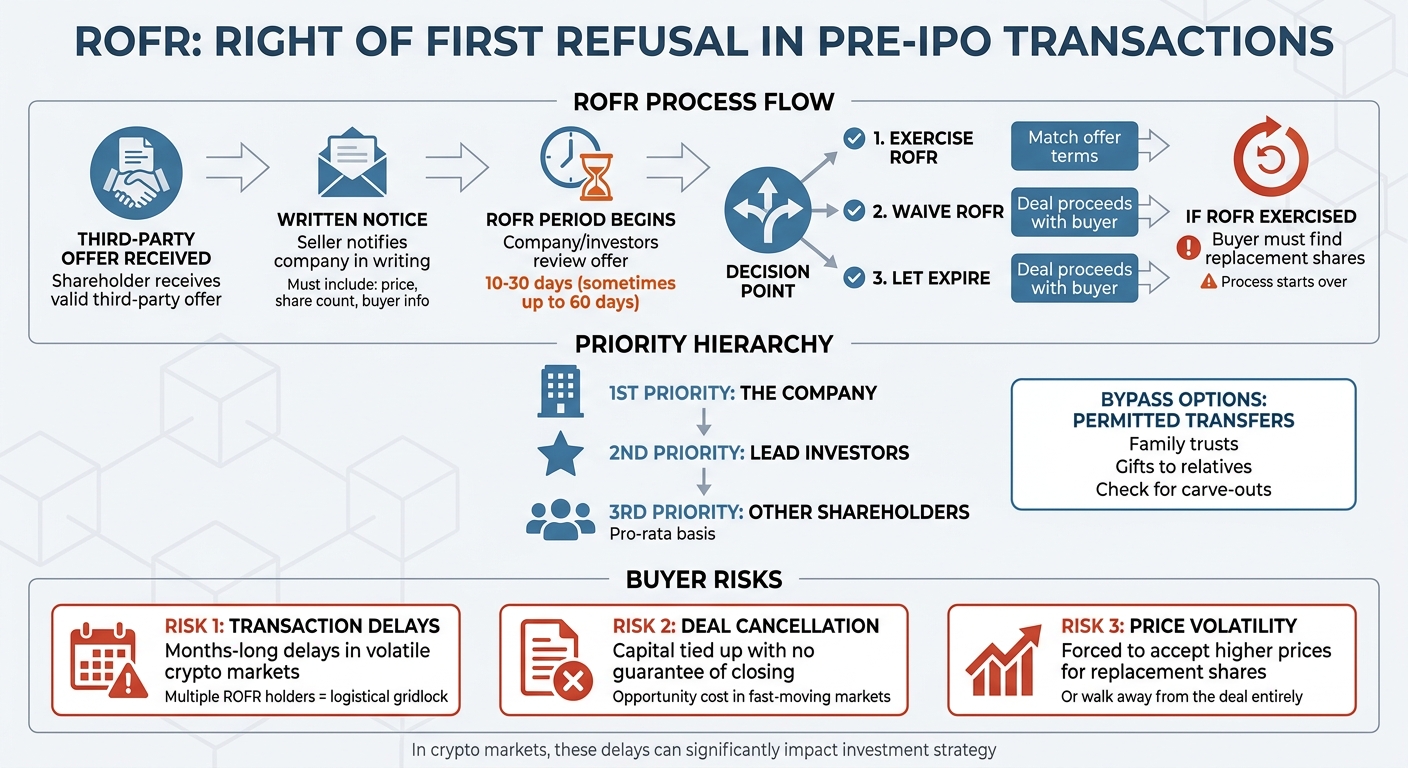
ROFR Process Timeline and Buyer Risks in Pre-IPO Transactions
ROFR Definition and Core Features
A Right of First Refusal (ROFR) is a clause in shareholder agreements that gives a company – or its existing investors – the chance to buy shares from a selling shareholder before an outside party can. Think of it as a "first-dibs" rule that kicks in when a valid third-party offer is on the table.
The main purpose of a ROFR is to restrict share transfers, helping companies keep control over their cap table. For blockchain startups, this can be especially important to protect sensitive intellectual property and regulatory filings.
Typically, ROFR clauses follow a set priority: the company gets the first opportunity, followed by lead investors, and then other shareholders on a pro-rata basis. If the ROFR is exercised, the holder must match every part of the third-party offer – price, payment terms, and conditions – without picking and choosing favorable elements. Many agreements also allow for "permitted transfers", like moving shares to a family trust or gifting them to relatives, which bypass the ROFR entirely. Buyers should always check these carve-outs during due diligence, as they might offer alternative ways to acquire shares.
These key features lay the groundwork for understanding how the ROFR process unfolds and the timelines involved.
ROFR Process and Timeframes
The ROFR process begins when a shareholder gets a valid third-party offer. At this point, the seller (or their broker) must notify the company in writing, providing essential details such as the price, number of shares, and buyer information. As Crowley Law LLC explains:
"A strong ROFR agreement clearly outlines how notice must be given, usually in writing, with a full copy of the third-party offer or term sheet attached."
Once the notice is sent, the clock starts ticking on the ROFR period. This is the window – usually 10 to 30 days, but sometimes up to 60 days – during which the company or investors decide whether to match the offer. During this period, the ROFR holder can choose to exercise the right, waive it, or let it expire.
If the ROFR is exercised, the seller must finalize the deal with the ROFR holder instead of the third-party buyer. If a replacement buyer is needed, the entire process starts over, which can delay the transaction.
For buyers in the crypto OTC market, these timelines are especially important. A 30-day review period might seem reasonable at first glance, but in a fast-moving market, token prices and valuations can shift dramatically. Add in multiple ROFR holders, and the process can stretch far longer than expected, complicating deals in volatile environments.
Buyer Risks in Crypto Pre-IPO Deals with ROFR
Transaction Delays Caused by ROFR
ROFR (Right of First Refusal) clauses can transform a seemingly simple transaction into a drawn-out ordeal. After terms are finalized, notifying the issuer triggers a decision window that typically lasts between 10 and 30 days.
If the company or current investors decide to exercise their ROFR, buyers are left scrambling to find replacement shares under similar terms. As MicroVentures explains:
"The process of finding new shares can be lengthy, and once new shares are found, the notice process starts over… This can draw out the entire process and make it take months longer than originally intended."
In the highly volatile world of crypto markets, delays stretching over several months can completely upend an investment strategy. When multiple ROFR holders are involved, it can create a "logistical gridlock" during pro-rata allocations.
Another challenge is the "stalking horse" scenario. Buyers often avoid ROFR-heavy deals to sidestep wasted due diligence, only to see an existing investor swoop in and match their offer at the last moment.
These delays don’t just complicate the transaction – they also heighten financial risks, as highlighted in the next section.
Deal Cancellation and Price Volatility Risks
ROFR clauses bring more than just time delays; they add a layer of unpredictability. Even after enduring the ROFR waiting period, there’s no guarantee the deal will close. If the ROFR is exercised, buyers face two tough outcomes: the deal could be canceled altogether, or they might be offered replacement shares at a higher price.
If the original deal collapses and no replacement shares can be secured, buyers could see their capital tied up for months. This creates a significant opportunity cost, particularly in a market as dynamic as crypto.
When replacement shares are available, buyers are often forced to choose between paying more or walking away from the deal. As DWF Group notes:
"ROFR protects investors from unwanted entrants but it can slow deals and discourage third party / outside investors."
For investors looking to capitalize on specific market cycles, these uncertainties can be a deal-breaker. The extended timelines, risk of price increases, and potential for complete cancellation make ROFR-heavy transactions especially difficult in the fast-paced blockchain space.
Understanding these risks is critical when structuring pre-IPO investments in the unpredictable crypto market.
How Buyers Can Navigate ROFR Clauses
Negotiation Tactics for ROFR Terms
To avoid potential complications tied to Right of First Refusal (ROFR) clauses, it’s smart to negotiate better terms right from the start. For example, try requesting a ROFR waiver before the notice period begins. If successful, this approach can bypass the usual 30-day waiting period entirely.
If a full waiver isn’t possible, you could aim for a shorter timeframe – such as a 10-day period – to minimize exposure to price changes and speed up the closing process. Another option is to include "sunset" clauses. These clauses automatically end ROFR protections once certain milestones are reached, like a Series C funding round or an IPO.
You can also structure your deal in a way that makes it tougher for existing shareholders to match. Crowley Law LLC explains:
"The ROFR holder must match the terms offered by the third-party buyer. This includes not just the share price but the entire economic package – payment structure, contingencies and closing conditions."
To make matching harder, consider adding non-cash contingencies or unique closing terms. For smaller deals, you might suggest a minimum threshold – like 1% of outstanding shares – below which the ROFR wouldn’t apply.
Effective negotiation up front can save you from headaches down the road, especially when paired with thorough due diligence.
Shareholder Agreement Due Diligence
Diving into the cap table and shareholder agreements is a must when assessing ROFR rights. Start by identifying "Major Investors" and evaluating both their ability and motivation to exercise these rights. This step can help you avoid surprises later in the process.
Also, confirm the priority order of ROFR rights and check for any over-subscription rights that might impact your offer.
For added support, consider working with advisory services like BeyondOTC. They can help buyers pinpoint potential ROFR risks before significant time or money is invested. Having a clear grasp of matching rights and response timelines can make all the difference in crafting offers that are more likely to succeed.
How BeyondOTC Helps Buyers Manage ROFR Risks
BeyondOTC builds on strategies to address ROFR (Right of First Refusal) clauses by offering tailored solutions that simplify access to deals while reducing restrictions.
BeyondOTC’s Access to Deals with Limited ROFR Exposure
BeyondOTC provides buyers with access to secondary transactions and early-stage investments that generally come with fewer transfer restrictions. Using an advanced algorithm, the platform sifts through a database of over 1,000 active deals to pinpoint opportunities that align with specific buyer needs – including those with minimal ROFR complications. Its global network, spanning more than 50 countries, enables cross-border transactions where ROFR terms are often less restrictive than in typical domestic agreements. Additionally, the platform focuses on companies where ROFR provisions have expired after milestones like Series C funding rounds or IPOs.
BeyondOTC Services for ROFR Navigation
BeyondOTC goes beyond deal access by offering fundraising advisory services that include due diligence and negotiation support, helping buyers navigate intricate ROFR clauses before committing capital. These efforts have contributed to raising over $2 billion for clients. The platform’s Deal Room feature allows buyers to review ROFR clauses in detail before making decisions. For institutional clients, BeyondOTC connects them to large liquidity pools and uses custom trading algorithms to efficiently execute block trades, even in complex regulatory settings. Notably, the platform has facilitated over $250 million in Bitcoin transactions and $30 million in OTC Altcoin trades – demonstrating its expertise in handling high-volume deals where ROFR challenges could otherwise arise.
Conclusion
Right of First Refusal (ROFR) clauses in pre-IPO transactions can create significant hurdles for buyers in the crypto and blockchain sectors. These clauses give existing shareholders a limited window to match the terms of a proposed deal, which can disrupt or even block transactions. This process often leads to delays and introduces considerable uncertainty for buyers.
The challenges include prolonged transaction timelines that can stretch for months, the risk of deals falling through, and exposure to price fluctuations during the waiting period. As Emin Altiparmak, Partner at Allens, points out:
"The liquidity of an investment goes to its value. When pre-emptive rights on transfers are involved, they can serve to diminish that liquidity if the shareholders agreement is not negotiated with a sale process in mind".
Without careful due diligence on ROFR terms, buyers might unknowingly act as a "stalking horse", negotiating deals that are ultimately claimed by existing shareholders.
To navigate these risks, buyers should adopt proactive strategies to minimize exposure to ROFR-related issues. This includes negotiating sunset clauses that limit ROFR rights after specific milestones, identifying permitted transfers that bypass these clauses, and approaching pre-IPO investments as supplementary positions rather than core allocations.
BeyondOTC supports buyers by providing specialized advisory services tailored to address ROFR challenges. Their approach ensures comprehensive due diligence and strategic negotiation to help buyers manage these complex risks effectively.
FAQs
How can I tell if a pre-IPO deal has a ROFR?
To find out if a pre-IPO deal includes a Right of First Refusal (ROFR), carefully examine the investment or shareholder agreement. These agreements usually outline whether the company or current investors have the opportunity to buy shares before they’re sold to external buyers. Pay close attention to sections that explicitly detail ROFR rights and any related conditions.
What happens to my offer if the ROFR is exercised?
If the Right of First Refusal (ROFR) is exercised, your offer to buy the shares is usually turned down. Instead, the company or its investors step in to purchase the shares based on the terms laid out in the ROFR agreement. In this case, the original seller is obligated to prioritize selling to the ROFR holder instead of external buyers like you.
How can I reduce ROFR delays and price risk?
To avoid delays and manage price risks tied to Right of First Refusal (ROFR) clauses, it’s crucial to negotiate precise terms upfront. Make sure the clause includes clear timelines that align with current market conditions. Setting firm deadlines for issuer responses and having all required documentation ready beforehand can significantly streamline the process. These proactive measures can help shorten negotiations, limit uncertainties, and lead to faster, more efficient outcomes.