
DeFi projects face growing pressure to reduce energy use, cut costs, and meet strict regulations. The energy-intensive nature of Proof-of-Work (PoW) blockchains like Bitcoin (700 kWh per transaction) poses challenges for compliance and investor appeal. However, energy-efficient alternatives such as Ethereum‘s Proof-of-Stake (PoS) system, Solana, and Algorand are transforming the landscape, using up to 99.99% less energy.
Key Takeaways:
- Energy Use: Ethereum’s shift to PoS in 2022 reduced its annual energy consumption by 99.95%.
- Regulatory Compliance: EU MiCA (2024) and SEC rules (2025) require transparency on blockchain energy impact.
- Investor Trends: ESG-focused investors prefer low-energy networks like Ethereum, Cardano, and Algorand.
- Cost Savings: PoS systems eliminate the need for high-cost mining, using consumer-grade hardware instead.
- Top Networks: Solana, Algorand, and Hedera lead in energy efficiency, with energy per transaction as low as 0.000008 kWh.
Switching to energy-efficient blockchains and leveraging Layer-2 solutions can help DeFi projects thrive while meeting regulatory and investor demands.
What Is Proof of Stake (PoS)? Ethereum’s Energy-Efficient Alternative to Mining

sbb-itb-7e716c2
How Blockchain Networks Consume Energy
Blockchain networks use energy for several interconnected processes: consensus mechanisms, transaction validation, block creation, ledger synchronization, smart contract execution, and peer-to-peer node communication. Each of these steps contributes to the overall energy demand of the network.
But energy use isn’t just about electricity. Scope 2 emissions cover purchased electricity, while Scope 3 includes the environmental impact of hardware production, shipping, and disposal. For example, Bitcoin mining produces around 38 kilotons of electronic waste annually – similar to the e-waste output of an entire country. Other factors, like the energy efficiency of data centers (measured by Power Usage Effectiveness or PUE) and the carbon intensity of local power grids, also play a role in determining a blockchain network’s energy footprint. These demands, however, vary significantly based on the consensus mechanism used.
Proof-of-Work (PoW) vs. Proof-of-Stake (PoS)
The energy consumption difference between Proof-of-Work (PoW) and Proof-of-Stake (PoS) is massive. PoW relies on miners solving complex cryptographic puzzles using specialized hardware called ASICs. This process requires enormous computational power and electricity. In 2025, Bitcoin’s network alone consumed an estimated 155 TWh, which accounted for over 90% of global crypto-asset electricity use. This high energy demand is driven by the constant competition among miners to validate blocks, with computational difficulty increasing as the network grows.
On the other hand, PoS eliminates the need for energy-intensive mining. Instead, validators lock up capital as a stake and are chosen to propose blocks based on their holdings. This system uses standard server-grade or even consumer-grade hardware, cutting electricity use by about 99.95%.
A clear example of this shift is Ethereum’s transition to PoS in September 2022, known as "The Merge." Overnight, the network’s annual energy use dropped from approximately 93.7 TWh to just 0.01 TWh. By early 2026, Ethereum maintained over 1.1 million active validators, with total energy use remaining steady at about 2.6 GWh annually, even as DeFi activity grew. Post-Merge, an Ethereum transaction consumes roughly 0.0003 kWh, while more efficient networks like Solana and Algorand process transactions at approximately 0.00051 kWh and 0.0001 kWh, respectively. This dramatic reduction in energy use not only minimizes environmental impact but also lowers operational costs – key advantages for DeFi projects.
"The energy cost to secure these assets through PoS is roughly 1/10,000th of what proof-of-work would require for equivalent economic security, making the sustainability advantage both environmentally and economically compelling." – Sustainable Atlas
These distinctions highlight why energy efficiency is a crucial consideration for DeFi.
Why Energy Efficiency Matters for DeFi
Energy efficiency isn’t just a moral choice – it’s becoming a regulatory necessity. The EU’s Markets in Crypto-Assets (MiCA) regulation, fully enforced by late 2024, and updated SEC guidance in 2025 now require digital asset service providers to disclose their environmental impact. DeFi projects that cannot demonstrate energy efficiency may face exclusion from institutional capital markets and major exchange listings.
Institutional investors are also prioritizing greener blockchains due to rising ESG (Environmental, Social, and Governance) standards. For instance, JPMorgan’s Onyx platform shifted its institutional DeFi operations to an Ethereum-compatible PoS framework to align with sustainability goals. Similarly, Walmart expanded its fresh produce supply chain traceability pilot to Polygon, a PoS Ethereum Layer-2 network, across 5,200 U.S. stores – citing the network’s energy efficiency as a deciding factor.
Beyond regulatory and investor pressures, energy efficiency directly reduces operational costs. PoS systems lower entry barriers for validators, requiring only a consumer-grade computer and a stable internet connection, unlike PoW mining, which demands high capital and energy investment. Additionally, Layer-2 scaling solutions on PoS networks batch thousands of transactions into a single on-chain proof, making the marginal energy cost per transaction nearly zero. These efficiency improvements make DeFi protocols more competitive and economically viable compared to traditional finance.
Best Energy-Efficient Blockchain Networks for DeFi
Selecting the right blockchain network can significantly lower your DeFi project’s energy consumption and operational expenses. These choices not only help reduce costs but also ensure compliance with regulatory standards and align with institutional ESG goals. Let’s take a closer look at some of the most energy-efficient networks reshaping the way DeFi projects operate.
Ethereum (Post-Merge PoS)
In September 2022, Ethereum transitioned to a Proof-of-Stake (PoS) system, eliminating the need for energy-intensive mining. Validators now lock 32 ETH as collateral and use standard servers, removing the reliance on specialized mining hardware like ASICs. This shift brought Ethereum’s energy use down to about 2.6 GWh annually – enough to power around 870 US households. A single Ethereum transaction now consumes just 0.0003 kWh, a stark contrast to the 238 kWh per transaction under the old Proof-of-Work (PoW) model.
"The Merge reduced Ethereum’s electricity consumption by approximately 99.95 percent, from around 93.7 TWh per year to roughly 0.01 TWh per year." – Ethereum Foundation
This massive drop in energy consumption not only cuts costs for DeFi projects but also helps meet sustainability benchmarks. Ethereum’s success highlights the potential of PoS systems, with other networks like Cardano offering similarly efficient solutions.
Cardano (Ouroboros PoS)

Cardano’s Ouroboros protocol employs a secure PoS system that selects validators based on a combination of stake size and randomness. By avoiding the computational puzzles required in PoW systems, Cardano achieves energy consumption of just 0.50–0.55 kWh per transaction. In fact, the network is approximately 1.6 million times more energy-efficient than Bitcoin.
Ouroboros divides time into epochs and slots, using a verifiable random function to select validators. This ensures robust security without the excessive energy demands of mining, making Cardano a strong choice for DeFi projects that need to meet environmental disclosure standards.
Algorand (Pure Proof-of-Stake)
Algorand’s Pure Proof-of-Stake mechanism uses a Verifiable Random Function (VRF) to randomly and secretly select validators for each block. This lightweight process ensures immediate transaction finality without requiring multiple confirmation rounds. The network’s energy use is impressively low, at just 0.000008 kWh per transaction – making it roughly 150 million times more efficient than Bitcoin.
Algorand also stands out for its sustainability measures. It calculates per-block emissions in real-time and automatically purchases verified carbon credits through ClimateTrade, maintaining a carbon-negative footprint. This approach makes Algorand especially appealing to DeFi projects under institutional ESG scrutiny.
Hedera Hashgraph (Hashgraph Consensus)
Hedera Hashgraph uses a Directed Acyclic Graph (DAG) structure and a "gossip about gossip" protocol instead of traditional blockchain architecture. This asynchronous design eliminates mining competition and consumes just 0.000017 kWh per transaction. The network’s energy efficiency remains consistent, regardless of its size, as validators don’t compete for rewards.
Hedera has earned recognition for its sustainability, with the World Bank using its consensus mechanism for the Climate Warehouse platform. This system has processed over 12 million verified carbon credit transfers with negligible energy impact. Additionally, Hedera’s governing council includes industry giants like Google, IBM, and Boeing, offering enterprise-level credibility for DeFi projects.
Nano (Block-Lattice with ORV)

Nano takes a different approach with its block-lattice architecture, where every account has its own blockchain. It uses Open Representative Voting (ORV), allowing users to delegate voting power to representatives who resolve transaction conflicts. This setup requires minimal computational resources, consuming just 0.0001 kWh per transaction.
Nano’s architecture supports parallel processing without relying on mining or staking rewards. By eliminating energy-intensive consensus mechanisms, Nano is one of the most efficient options available, particularly for payment-focused DeFi applications.
Energy Consumption Comparison Table
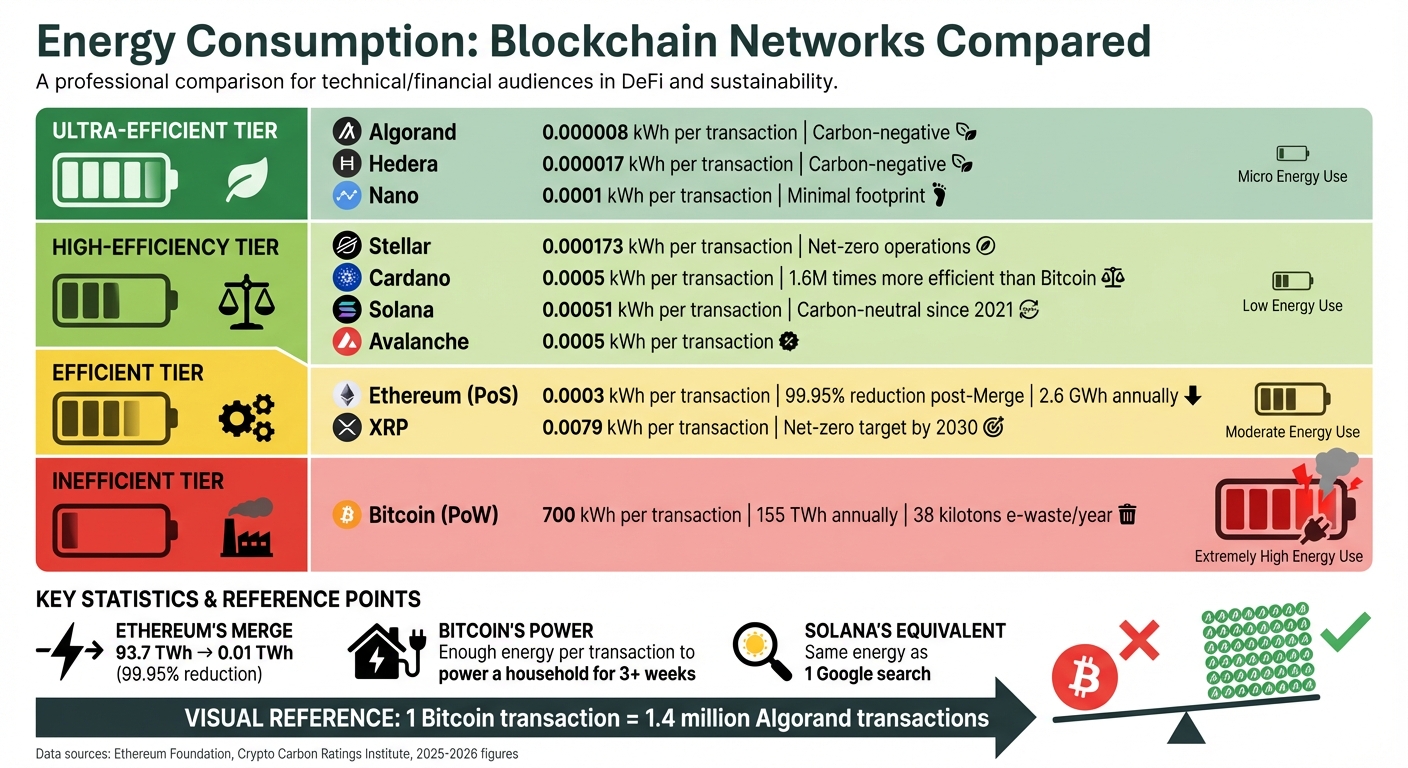
Energy Consumption Comparison of Blockchain Networks for DeFi
Energy efficiency varies greatly across blockchain networks, as discussed earlier. To give you a clear snapshot, here’s a table summarizing the energy consumption and key metrics of popular blockchain networks, particularly useful when selecting a platform for DeFi projects.
| Blockchain Network | Consensus Mechanism | Energy per Transaction (kWh) | Annual Network Energy | DeFi/TVL Support | Sustainability Status |
|---|---|---|---|---|---|
| Algorand (ALGO) | Pure Proof-of-Stake (PPoS) | 0.000008 – 0.0006 | 0.0002 TWh | $1B+ ecosystem TVL | Carbon-negative through automated offsets |
| Hedera (HBAR) | Hashgraph (ABFT) | 0.000017 | Negligible | Enterprise-grade | Carbon-negative |
| Nano (XNO) | Block-Lattice (ORV) | 0.0001 – 0.000112 | Negligible | Feeless; lightweight | Minimal footprint |
| Solana (SOL) | PoS + Proof-of-History | 0.00051 – 0.001 | 3.2 GWh | $70B+ ecosystem TVL; 3,500–4,000 TPS | Carbon-neutral since 2021 |
| Ethereum (ETH) | Proof-of-Stake (PoS) | 0.0003 – 0.03 | 2.6 GWh | $115B+ staked ETH; largest DeFi ecosystem | 99.95% reduction post-Merge |
| Cardano (ADA) | Ouroboros PoS | 0.0005 – 0.55 | 0.6 GWh | $2B+ ecosystem TVL | 1.6 million times more efficient than Bitcoin |
| Avalanche (AVAX) | Snowball (PoS) | 0.0005 | Minimal | Sub-2 second finality | One of the lowest industry footprints |
| Stellar (XLM) | Federated Byzantine | 0.000173 | Minimal | Supports carbon credit initiatives | Net-zero operations |
| XRP (XRP) | Distributed Agreement | 0.0079 | Minimal | Payment-focused | Net-zero target by 2030 |
| Bitcoin (BTC) | Proof-of-Work (PoW) | 700 – 1,375 | 155 TWh | Baseline for comparison | Generates 38 kilotons of e-waste annually |
The disparity is striking. For instance, a single Bitcoin transaction consumes enough energy to power a household for over three weeks, while platforms like Solana or Nano use only a fraction of that energy. This makes them ideal for high-volume DeFi operations, offering both cost efficiency and a reduced environmental impact.
Ethereum, for example, stands out with over $115 billion in staked assets and an annual energy consumption of just 2.6 GWh, thanks to its transition to Proof-of-Stake. Such efficiency is crucial for DeFi projects navigating regulatory requirements like the EU’s MiCA, which emphasizes environmental accountability. With this comparison, DeFi developers can make informed decisions to optimize costs while aligning with sustainability goals.
How to Implement Energy-Efficient Blockchains
To create energy-efficient blockchains, focus on transitioning to Proof-of-Stake (PoS) networks, adopting Layer-2 solutions, and integrating renewable energy practices. These steps help reduce energy use, lower transaction costs, and align with regulatory requirements.
Migrating from PoW to PoS Networks
Start by verifying the energy consumption of any PoS network you plan to migrate to. Use independent evaluations from groups like the Crypto Carbon Ratings Institute (CCRI) instead of relying on promotional claims. Also, consider the geographic location of validators – regions with low-carbon electricity grids are preferable.
For Ethereum-based decentralized finance (DeFi) projects, Layer-2 rollups such as Arbitrum, Optimism, or Base are excellent options. They reduce the energy footprint per transaction while maintaining the security of Ethereum’s mainnet. For instance, JPMorgan’s Onyx platform transitioned to an Ethereum-compatible PoS framework in 2024 to meet sustainability goals.
When selecting staking providers, prioritize those using renewable energy. A notable example is Northstake, which launched a facility in Denmark in 2025 powered by surplus wind energy. This facility achieved a Power Usage Effectiveness (PUE) below 1.15, outperforming the global data center average of 1.58.
Adopt standardized frameworks for reporting emissions, including Scope 1, 2, and 3. The EU’s Markets in Crypto-Assets (MiCA) regulation, effective December 2024, now requires crypto-asset service providers to disclose environmental impacts. Additionally, consider restaking protocols like EigenLayer to share an existing consensus layer’s energy and security footprint instead of deploying separate validator sets.
Once the migration is complete, focus on optimizing transactions through Layer-2 solutions.
Using Layer-2 Solutions
Layer-2 networks drastically reduce energy use by bundling thousands of transactions into a single proof on the main blockchain, lowering the energy cost per transaction. By late 2025, Ethereum Layer-2 networks processed over 45 million transactions weekly, while Ethereum’s mainnet maintained an annual energy consumption of about 2.6 GWh.
"These systems batch thousands of transactions into a single on-chain proof, amortizing the per-transaction energy cost further… marginal energy costs per transaction approaching negligible levels." – Sustainable Atlas
Some real-world examples highlight the benefits. In 2024, the DeFi protocol Aave launched on the Base network, achieving $13.89 billion in Total Value Locked (TVL) with transaction costs 90% lower than Ethereum’s mainnet. Similarly, GMX utilized Arbitrum’s Nitro upgrade to process over $8 billion in trading volume, cutting transaction costs by 85% while maintaining 99.9% Ethereum Virtual Machine (EVM) compatibility.
For projects needing advanced features like enhanced privacy or computation, ZK-rollups such as StarkNet or zkSync are ideal. zkSync Era’s ZK proof system has cut proof generation costs by 71%, enabling transaction fees as low as $0.08. Optimistic rollups like Arbitrum and Optimism have also proven reliable, boasting 99.99% uptime while handling millions of transactions.
When choosing a Layer-2 provider, ensure they support EIP-4844 (proto-danksharding), which is expected to cut data-related fees and energy use by 90%. Look for providers with plans to decentralize sequencers to reduce centralization risks.
With transaction layers optimized, the next step is to incorporate renewable energy practices.
Integrating Renewable Energy Incentives
Combining network migration and Layer-2 solutions with renewable energy practices creates a sustainable foundation for blockchain projects. Use transparent, on-chain dashboards for real-time carbon accounting to meet sustainability and regulatory standards under MiCA.
Consider protocols that automatically buy and retire carbon credits during transactions. For example, in 2023, Polygon Labs spent $400,000 on high-quality carbon credits through KlimaDAO and Offsetra, offsetting its entire historical operational footprint. Similarly, the Solana Foundation reduced its carbon footprint by 69% in September 2024, using blockchain-based carbon offsets and biodiversity credits from Terrasos.
Green staking is another option, where a portion of staking rewards funds carbon offsets or reforestation efforts. For cross-chain operations, implement "green routing", ensuring transactions are processed only through PoS networks.
Geographic location also plays a critical role. Hosting validator infrastructure in areas with surplus renewable energy can significantly improve energy efficiency. Leading sustainable blockchains maintain over 70% renewable energy usage among validators, compared to the 20–40% average for PoS networks. Use the GHG Protocol for emissions reporting to provide reliable data for institutional clients.
Cost Savings and Sustainability Metrics for DeFi Projects
Energy-efficient blockchains bring a dual advantage: they lower costs while reducing emissions, making DeFi projects more appealing to both investors and users. The transition from energy-intensive Proof-of-Work (PoW) systems to Proof-of-Stake (PoS) networks has replaced costly mining setups with standard server equipment. This shift not only cuts operational costs but also delivers measurable environmental benefits. Let’s break down how these changes impact DeFi projects.
Lower Operating Costs
Energy-efficient networks significantly reduce both transaction fees and infrastructure costs. For instance, staking on major PoS networks yielded annual returns of 4.2–8.7% as of late 2025. Validators can generate consistent revenue without the high energy expenses tied to mining. These cost savings make DeFi protocols more competitive and scalable. Additionally, green blockchains simplify compliance with carbon reporting standards required by regulations like MiCA and SEC guidelines, further reducing operational hurdles.
Reduced Carbon Footprint
The environmental benefits of energy-efficient blockchains are both measurable and impactful. Solana, for example, uses just 0.0009 kWh per transaction, emitting roughly 0.5 grams of CO₂ – comparable to the energy used for a single Google search or a transaction on Visa. In September 2024, the Solana Foundation reported cutting its carbon footprint by 69%, dropping from 8,786 tons of CO₂ in 2023 to 2,671 tons in 2024. This was achieved through on-chain carbon credit purchases verified by the Crypto Carbon Ratings Institute.
Here’s a comparison of energy use and emissions across networks:
| Network | Energy per Transaction | CO₂ per Transaction | Annual Network Consumption |
|---|---|---|---|
| Bitcoin (PoW) | 700 kWh | 400,000 g | 155 TWh |
| Ethereum (PoS) | 0.03 kWh | 15 g | 0.01 TWh (10 GWh) |
| Solana (PoS) | 0.0009 kWh | 0.5 g | 8.48 GWh |
| Algorand (PoS) | 0.0005 kWh | 0.2 g | N/A |
| Visa | 0.001 kWh | 0.5 g | N/A |
Polygon Labs also achieved carbon negativity by investing $400,000 in verified carbon credits. By 2025, Walmart expanded its supply chain traceability pilot to Polygon’s PoS Layer-2 network to monitor fresh produce across 5,200 U.S. stores. Walmart specifically cited the network’s low energy consumption as a deciding factor. These efforts not only reduce environmental impact but also attract investors who prioritize sustainability.
Impact on DeFi TVL and Fundraising
Sustainability metrics play a growing role in building investor confidence and driving funding. By Q3 2025, DeFi’s Total Value Locked (TVL) hit an all-time high of $237 billion, with institutional investors contributing about 20% of the market. Tokenized Real-World Assets (RWAs) on green blockchains accounted for $16.6 billion in TVL by late 2025, making up approximately 14% of the total DeFi market.
"Choosing a greener blockchain isn’t just an ethical move – it’s increasingly a sign of forward-thinking trading and investing." – Paul Holmes, Broker Analyst and Editor, DayTrading.com
Institutional investors are gravitating toward platforms that align with their sustainability goals. For example, JPMorgan’s Onyx platform transitioned its institutional DeFi operations to an Ethereum-compatible PoS framework in 2024 to meet corporate environmental objectives. Similarly, the World Bank selected Stellar’s PoS consensus for its Climate Warehouse platform in 2025, enabling over 12 million verified carbon credit transfers with minimal energy use. Standardized carbon reporting frameworks that track Scope 2 and Scope 3 emissions further enhance the appeal of these projects to institutional investors and regulators alike.
How BeyondOTC Supports Sustainable DeFi Growth
BeyondOTC plays a key role in driving sustainable growth within the DeFi space by focusing on energy-efficient blockchain solutions. As institutional investors increasingly prioritize environmental responsibility alongside security and performance, BeyondOTC bridges the gap between eco-friendly DeFi protocols and the resources they need to thrive in an ESG-conscious market.
TVL Funding Advisory for Sustainable Protocols
Institutional investors are channeling funds into DeFi projects that showcase clear sustainability efforts. BeyondOTC’s TVL funding advisory helps energy-efficient protocols secure this capital by highlighting their reduced energy consumption – up to 99.99% less than traditional Proof-of-Work (PoW) systems. By aligning projects with networks like Ethereum’s Proof-of-Stake (PoS), Algorand, or Cardano, BeyondOTC positions them to meet the stringent environmental, social, and governance (ESG) standards investors now expect. This approach not only strengthens the credibility of these DeFi protocols but also ensures they align with the evolving demands of the market.
OTC Trading Solutions for Efficient Networks
High-volume cryptocurrency transactions demand both discretion and efficiency. BeyondOTC supports these needs by offering OTC trading solutions tailored specifically for energy-efficient blockchain networks. By connecting clients with established OTC desks, institutional investors, and liquidity providers, the agency ensures that large trades on PoS networks – such as Cardano, Hedera, or Polygon – are executed with minimal energy consumption. This service aligns with the broader goal of reducing the environmental impact of blockchain transactions.
Go-to-Market Strategies for Green DeFi Projects
Launching a sustainable DeFi project requires more than just a good idea – it needs smart positioning in the market. BeyondOTC crafts go-to-market strategies that highlight a project’s energy efficiency as a key selling point. Through its extensive network, the agency connects green DeFi initiatives with centralized exchanges, decentralized platforms, launchpads, and market makers. These efforts are backed by tailored legal consultancy to ensure compliance with regulations, as well as partnerships with marketing specialists who can effectively communicate a project’s environmental benefits. This comprehensive approach helps green DeFi projects stand out, making sustainability a clear competitive edge in the fast-evolving DeFi sector.
Conclusion
Energy-efficient blockchains are reshaping how DeFi projects operate by cutting costs, aligning with regulations, and attracting new investment opportunities. A prime example of this shift is Ethereum’s transition from Proof-of-Work (PoW) to Proof-of-Stake (PoS) during the September 2022 Merge. This change slashed Ethereum’s electricity use by 99.95%, reducing its annual consumption from 93.7 TWh to just 0.01 TWh overnight. As Paul Holmes, broker analyst and editor at DayTrading.com, aptly stated:
"Choosing a greener blockchain isn’t just an ethical move – it’s a sign of forward-thinking trading and investing."
The difference in energy efficiency between blockchain technologies is staggering. For instance, a single Bitcoin transaction requires about 700 kWh of energy, while a Solana transaction uses just 0.00051 kWh – less than the energy needed for a typical Google search. This efficiency also translates into cost savings. PoS validators can operate on standard server hardware, eliminating the need for expensive ASICs. Meanwhile, Layer-2 solutions like Arbitrum optimize energy use even further by batching thousands of transactions into single on-chain proofs, with transaction fees averaging just $0.0044 as of February 2026.
Energy efficiency isn’t just about cost – it’s becoming a regulatory requirement. Policies like the EU’s Markets in Crypto-Assets (MiCA) framework and SEC guidelines now demand environmental impact disclosures from crypto service providers. PoS networks such as Ethereum, Cardano, and Algorand are well-equipped to meet these standards. By late 2025, these networks secured roughly $820 billion in staked assets, showcasing their ability to align with environmental, social, and governance (ESG) expectations.
This drive for sustainability has fueled innovation across the industry. BeyondOTC plays a critical role here by connecting energy-efficient DeFi protocols with the resources they need to grow. The agency advises on TVL funding, linking green projects with institutional investors who prioritize environmental responsibility. Its OTC trading solutions ensure large transactions on PoS networks are executed with minimal energy use, while its go-to-market strategies help DeFi initiatives showcase their sustainability to key stakeholders.
The takeaway? For DeFi projects, energy efficiency is no longer optional – it’s essential for gaining institutional trust and ensuring long-term success. By adopting PoS networks, leveraging Layer-2 solutions, and forming strategic partnerships, projects can significantly lower their carbon footprint, reduce costs, and stay ahead of evolving regulatory demands.
FAQs
How can I identify the most sustainable blockchain without relying on marketing claims?
When evaluating blockchain sustainability, it’s crucial to focus on measurable and transparent data. Key aspects to consider include:
- Energy consumption: Look at the actual energy usage of the blockchain network. Lower energy requirements often indicate a more efficient system.
- Consensus mechanisms: Blockchains using energy-efficient systems like proof-of-stake (PoS) tend to have a smaller environmental footprint compared to more energy-intensive mechanisms like proof-of-work (PoW).
- Carbon reduction efforts: Prioritize networks that actively invest in carbon offsets or explore innovative solutions to reduce their environmental impact.
Also, pay attention to blockchains that publish clear energy metrics or undergo independent audits to verify their claims. These objective factors provide a more reliable way to assess sustainability, cutting through potential marketing hype.
Will switching to PoS or a Layer-2 impact my DeFi protocol’s security assumptions?
Switching to proof-of-stake (PoS) or Layer-2 networks can significantly impact the security framework of a DeFi protocol. While PoS cuts down on energy consumption, it also brings potential risks, such as stake centralization or validator collusion, which could compromise decentralization.
Layer-2 solutions, on the other hand, improve scalability by building on top of the base chain and leveraging its security. However, they might introduce challenges like data availability issues or vulnerabilities in fraud proofs.
When considering such transitions, it’s crucial to weigh the trade-offs. Pay close attention to factors like the level of validator decentralization, the reliability of data integrity, and the possibility of new attack vectors that could emerge in these systems. Balancing these elements is key to maintaining a secure and effective protocol.
What energy and emissions data must be reported for MiCA or U.S. disclosures?
When preparing reports for MiCA or U.S. disclosures, it’s crucial to include detailed blockchain energy data. This should cover:
- Total energy consumption: Provide figures such as annual electricity use measured in terawatt-hours (TWh).
- Emissions reductions: Highlight measurable impacts from mechanisms like proof-of-stake. For instance, Ethereum’s transition to proof-of-stake resulted in an annual reduction of approximately 11 million metric tons of CO2.
- Key metrics: Ensure data is specific and quantifiable, focusing on metrics that align with reporting requirements.
By focusing on clear, measurable figures, you can effectively meet the necessary disclosure standards.