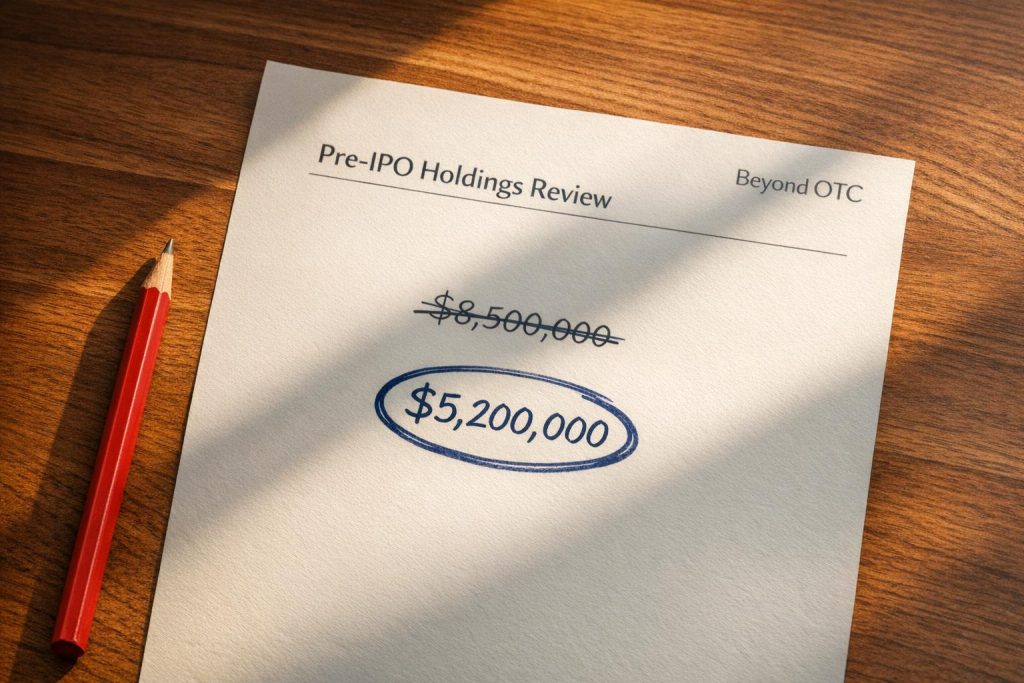
When mutual funds reduce the value of pre-IPO holdings, it often reflects changes in market conditions, economic pressures, or regulatory requirements. These markdowns are not always a sign of a company’s poor performance but are necessary for aligning valuations with public market trends and ensuring transparency. Here’s what you need to know:
- Why It Happens: Funds adjust valuations due to market declines, economic shifts (e.g., rising interest rates), or regulatory rules that mandate fair value reporting.
- How It’s Done: Valuations rely on methods like market comparisons, cash flow models, or asset evaluations.
- What It Means: Markdown trends can indicate broader market corrections, company-specific risks, or even buying opportunities in discounted assets.
- Investor Takeaways: Focus on thorough research, monitor public market trends, and diversify your portfolio to manage risks effectively.
Markdowns are a routine part of private asset valuation and can signal market recalibrations or potential investment opportunities. Always evaluate these changes in the context of broader market indicators and company fundamentals.
Investing Pre-IPO: What Investors Need to Know to Navigate the Market
sbb-itb-7e716c2
Why Mutual Funds Mark Down Pre-IPO Holdings
When mutual funds adjust the valuations of their pre-IPO holdings, it’s not just about numbers – it’s a reaction to market realities, economic pressures, and regulatory frameworks. These markdowns provide insights into the risks and potential opportunities within the investment landscape.
Liquidity Needs and Portfolio Adjustments
A declining public market often forces funds to reassess the value of their private holdings. Many funds use the Market Approach, which relies on public comparables, to recalibrate these valuations. For example, when indices like the Nasdaq drop, funds align the valuations of private unicorns with those of their public counterparts. Late-stage private investments, which are closer to an IPO or exit, are especially vulnerable to these shifts.
Take January 2022 as an example: after a sharp Nasdaq decline, secondary market activity for shares in companies like Impossible Foods, ByteDance, and Kraken slowed dramatically. According to Rainmaker Securities, buyers either pulled their bids or demanded steep discounts. This kind of market freeze forces funds to lower the value of such illiquid assets.
"This feels very much like what happened at the beginning of the pandemic, where there was a shock to the system. And everyone said, ‘I don’t know what this shock really means, but let’s slow down for a little bit.’"
- Frank Rotman, Co-founder and Partner, QED Investors
These liquidity-driven markdowns often set the tone for further adjustments as market conditions evolve.
Market Conditions and Economic Pressures
Economic shifts, like rising interest rates, also play a big role. Higher rates increase the cost of capital, which can weigh heavily on tech valuations. In early 2022, for instance, a market sell-off led venture capitalists to abandon the sky-high revenue multiples – sometimes as high as 50x – they had been using to value late-stage software startups.
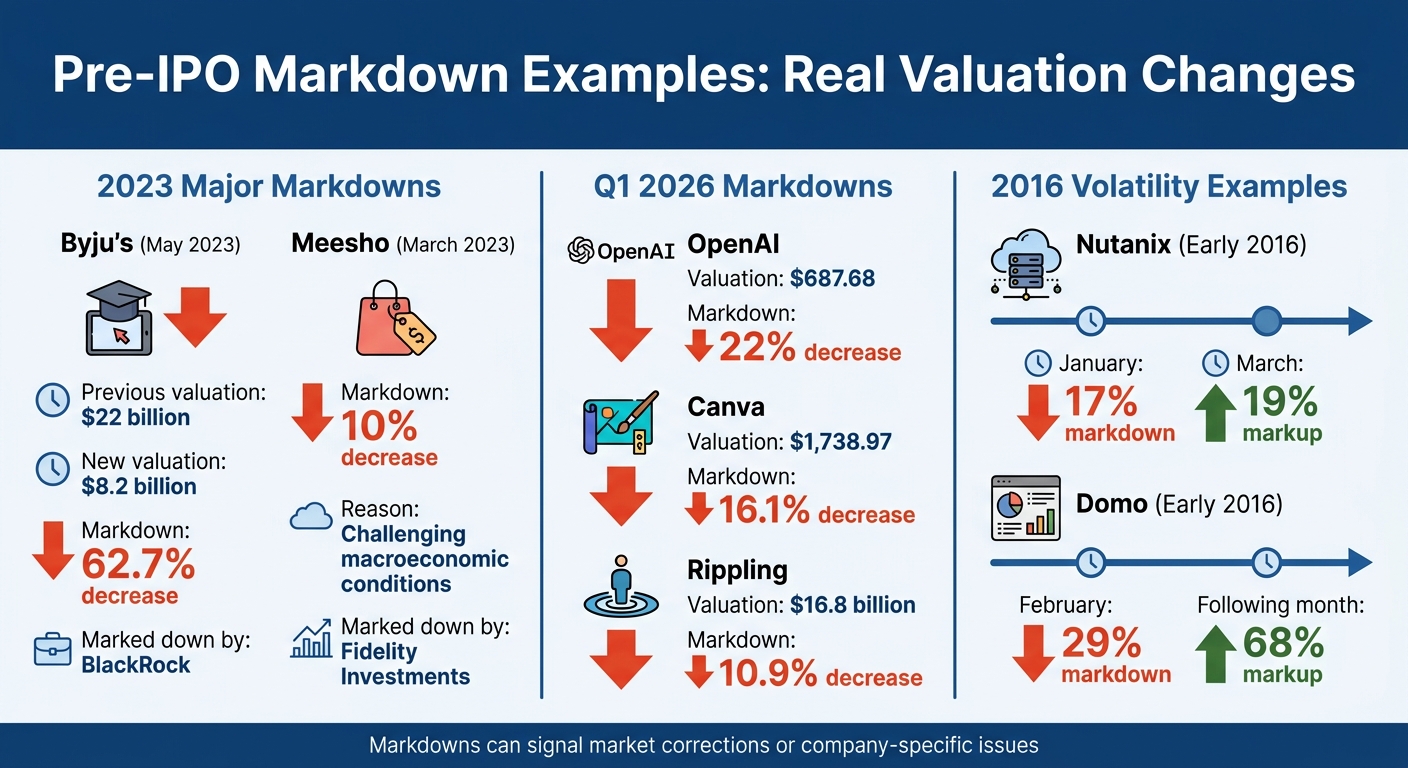
Such market corrections can lead to widespread markdowns. A clear example occurred in May 2023, when BlackRock slashed the valuation of Indian edtech giant Byju’s to $8.2 billion – a staggering 62.7% drop from its $22 billion valuation just seven months earlier. Similarly, Fidelity Investments reduced its valuation of social commerce platform Meesho by 10% in March 2023, citing challenging macroeconomic conditions.
"Now that people understand that the Fed tightening is going to happen, valuation adjustment is happening in a very orderly fashion. Much more orderly than people would think."
- Frank Rotman, Co-founder and Partner, QED Investors
These adjustments are not just a response to market trends but are also shaped by strict accounting and regulatory standards.
Accounting Standards and Regulatory Requirements
Regulatory frameworks require funds to update valuations regularly, ensuring transparency and accuracy. Under the SEC’s Investment Company Act of 1940, open-end funds must reflect changes in their portfolio holdings’ values in the Net Asset Value (NAV) calculation by the next business day. Similarly, the Financial Accounting Standards Board mandates that private holdings be reported at "fair value", defined as the price achievable in an orderly transaction between market participants.
Since private equity holdings are categorized as Level 3 assets, their valuations often rely on management judgment and unobservable inputs. This subjectivity, combined with regulatory oversight, pushes funds to mark down values during downturns to avoid accusations of overvaluation. As a result, the same private company might be valued differently across funds – sometimes with differences as large as 50% – depending on the comparables and methods used.
"Declining public valuations are going to hurt those on the private side… the markdowns we’ve seen are far more indicative of the comps they have to measure these holdings against."
- Nizar Tarhuni, Analyst, PitchBook
What Pre-IPO Markdowns Tell Investors
Pre-IPO Markdown Examples: Major Valuation Changes 2022-2026
Pre-IPO markdowns can reveal a lot about the health of private companies and the broader market. They might highlight company-specific issues, signal market corrections, or even present buying opportunities. These adjustments, whether cautionary or advantageous, tie back to the valuation challenges discussed earlier.
Warning Signs of Company Problems
When a private company’s valuation is marked down while its public counterparts remain steady – or even gain value – it often points to internal problems. These could include slowing revenue growth, instability in leadership, or an initial overvaluation that wasn’t backed by strong business fundamentals.
The private market’s lack of transparency makes this even trickier. Unlike public companies that release quarterly financials, private firms share very limited data. This makes mutual fund markdowns one of the few visible indicators of a company’s perceived health. If most funds adjust their valuations downward but one fund does not, it could hint at internal challenges like weak revenue or leadership turnover.
Buying Opportunities in Discounted Assets
Markdowns don’t always spell trouble – they can also signal opportunities. When market sell-offs lead to widespread valuation cuts, investors willing to navigate secondary markets might find high-quality assets at reduced prices. For example, in early 2022, secondary market buyers pushed for steep discounts, creating openings for those confident in certain businesses.
Take Q1 2026 as an example: OpenAI’s valuation dropped 22% to $687.68, Canva fell 16.1% to $1,738.97, and Rippling’s valuation declined 10.9% to $16.8 billion. However, these markdowns didn’t necessarily mean the companies were struggling. Sometimes, they reflected a recalibration of overinflated valuations, bringing them closer to actual performance metrics.
For investors, the key is to focus on companies with consistent revenue growth. Comparing how different institutional investors value the same company is another useful strategy. Discrepancies in valuations – sometimes as wide as 50% – can help pinpoint a realistic price range and uncover potential bargains.
Market Trends and Sector Corrections
Beyond individual companies, markdowns often reflect broader market movements. For instance, when late-stage software startups saw their valuation multiples drop from 50 times annualized revenue in early 2022, it wasn’t just about individual companies – it was part of a broader market recalibration driven by rising interest rates and tighter monetary policies.
To separate market trends from company-specific issues, keep an eye on public comparables in the same sector. If a major index like the Nasdaq declines, it’s reasonable to expect markdowns in private holdings tied to those benchmarks. On the other hand, if a company’s valuation is reduced while its sector remains strong, it might signal deeper, company-specific problems. Tracking public market trends alongside private valuations can help investors distinguish between sector-wide corrections and isolated struggles.
How to Manage Pre-IPO Markdown Risks
Pre-IPO markdowns are a reality investors must face. To safeguard your portfolio, focus on in-depth research, maintaining liquidity, and diversifying your investments wisely.
Conduct Thorough Pre-Investment Research
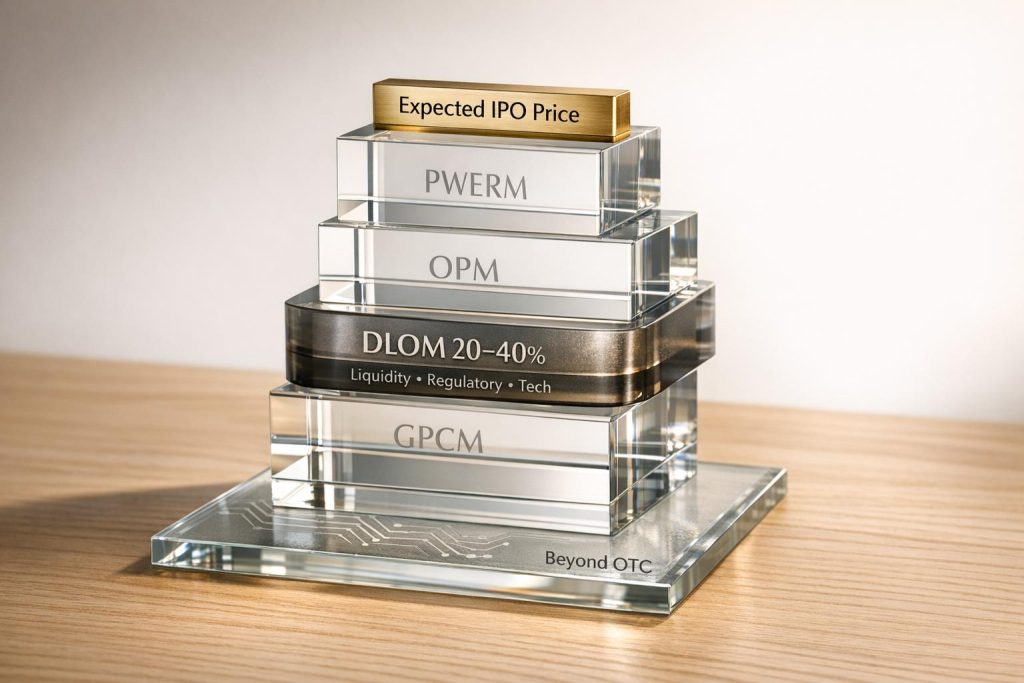
Before investing, go beyond surface-level data. Use ASC 820 standards to calculate the fair value of an asset – essentially, the price you’d get in an orderly transaction. Advanced models like the Option Price Method (OPM) or Probability-Weighted Expected Return Method (PWERM) can help you navigate complex capital structures, such as liquidation preferences that might significantly impact share values during markdowns.
When evaluating private companies against their public counterparts, apply a private market discount ranging from 20% to 35% to account for risks like illiquidity. For instance, high-growth SaaS companies with over 40% annual growth are valued at 8–14x forward revenue in public markets (as of mid-2025). However, their private market equivalents should reflect lower valuations. Always cross-check company projections with independent data and public market multiples.
"Mark down proactively – it builds more LP trust than any aggressive markup ever will." – Michael Kaufman, Founder & Editor-in-Chief, VC Beast
Once you’ve done your homework, ensure you have the liquidity to act on these valuations.
Use OTC Trading and Secondary Markets for Liquidity
Secondary markets offer a way to exit pre-IPO positions when liquidity is needed. Platforms like BeyondOTC allow you to trade pre-IPO shares through OTC transactions, providing real-time price discovery that reflects current market sentiment faster than internal fund valuations. During public market downturns, secondary bids often drop, offering a more immediate market-driven price signal.
For example, in January 2022, Greg Martin of Rainmaker Securities reported that buyers began placing discounted bids for private companies like Impossible Foods, ByteDance, and Kraken following a Nasdaq sell-off. Similarly, in September 2014, venture capitalist Ozi Amanat bought $35 million in Alibaba pre-IPO shares at under $60 per share through a secondary placement. By November 2020, Alibaba‘s stock had risen above $276 per share.
Always work with regulated intermediaries and ensure all documentation is verified in a demat account before completing secondary sales. Keep an eye on publicly traded peers to ensure secondary market bids align with realistic valuations.
Beyond managing liquidity, spreading investments across various stages is key to balancing risk.
Diversify Across Investment Types and Stages
Pre-IPO investments are inherently volatile – returns tend to hinge on a few standout winners, while many others yield mediocre or negative results. Diversifying across multiple companies is far safer than concentrating too heavily on a single holding. Treat pre-IPO investments as a high-risk portion of your portfolio and limit their size to prevent one markdown from significantly impacting your overall portfolio.
Diversify by stage as well. Late-stage investments are more vulnerable to public market sell-offs since they are closely tied to public market multiples. Early-stage startups, on the other hand, may hold their valuations longer due to infrequent funding rounds. For example, in early 2016, Nutanix experienced a 17% markdown in January but was marked up 19% by March. Similarly, Domo was marked down 29% in February 2016, only to be marked up 68% the following month. This volatility highlights the importance of spreading capital across different stages and asset types.
A practical strategy is the 80/20 rule: allocate 80% of your portfolio to lower-risk, diversified assets like index funds or debt, and reserve 20% for high-risk, high-reward investments like pre-IPO shares. Focus on late-stage companies with proven revenue and strong institutional backing to reduce the chance of a total loss.
Conclusion: Managing Pre-IPO Markdown Challenges
Pre-IPO markdowns arise from a mix of accounting rules, market swings, and company-specific risks. While these adjustments can highlight potential concerns like cash flow issues, they’re often driven by regulatory requirements that push mutual funds to align private valuations with falling public market comparables.
These trends emphasize the importance of staying ahead with solid risk management. Keeping a close eye on public market peers is key, as their declining valuations often hint at upcoming markdowns in private markets. For instance, when the Nasdaq dropped over 31% from its all-time high in 2022, it directly impacted private market valuations. Recognizing this connection can help you anticipate portfolio changes.
"Valuing private businesses is now all the harder with funding rounds on hold and IPOs stalled. It’s an art."
- Jennifer Liu, Private Market Strategist, UBS Group AG
To navigate these challenges, consider limiting pre-IPO investments to a small portion of your portfolio – around 3% to 5%. Focus on late-stage companies that have filed their Draft Red Herring Prospectus (DRHP), and negotiate buyback clauses that require the company to repurchase shares at the acquisition cost plus interest if an IPO is canceled or delayed.
The private market remains unpredictable, but by conducting thorough research, planning for liquidity needs, and diversifying your investments, you can mitigate markdown risks while positioning yourself to take advantage of pre-IPO opportunities. Stay alert, follow market trends, and remember – what looks like a markdown today might be a chance to invest tomorrow.
FAQs
How do pre-IPO markdowns affect a mutual fund’s NAV?
When mutual funds apply pre-IPO markdowns, they adjust the estimated fair value of their private holdings. This adjustment directly impacts the fund’s net asset value (NAV), lowering it to reflect shifts in market conditions or the performance of the companies in question.
How can I tell if a markdown is market-driven or company-specific?
To figure out if a markdown is market-driven or company-specific, you need to look at the bigger picture.
- Market-driven markdowns are usually caused by external events, like an economic slump or a drop in the stock market, which affect many companies at once.
- Company-specific markdowns, on the other hand, stem from internal problems, such as weak financial results or operational setbacks.
Pay attention to patterns: if markdowns are happening across the board, it’s likely due to market conditions. But if only one company is making adjustments, it’s probably tied to their own unique challenges.
Can I use secondary market pricing to judge a fair value?
Secondary market pricing can offer some insight but isn’t always a reliable indicator of a company’s actual value. Prices in these markets can fluctuate widely, and mutual funds often rely on their own valuation methods. It’s important to keep these differences in mind when assessing pre-IPO investment opportunities.